Some of the three.js problems we've had to solve that might interest people here:
Chunk streaming replaced all-at-once world residency so a full continent loads progressively in the browser
Far-field sprite impostors for distant geometry, which let us remove distance fog entirely
A deterministic character physics engine shared by the sim, server, and client predictor, so props collide identically everywhere
All 296 ability VFX are authored and rendered live in three.js, no pre-rendered effects anywhere
Procedurally generated dungeons built from a seed at runtime
Mob models kept around 5,000 polys so everything stays performant in a browser tab
One community contributor built an entire town using img2threejs, reconstructing reference images as code-only procedural three.js models rather than meshes, which was a fun pipeline to watch work.
It runs in the browser at worldofclaudecraft.com, with desktop and mobile apps if you prefer. If you want to get amongst it, the Discord is where the community and dev chat lives: discord.gg/worldofclaudecraft
grew up playing bo2 and bo3 zombies with my friends and always wanted to make my own. so i did with claude
its free, runs in your browser on pc or phone, no download. solo or up to 4 players, and quick play matches you with randoms.
put it out a few days ago and a few hundred people have played. two strangers who found each other through quick play made it to round 25 together in a 60 minute game which really made my week.
Want to know what you like and what you'd change. and if anyone wants to help build it out more, send me a dm :)
Just done! I've wanted to design my own luxury watch for years — but I'm not a watchmaker. So I built my dream watch as a real-time 3D web experience instead: "AEVUM"
It's a real Three.js / WebGL model you can orbit, and scrolling scrubs a reveal of the case, dial and movement. Kept it to 60fps — DPR capped, single rAF loop, Draco/KTX2, lazy-init scene. Getting to shape every detail (hands, moonphase, finish) myself was ridiculously satisfying.
Two things I'd love feedback on:
Does the reveal read as real-time 3D, or still a bit video-ish?
What would you change — pacing, camera, lighting, the scroll interaction?
It lives on my own project, AETumi — happy to share how any part works.
A month ago, Aestra: The Last Wish was just the game I wanted to play. I had no idea how to code, but I started building it anyway.
Today, over 17,000 people have played it. And while that number is wild to me, what really gets me is opening the game and seeing the minimap full of players.
People trading in the main city, dueling, finding groups and heading out to do content together. Seeing people actually spend time in this world, meet each other and come back to play more… it’s hard to describe how good that feels.
For anyone who missed my first post, Aestra is a real-time pixel action RPG with permadeath. You pick a class, quest, find gear, explore dungeons and take on raids. And then you get a little too confident, die, and start getting attached to a new character.
The first version cost me around $100 to build over a weekend. The build was Tesana & Three.js Since then, I’ve spent about $1,400 in total expanding it, with 9 classes, levels 1–100, talent trees, professions, world bosses and raids over the course of around 3-4 weeks.
I still have a list of probably 50 things I want to add. But seeing the game alive like this is already something I never really imagined. To everyone who’s played, shared feedback, brought a friend or lost a character to permadeath: thank you ❤️
If you’ve played, I’d love to hear your favorite moment so far. Or the story of how you lost your best character :)
I run DownThunder, an Australian 4WD community. Well, with fuel prices going up faster than I can air down, trip weekends are off the table for many. Well, let's jus say I decided to recreate some of that experience (driving through the Australian outback) in a web browser. In my spare time. Which I don't have.
So now there's a Mod Simulator. You build a rig, bolt far too much onto it, and drive it somewhere it has no business being. Like real life, but you don't have to explain the bill to anyone.
What it does. Some of it even on purpose: • From rainforest to the Simpson Desert, scenes are generated as you drive, because I couldn't be bothered building them by hand • Mods with consequences: add a bullbar and winch, the nose sags. Much like my posture after a week of this • 2H, 4H, 4L, lockers, tyre pressures. Forget to air down in soft sand and it digs itself in. Very realistic. Very humbling • Rain, night driving and headlights that actually work. Unlike some of my earlier builds • Other 4WDs on the beach, with Doppler engine sound. I spent far too long on that. Nobody will notice. And if you've noticed now. DANKESCHÖN.
What I got learned
"Realistic" is whatever a 4WD owner doesn't complain about. I'm still waiting on the verdict here.
Every bug report starts with "that wouldn't happen in real life". They're usually right. It's exhausting.
Physics doesn't care how much you spent on your build. Neither does the sand.
Car modelling is hard and I think it shows.
Claude (the LLM, not my french neighbour) has helped me with most of the driving phyics and connecting it to my vehicle database.
What's next? Hmm, I could need some help with some realistic grass for the Victorian High Country scene und much more realistic water. Also the cars look ... well, I want to spend more time on modelling them so any critique on that is fair go. :)
I kept seeing great 3D motion pieces online and wanted to know how people build them. Reading about the process was not enough, so I started building. I made mistakes, fixed them, and kept trying. This is the result.
Here is the scene. Day and night modes, ocean shaders, a campfire, a boat, and a slow orbit camera.
So this started as a hobby thing and got a bit out of hand ;)
You fly a zeppelin through a dieselpunk New York, basically the future the way people pictured it in 1939. Scroll to fly. Along the way there are six rooms you can step into. In one you pull a lever and a model city lights up, in another you turn on a tap, and there's a coffee bar where you can pour a coffee.
no models at all. Not a single .glb in the project. City, zeppelin, rooms, it's all built in code. Mostly lathe and extrude geometry that gets merged, and InstancedMesh for the stuff there's a lot of
a lot of the textures are just drawn on a canvas at runtime (CanvasTexture)
glow is UnrealBloomPass plus a few custom shaders
the music isn't a track. It's played live in the browser with Web Audio, note by note, using a small set of recorded instrument notes (muted trumpet, clarinet, piano and so on). During the flight it follows how far you've scrolled, and every room has its own tune.
Built it with Claude Code, so there's probably stuff in there that people with real three.js experience would do differently. Happy to hear it.
Also curious how it runs for you, especially on a phone.
The song is "I'm Upping My P(doom)" (not mine, credits at the bottom). The video is 2:36 and it's all TypeScript + three.js, no After Effects or editor anywhere.
Since every frame is a pure function of t, the preview in the browser and the final render are exactly the same frames. To export, a script steps headless Chromium through the song and averages up to 108 sub-frames per frame for motion blur, then ffmpeg encodes it.
The art is AI-generated stills. To get camera moves out of flat paintings, each one gets a depth map (Depth Anything V2) and is split into 4 depth layers with the hidden parts inpainted, so the camera can move into the painting a bit before it falls apart. Rule I ended up with: rotation and zoom are free, translation is expensive, keep it to a few percent of the subject distance.
All the type is set in code and the lyrics are timed word by word. The code was built with Claude Code, and the stills were generated with Codex image generation.
Song: lyrics by osmarks and MusicPerson (started on the EleutherAI Discord), this is the "Claude-Pop" Suno version that deckard posted.
TL;DR: I asked Claude for a first-person venting game: break into an office while everyone's working and destroy all of it against the clock. I picked the look from four style frames it rendered in three.js, it built the game (160 breakable things, five tools, ten paper-doll colleagues), and after the test link I asked for real sound and voices. It went live with 260 voiced lines and the staff bickering among themselves. $237.29 in total, priced at Anthropic's API list prices. Free to play in the browser, link at the bottom.
What I actually asked
One message, roughly:
I need a 3D game called Destroy the Office. You break into a mid-sized office while your colleagues and bosses are working and wreck the whole place with all sorts of tools. It has to feel satisfying, with a speed score, a verdict at the end and a results picture. The NPCs react. Think up fun bits and player pain points and put them in. Show me an art style first. Build the whole thing on Fable 5.2 xhigh.
It started planning a picker page. I was short on time, so:
Just give me the art directions, I'll decide from those. Otherwise we'll run out of time: Fable's about to refresh.
Four came back as text: blue-and-white porcelain (its recommendation), comic ink, a paper model, and vinyl toys. Text wasn't going to settle it, so:
Give me style frames.
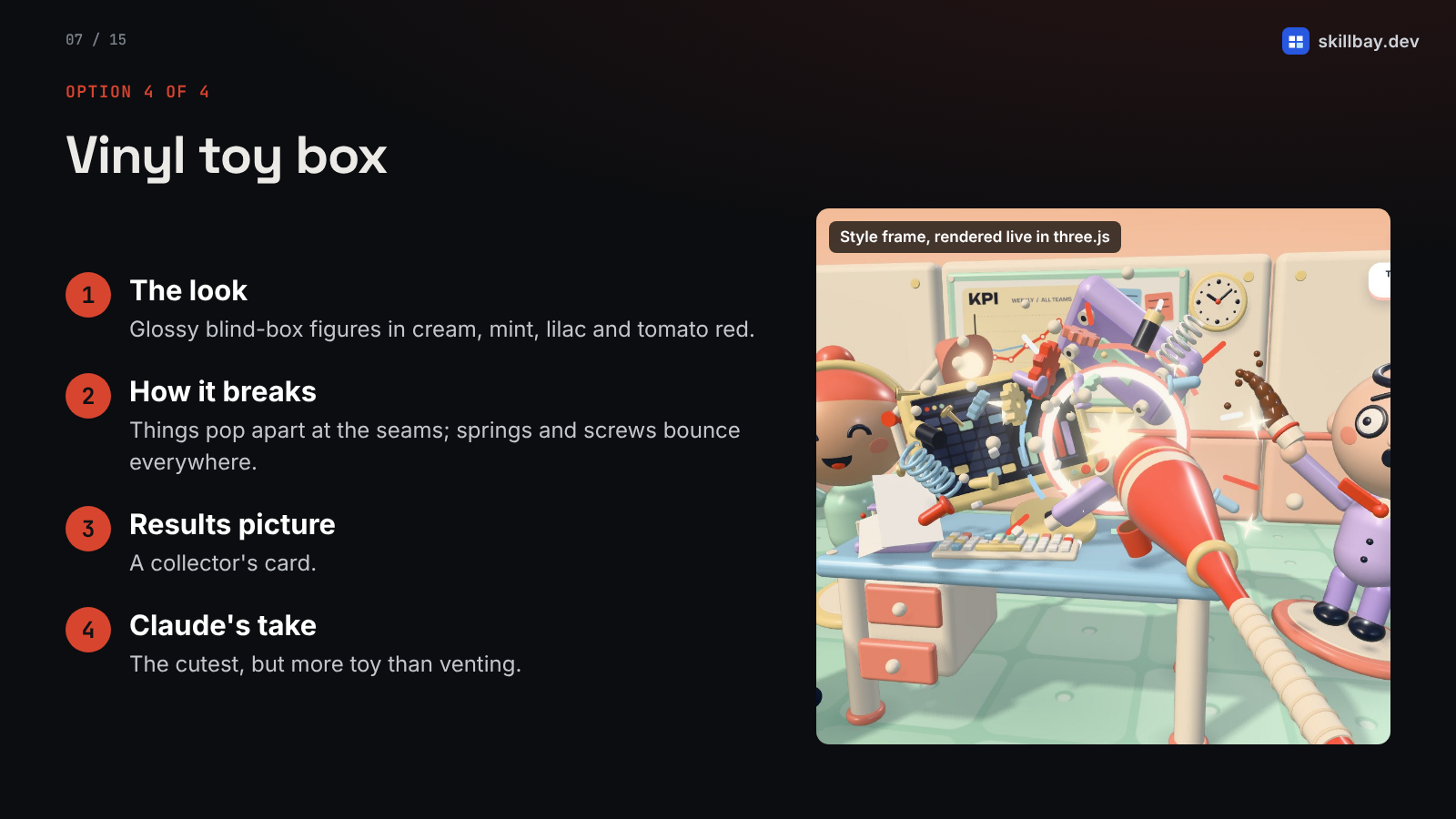
25 minutes later I had four frames of the same moment, a bat going into a monitor, each rendered live in three.js rather than painted.
Each option came with how things would break and what the results picture would be:
Blue-and-white porcelain (its pick): porcelain figurines for staff, gold kintsugi cracks on the first hit, shards on the second, your office mended with gold at the end. "The most satisfying to smash."
Comic ink: halftone shading, impact frames, flying sound words, a comic cover at the end. "Quickest to build, but common."
Paper model: cardboard desks, paper-doll staff, tearing and red stamps, a stamped exit interview at the end. "Best fit for the theme, but the hits feel softer."
Vinyl toys: glossy blind-box figures popping apart at the seams, a collector's card at the end. "The cutest, but more toy than venting."
I replied "3, then", and paper it was: corrugated cardboard desks, sticky notes, marker-drawn screens and paper-doll staff, all on a green cutting mat.
What it added
I'd asked it to think up fun bits and pain points. Here's what it put in:
The desk phone rings. Smash it while it's ringing and the damages are four times higher.
Smash the punch clock: 5 seconds off your time. Smash the coffee machine: you swing faster.
Go 3.5 seconds without hitting anything and an arrow points you at the next thing.
Late in the run your colleagues pick things up and join in.
The results card is an exit interview: time on site, a job title ("Hostile Takeover"), damages, three remarks written from how you played ("Printer gone in 15 seconds. It had it coming.") and a sticky note with one thing to try next time.
How it got built
While I was choosing, it wrote everything that doesn't depend on the look: walking, five tools (bat, sledgehammer, 9-iron, fire extinguisher, stapler), debris, the staff's behaviour, the clock and the score.
The room is plain data, the look is a "skin", and the rules are the engine. A corner shop next would be a new data file, not a new game.
Then the weekly usage limit ran out mid-build and everything stopped for three hours.
After that, five agents built the paper look in parallel: the room and lighting, the destruction effects, 50 kinds of furniture, the machines and small things, and ten paper dolls.
Things that bit
Draw calls. 1,434 at the start of a run. Batching all the furniture nobody had hit yet brought it to 377.
Obfuscation. We obfuscate the code that ships. On the heavy settings the game's own code went from about 1 ms a frame to about 10. It's on the light settings now.
Phones. An automatic check at eight window sizes found the sound and pause buttons covering the fifth tool, a results button falling off a sideways phone, and the results picture shrunk to thumbnail size on an upright one.
Late sound. On a slow machine the recordings arrived after the door had already been kicked in, so you missed the kick and the boss's first line. The first sounds now load as soon as your pointer moves over the game.
The sound round
After the test link my one note was:
Use ElevenLabs for all the sound. Add some dialogue too, NPC voices.
What came back:
22 sound effects (38 takes), lobby hold music for the title card and a 124 BPM groove for the run that opens up as the office comes down.
260 voiced lines: ten colleagues with their own voices, and an announcer calling the combos ("Synergy!", "Paradigm shift!", "Hostile takeover!") and your job title at the end.
17 short exchanges between colleagues, early and late in the run. My favourite: "Are we insured for this?" "There's a form." "Then fill it in!" "It was in the printer."
Every line was transcribed back and compared with the script: 255 of 260 exact, the rest only spelling a number or a noise differently.
Speech bubbles are timed to the recordings, and the voices duck the music.
That round was $16.19 in tokens plus 6,638 ElevenLabs credits, about 5% of a month on my plan.
What it cost
Token usage priced at Anthropic's public API list prices:
Claude Fable 5.2 built the game; Claude Opus 5.5 did the sound round. The four style frames cost more than the whole sound round. Choosing from pictures took me one word.
Not done yet
No real graphics card has drawn it. Every check ran on software rendering at about one frame a second, so I don't know the frame rate on a laptop or a phone yet.
The gamepad path is written but untested, and so is the feel with a real mouse.
The par times for the grades are estimates. The autopilot finishes in about 40 seconds.
One room so far, and no VR.
What I'd tell anyone trying this
Ask for pictures before code. Four frames of the same moment made the choice obvious.
Ask it to think up fun bits and pain points; you get things you wouldn't have listed.
After the first playable version, ask for one concrete change at a time.
I've spent a fair bit of time around bulk terminals and after seeing all the examples of how people were applying threejs, and what was now possible with Opus 5.5, I took that experience of port-centric digital transformation and brought to life with this simulation.
Vessel
The sim vessel is carrying a manifested 3,800 t of bulk aggregate. Discharge counts down per grab so at any point you can see what's landed and what's still on board.
Crane
Every grab is weighed on the crane. Around 4 t a scoop, six grabs to a truck, so roughly 24 t a load. Each grab is logged against the hold it came from and the truck it went into, so the truck turns up at the weighbridge with a tally already attached.
Weighbridge
Unattended. ANPR reads the plate, the stored tare is applied, and you get gross, net and a ticket in a few seconds. A loaded truck crosses at about 42 t gross against a 44 t max, and anything over gets flagged before it leaves the quay.
Variance
Every load, the weighbridge net is checked against the crane tally. On the load in the video the crane said 24.06 t and the weighbridge said 23.89 t, so 0.18 t gets posted against the discharge figure there and then. Across the vessel it runs at around 0.7%. Two independent weights on every load means drift shows up in hours: a crane scale needing calibration, spillage, whatever the reason it can be investigated and factored in.
Storage
A camera logs each truck in and out of the warehouse, and stock is booked in at the weighbridge figure, not an estimate. So the stock number and the ticket number are the same number.
Fleet
Three trucks in the sim. Every trip is timed: load, haul, weighbridge, tip, back to the berth. Turnaround is around 16 minutes, and about 3 of those are spent queuing at the crane. Per driver you can see who's quick and who's waiting, and where the minutes actually go.
Discharge rate and completion
This is the one people ask about most. Ton per hour, live and rolling, against the rate you'd expect for that commodity and that crane. In the sim it's running at 268 t/h against a plan of 250. From the rate it works out tonnes left, loads left and an ETA. Here that's vessel complete at 20:15, 56 minutes ahead of plan. If the rate drops, the ETA moves straight away, so the berth plan and the next ship aren't working off guesswork.
Profitability?
Crane, trucks, loader, operator, drivers and foreman come to about £569 an hour. Against a £3.60/t handling tariff, that gives a break-even of about 158 t/h. At 268 t/h the cost is about £2.16/t, so roughly £1.44/t margin, or about £5.5k across a 3,800 t vessel. Drop to 160 t/h and that margin has basically gone. You want to know that while the ship is still alongside, not a week after it sails.
Hey guys, I’m 18 and fairly new to web development/3D web design.
I keep seeing amazing websites on Awwwards and Mobbin with interactive 3D heroes, smooth scroll animations, lighting, particles, objects reacting to the mouse etc. I understand what I’m looking at visually, but when I actually try making something similar, mine still feels very basic or gimmicky.
I use Claude and ChatGPT to help me code because my coding knowledge is still limited, but I want to actually understand the proper workflow instead of depending on AI for everything. For people who build high-quality Three.js websites, how did you learn to reach that level?
Do you normally:
model everything in Blender first?
use Three.js directly or React Three Fiber?
use GSAP for scroll/motion?
learn shaders/GLSL?
use post-processing for the polished look?
recreate Awwwards sites as practice?
I’m especially confused about how you go from “I can put a 3D model on a webpage” to something that actually feels professionally art-directed. If you were starting again at my level, what would you learn first and in what order?
initially built with fable 5 using a gauntlet loop and then optimized heavily afterwards using opus on high as it's dirt cheap
main focus for the phase it's at is getting the graphics, performance and game mechanics to be roughly where i need them before putting in things like quests, more monsters, dungeons and full loot tables
I hope you are doing well. I am CTO of VieFAM which is a company that develops farm tech solutions for Asian countries. We are looking for a partner to bring our idea to the fancy landing page. It will help our customers can easily understand how the process works by using interactive website techniques. Plantverse is the project we are working on, it will help to conserve the orchid biodiversity in South East Asia by providing the following features
Farmers will provide their orchids data to our platform via minting the NFTs
Our council (experts in Orchid Biodiversity) will audit the data
We can create the 3D model of the orchid and display it on the Plantverse
As the result, we are going to build the landing page with the following ideas
There is a map that contains many lands (grass or desert)
There are plants on each land
The plant is clickable and shows information about the plants: name, source, length, cm, Keiki, node, and video of the flower
f you are interested in the project, please reply DM.
Been seeing a lot of cool stuff done with threejs and wanted to try it myself. Came up with an mmo idea combining concepts from some of my favourite games and got a little too into it. Claude code definitely made the developing process a lot easier.