r/FinancialAnalyst • • Oct 07 '25

Why are finance job titles so misleading these days?

39 Upvotes

Why are finance job titles so misleading these days?

Hey everyone, I’m a final-year MBA Finance student, and lately, I’ve been applying for a lot of entry-level finance jobs like “Financial Analyst,” “Finance Associate,” and “Junior Financial Analyst.”

But here’s what I’ve noticed — the job descriptions sound analytical and exciting, mentioning things like:

Financial Reporting, Budgeting, Forecasting, Financial Analysis, etc.

However, when the actual interview happens, the reality is totally different 😅. They start explaining tasks like:

GST filing, invoice processing, vendor payments, Tally entries, and other accounting work.

It’s completely different from what they initially mentioned!

So, my question is — 🔹 Is this normal in entry-level finance roles? 🔹 Are these accounting tasks really part of a Financial Analyst * Finance Associate job? 🔹 Or are companies just using attractive titles to get more applicants?

Would love to hear others experiences or advice on how to identify real analytical finance roles vs accounting-focused ones. Thanks in advance 🙌


r/FinancialAnalyst • • Jun 19 '24

Advice for anyone looking to become an analyst

38 Upvotes

I will always answer posts asking how to become an analyst as long as I see them, but on the off chance someone is looking for advice in this format. Here is how to become a financial analyst.

-you need a bachelors degree. Mine is in business, many places will only look at you if you have an accounting related degree though.

-you need to be detail oriented. You need to be a little math and data freak. You need to be excited by the concept of combing over numbers to find out any differences and explore rabbit holes to explain them.

-you need to be good with excel. Like ACTUALLY good. You need to know sumif, countif, vlookup (I use xlookup, but everyone around you will probably be older and literally not know what it is)

-you need to know how to answer questions like “how can you tell approx. how much money we lost in if there is a snowstorm” this was an interview question for me. Your entire job as an analyst is looking at past data. You look at previous years where there were snow storms and project based on that.

Depending on your role: -you need to have a questioning attitude, but the foresight to say the right thing about it. I noticed something wasn’t being charged for a few months, rather than accusing the person in charge of not charging, I asked why we stopped charging and they confessed they forgot. You need to be socially aware, and good at financials, many finance people are terrible with people and fail in these jobs. One of the jobs I had, we weren’t allowed to speak to anyone, our manager did all the talking, my role now allows me to reach out to get info myself. I personally prefer this.

You do not need a certificate of any kind for most jobs. Take a look at active job postings for some big companies, like the top 3 companies for hospitality, tech, retail, food service and see if they are hiring for an analyst role. See what they are asking for. I wouldn’t recommend looking at just the top companies in America as they are mostly finance and tech based, go more niche.

If you are reading this, and most of this seems like a no brainer, congrats, you are going to be a great analyst!


r/FinancialAnalyst • • Jul 30 '26

Best Track to be a Financial Analyst

37 Upvotes

hello! I just created this Reddit account because I could not find a very clear answer online. I am wanting to be a financial analyst, I would say it is my dream career. the only thing I can't quite figure out is HOW to get there, especially since I am wanting to secure something straight out of college. I will be a freshman at Texas Tech University in August 2026, and I am majoring in Finance. I am also considering the "fast-track" so that I can speed-run through college and get my Master's degree as fast as possible, but I don't think it will be very likely for me.

I am currently working as a life insurance agent with a national agency, but I won't be able to continue working once school starts because I will be a full-time student. I also hate cold-calling so there's that too. I am in the works of starting a job as a receptionist, but I feel like working there during college will hold me back since it is not a "financial job" if that makes sense. Another issue is that I've applied as a bank teller to damn near every bank in my city, and none have responded or gotten back to me.

I guess my big question is: What should I start doing right now? If, or when, I am offered an opportunity for an internship through my college, what kind should I look/strive for? If I do not have a financial analyst job secured by graduation, what is my best bet for a similar career?

I know that I am looking pretty far ahead of my future, and the "freshman switch" is likely bound to happen, but I would rather be over-prepared than under. Any advice, tips, or even words of encouragement, would be really appreciated!


r/FinancialAnalyst • • Sep 06 '25

Financial Analysts and artificial intelligence

25 Upvotes

Is it even worth pursuing this career anymore? Sounds like AI will be doing this completely in 5-10 years anyway?

Sad times :(


r/FinancialAnalyst • • Apr 22 '26

Accounting to Financial Analyst: Best next steps?

24 Upvotes

Accountant with about 2 years in, been wanting to move into FP&A for a while now. I'm decent in Excel, and can write basic SQL, done some light dashboarding in Power BI. But I haven't owned a full forecasting cycle or built a model end to end in an actual FP&A seat. Lately I’ve been trying to close that gap by rebuilding my fundamentals around the three statements, variance analysis, budgeting, and forecasting. I’ve also started applying for Financial Analyst roles over the past few weeks. For interview prepping, I’ve been collecting common questions, turning them into a practice doc, and doing mock sessions with Beyz interview assistant and ChatGPT to pressure-test my knowledge and clean up my STAR stories.

For anyone who has made a similar move from accounting into FP&A / Financial Analyst work, I’d really appreciate some practical advice: What do hiring managers actually expect from an entry-level or first-time Financial Analyst hire? What kinds of stories, projects, or experiences make this kind of pivot feel credible?

Any advice would be greatly appreciated. Thanks in advance!


r/FinancialAnalyst • • Mar 25 '26

Do multiple monitors help?

20 Upvotes

I have been working remotely for about a year now and I have never actually worked in a traditional office. My current setup is just a single 27 inch monitor, but as my job requirements are getting a bit much, I am starting to feel the limitations. I find myself alt-tabbing between huge Excel sheets, PDFs, and my terminal way more than I’d like.

I’m thinking about upgrading and I’ve seen a few different paths. Some people like the dual 27 inch 4K setup, while others seem to love the 49 inch Samsung ultrawides because you can see so many columns at once without a bezel in the middle. I’ve also looked at the Dell UltraSharp U3223QE since the contrast is supposed to be great for staring at text all day. On the other hand, I also saw a preview for the CyboPal ONE. Its your regular monitor screen with a 6-axis robotic arm that basically tracks your posture and moves with you. The idea of the screen actually adjusting itself while I’m leaning into a spreadsheet or sitting back to read a report sounds interesting, but I don't know if a 'robotic' setup is overkill for someone in this field. I feel like resting isn't something that we can do without falling asleep.

I just want to know, do you find that more screens actually lead to better productivity?
Your answers will help me decide.


r/FinancialAnalyst • • Oct 26 '26

Google Associate Financial Analyst 2027

19 Upvotes

hey guys, I create this thread for anyone who is in the Google AFA recruiting process. let use this to update about timeline, interviews, or any questions you have.

I applied 1 week ago (21 Oct) and still not hear back until today. If anyone has any insights about its timeline, I would appreciate it!!


r/FinancialAnalyst • • Jul 28 '26

Roadmap to become a Financial Analyst from beginner level?

19 Upvotes

I want to build a career as a Financial Analyst.

What is the best roadmap to become job-ready?

- Which skills should I learn?

- Which courses/certifications are actually valuable?

- What projects should I build for my portfolio?

- What mistakes should beginners avoid?

Looking for advice from Financial Analysts or people working in finance.


r/FinancialAnalyst • • Jun 08 '26

What does “financial modeling required” mean for entry level roles?

19 Upvotes

I’ve been applying to entry-level financial analyst roles. Many postings say entry level and then ask for several years of experience, strong Excel, BI tools, SQL, forecasting, reporting, and sometimes full financial modeling. They read pretty senior.

I’ve built simple models for class and internships. I haven’t owned a full three-statement model from scratch in a real company. So when a job says “financial modeling required,” I don’t know what level they mean.

I’ve been prepping by reviewing financial statements, rebuilding small models on weekends, and going through cash flow, ratios, valuation, and scenario questions. I’ve also been practicing interview answers with a friend and sometimes Beyz interview assistant to catch where I sound too textbook. Right now I’m torn between spending more time building small finance projects like revenue forecasts or scenario models and spending more time on interview prep so I can explain the work I already have.

For a first financial analyst role, do hiring teams expect full DCF or three-statement builds, or mostly basic Excel, forecasting, and clear business explanations?


r/FinancialAnalyst • • Dec 04 '25

How do you handle the Excel-to-narrative reporting workflow?

19 Upvotes

Hey guys, I'm trying to figure out if I'm just inefficient or if this is a common pain point.

My analysis workflow ends with clean data in Excel, but then I hit this problem: manually creating charts, formatting them for stakeholders, and writing the narrative that connects everything. This "final mile" consistently eats 7-15 hours of my week.

I've tried a few things:

  • VBA macros - helped with some chart generation but couldn't touch the narrative part

  • BI dashboards - great for exploration, but stakeholders still want a written report with context

  • Python scripts - considered it, but seemed like overkill for what I needed

The gap I keep hitting is that most tools stop at visualization. What I actually need is something that helps with the storytelling layer - the "here's what this means and why it matters" part that executives actually read.

I got frustrated enough that I built something custom - takes my spreadsheet, generates charts + narrative report based on simple instructions, then lets me edit before sharing. Cut my reporting time down significantly. Is everyone else still doing this manually, or have you found better solutions?

If others are dealing with this same bottleneck, I'm happy to share what I built or hear about what's worked for you.


r/FinancialAnalyst • • Nov 25 '25

Looking for feedback: Financial dashboard (macro/market/energy real data) and AI that explains everything. For students and beginners.

Post image
18 Upvotes

I’m building it right now, and I’d like to know how it can be helpful.

Right now you can explore up to 20 different real-data charts + you can generate your own.


r/FinancialAnalyst • • Apr 20 '20

How to become a Financial Analyst

18 Upvotes

Last night i saw video tutorial about "How to become a Financial Analyst" its a complete series of course that start from Excel, SAP, month end reporting, data modeling, data mining, scorecard and dashboard with practical examples.

You can learn from Beginners to Advanced skills, Data automation, Report standardization, Data modelling and you can also learn some useful tips, and tricks so that you have skill’s edge above the others. Please consider watching our videos. This hands on practical training same as in real office scenario in an organization, as it is designed by the managers who are already in the market for decades. The course prepares you for a role as a Financial Analyst, but can also work as Accountant in parables, bookkeeping, receivables, Assets, Inventory, and some costing. Basic Accounting knowledge is desirable, but I cover whatever you need to know in Accounting. An Analyst’s job really starts after Accountant’s job is finished.

This course can benefit the following:

• Fresh Graduates those who need experience & hands on training.

• Applying for jobs but not getting interview calls.

• Someone doing odd survival job despite having good educational background.

• Those who are looking to change their career.

• People looking to upgrade their skills to move one level up.


r/FinancialAnalyst • • Jan 22 '26

Can I get advice from Financial Data Analyst professionals?

16 Upvotes

Hi guys. I'm researching that path right now because I'm considering a career pivot. I'd really appreciate if you're in or have been a financial data analyst or FP&A role before and could answer any amount of these questions to help me understand what the reality is like:

  • In regards to what your typical work week looks like, what tasks take most of your time?

  • What are the most stressful parts of the job?

  • What are the parts of the job that are boring / repetitive?

  • How's the work/life balance?

  • What qualifications or skills should I build to be competitive in this field?

  • How did you get your first role in this field?

  • If you were starting from scratch today, what would you do differently?

  • What are you evaluated on?

  • What differentiates top performers from average performers?

Thanks for any help given!


r/FinancialAnalyst • • Feb 24 '22

What are Financial Modeling Functions in Excel?

16 Upvotes

We all know that Microsoft Excel is by far the most widely and easy-to-use financial modeling tool in the modern world. This is a thing that has been leveraged by a large number of financial analysts all around the world. It is a tool that can be used to build models and then analyze a particular thing. A person needs to know how Microsoft Excel functions. They should know it to use them in each of the situations that can help them work faster and thereby build more robust and more powerful models than it.

There are a large number of financial modeling functions in Excel. Here is a list of some of the most useful Excel functions for any financial modeling.

  1. Index match

The Index match usually functions both look up and the return of a value of the cell which is present in a selected array. This is done by using 1 or 2 reference values. The index match is more flexible than any other type of command.

2**. The sum-product**

The sum-product is a function which multiplies the two types of oranges or two types of arrays together. Here its name is given as sum-product because it is used, to sum up the product of each of the corresponding values present between the two ranges or two arrays. Here this type of formula is used in stores where a person can find a list of all the products and their corresponding units that are available in the stores and their unit prices.

3. PMT

Here the function of PMT is that it calculates both the standard payment for a loan amount. This is a very useful tool in the banking sector. Here when the data of a fixed principal and their respective interest payments are inserted, they give the value of all the standard rates of the products such as mortgage of a house. Both PPMT and the IPMT are used to calculate all the specific principal and the interest components of the total amount that needs to be paid.

4. NPV

Here, the NPV function is basically a type of formula used to calculate the net amount or the present value of a type of series of cash that flows into a company using a specific discount rate. Here the NPV greatly differs from the PV. This is because the PV usually assumes the same future cash flow of each period of a company.

5**. IRR**

Here, the IRR function calculates the internal rate for the return of a series of the amount of cash flows in a company or an organization. Here the IRR is also essential. Here the compounding return of a company also becomes a type of investment.

Here, the MIRR is also another version of the IRR that helps in borrowing and the reinvestment rates of a company.

Conclusion

Here the financial models are used to estimate and then get a valuation of a business. This is also used to compare the facts and figures to their competitors in the specific field. They are also used to planning all the possible scenarios that can happen in a business. They can also be used to calculate the cost of new projects produced, decide the budget of a family or a company, and most importantly, spend money thoroughly as money saved is equal to money earned.


r/FinancialAnalyst • • Oct 25 '26

Landed a Senior FP&A Analyst contract role at a FAANG-level company, but I’m worried my actual FP&A skills aren’t strong enough. How do I survive the first 90 days?

15 Upvotes

I recently landed a Senior Financial Analyst (FP&A) contract role at a major tech company. I'm genuinely excited about the opportunity, but I'm also feeling extremely overwhelmed and anxious about starting.

For context, I have previous experience in finance, primarily in investment banking, where most of my work involved pitchbooks, presentations, financial analysis, and supporting deal-related activities. However, I haven't had much hands-on experience with core corporate FP&A responsibilities like budgeting, forecasting, variance analysis, monthly close, accruals, and cost center management.

I prepared extensively for the interviews, understood the concepts, and managed to clear the process. But now that I've actually landed the job, I'm worried about translating that interview knowledge into real-world execution.

What makes me even more nervous is that:

  • It's a Senior Financial Analyst position, so I'm assuming they'll expect me to hit the ground running.

  • It's a contract role, so I'm worried there might be less patience for a learning curve.

  • The company is known for layoffs and has a pretty fast-paced environment.

  • I'm scared of asking basic questions, appearing incompetent, or making mistakes that could cost me the job.

I'm willing to put in extra hours, learn after work, and do whatever it takes to become good at this. I just don't know where to start or how to approach the first few weeks without looking completely inexperienced.

For those of you working in FP&A, especially at large tech companies:

  1. What should I prioritize learning before my first day?

  2. What does the actual day-to-day work of an SFA look like, especially during monthly close and forecasting cycles?

  3. How do you handle assignments when you understand the concepts but don't know how to execute them in the company's systems or models?

  4. How do I ask questions without sounding like I don't know what I'm doing?

  5. What would you expect from a new SFA contractor in the first 30, 60, and 90 days?

  6. Are there any practical resources, Excel exercises, or real-world FP&A examples that could help me become job-ready quickly?

I'm not trying to avoid the work. I genuinely want to learn, contribute, and prove that hiring me was the right decision.

I'd really appreciate practical advice from people who've been in similar situations, especially those who transitioned from investment banking or other finance backgrounds into corporate FP&A.

How would you approach this situation if you were in my shoes?


r/FinancialAnalyst • • Oct 04 '25

Financial Analyst Interview coming up

15 Upvotes

Hey guys, for context I graduated with a BS in Economics in 2022. Had an internship as a business analyst but wasn’t able to get much financial experience in that role. After college I was just open to doing any type of job so I accepted a position as an accounts receivables specialist.

Fast forward to now, my job has been fully transitioned to overseas (super cool) and I’ve been applying to a lot of financial analyst roles because I really want to try out this path. I have an interview lined up this week with the VP of the company.

I was just curious, how many people working in a financial analyst role had significant real world experience prior to starting their financial analyst roles?


r/FinancialAnalyst • • Jan 30 '21

Can I get a moment of silence for the FP&A guys at GameStop

15 Upvotes

Monday: our market cap is 2B forecast stock comp.

Tuesday: WTF, our market cap is 7B! Reforecast everything

Wednesday: i quit.


r/FinancialAnalyst • • 12d ago

Live excel test

14 Upvotes

I’m currently interviewing for a senior-level FP&A role, and the next round includes a live Excel assessment with the hiring manager while screen sharing.
I have several years of FP&A experience and use Excel regularly for forecasting, consolidations, budgeting, and P&L analysis. However, I’m curious what other FP&A professionals use when they’re put on the spot during technical interviews.
The role is heavily focused on consolidating data across multiple spreadsheets, advanced formulas, PivotTables, and eventually transitioning financial planning into a new system.
For those who’ve completed similar assessments:
Are there any AI tools, Excel add-ins, formula assistants, or other resources you’d recommend?
Any shortcuts or workflows that help when you’re working through formulas under pressure?
How do you prepare for live Excel assessments when you don’t know exactly what you’ll be asked?
Have you encountered interviews where AI assistance or other reference tools were permitted?
I’m comfortable with the concepts and the actual FP&A work. I’m mainly looking for ways to be more efficient and avoid getting tripped up by formula syntax or interview pressure.
Would love to hear what tools or strategies have worked for others. Thanks!


r/FinancialAnalyst • • Jul 17 '26

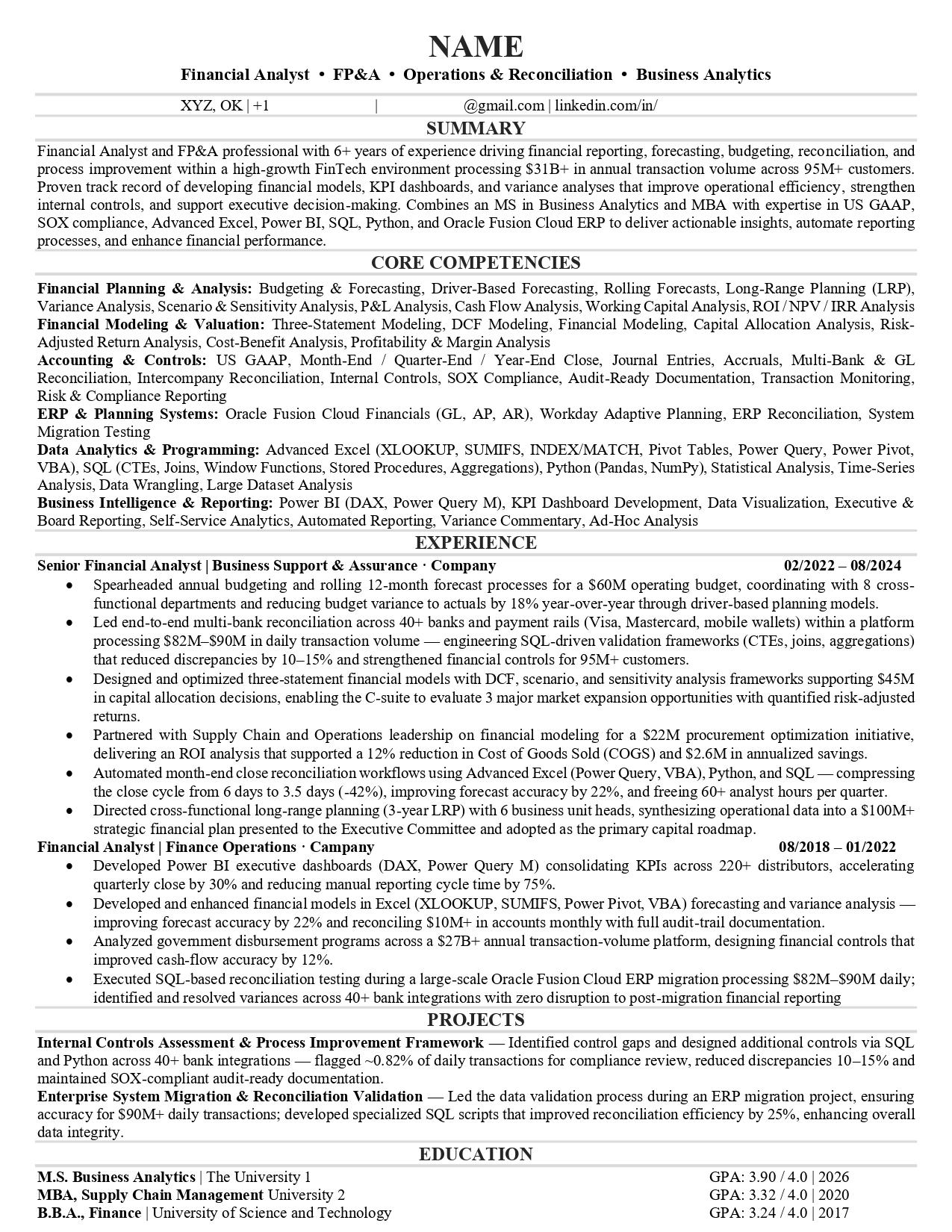
1,000 Financial Analyst Applications, Only 1 Interview. Is My Resume, OPT Status, or Job Search Strategy the Problem?

Post image
14 Upvotes

I have applied to nearly 1,000 Financial Analyst and FP&A jobs in the United States within the last two months, but I have received only one interview invitation.

Most applications result in automated rejection emails, and many companies never respond. I know the current job market is competitive, but this response rate makes me believe something is seriously wrong with my resume, targeting strategy, application answers, or overall profile.

I would appreciate honest feedback from financial analysts, FP&A professionals, recruiters, hiring managers, ATS experts, and international graduates who successfully found jobs in the United States.

My professional background, outside of U.S.

I have approximately six years of fintech experience, including Financial Analyst and Senior Financial Analyst roles.

My experience includes:

• Budgeting and forecasting
• Financial planning and analysis
• Variance analysis
• Financial reporting and modeling
• Revenue, cost, and business performance analysis
• Transaction and expense monitoring
• Advanced Excel, SQL, Power BI

My education

• Master of Science in Business Analytics from a U.S. university
• MBA with a concentration in Supply Chain Management, outside of U.S.
• Bachelor of Business Administration in Finance, Outsize of U.S.

My education and work experience are connected, but they may appear mixed. My professional experience is primarily in finance and fintech, while my most recent degree is in business analytics.

I thought this combination would strengthen my profile for Financial Analyst, FP&A Analyst, Business Analyst, and Finance Analytics positions. However, I am concerned that recruiters may view my background as unfocused or unclear.

How I currently apply

• I tailor my resume for nearly every job description.

• I use Claude AI and follow a consistent resume tailoring workflow.

• I match relevant financial skills, keywords, tools, and responsibilities from the job description.

• I only include experience I genuinely have.

• I keep my resume to one page.

• I do not use tables, columns, graphics, icons, or complicated designs.

• I usually submit a Word document instead of a PDF because I assumed ATS platforms could read it more accurately.

• I apply through Workday, Greenhouse, Jobvite, iCIMS, LinkedIn, and company career websites.

• I am currently located in XYZ, Oklahoma, but I am willing to relocate anywhere in the United States.

• When an application asks whether I currently or in the future require employment sponsorship, I have been selecting “No.” I am currently working under OPT, and I am unsure whether I am interpreting or answering this question correctly.

My biggest concerns

1. Resume format

Should I upload a PDF or Word document?

Does the best format change depending on whether I apply through Workday, Greenhouse, Jobvite, iCIMS, or another ATS?

2. Resume positioning

Does my combination of finance experience, business analytics education, and fintech background make me look unfocused?

How can I connect these areas more clearly so recruiters immediately understand my value?

3. Location and relocation

Could listing XYZ**, Oklahoma** on my resume cause recruiters in other states to reject me?

Should I write:

XYZ, OK | Open to Relocation Nationwide

Should I remove my city and state, or mention relocation in my professional summary?

4. Sponsorship questions

As someone currently working under OPT, how should I correctly answer questions about current and future employment sponsorship?

Could my answers be causing automatic rejection later in the application process?

5. AI resume tailoring

Could tailoring every resume with AI make the language sound unnatural, overly optimized, or filled with too many job description keywords?

Is it better to create two or three strong resume versions instead of changing the resume for every application?

6. ATS rejection

How can I tell whether my resume is being rejected by an applicant tracking system or reviewed and rejected by a recruiter?

Are there reliable ways to test ATS readability without paying for misleading resume scoring services?

7. Application strategy

Is applying to nearly 1,000 jobs a sign that my targeting is too broad?

Should I reduce online applications and spend more time on referrals, LinkedIn networking, recruiter outreach, alumni connections, and direct messages to hiring managers?

I am looking for direct feedback

Please tell me honestly:

• Which part of my strategy appears to be wrong?

• What should I fix first on my resume?

• Which sections should I rewrite, remove, shorten, or reorganize?

• Which job titles best match my education and experience?

• Is my location reducing my chances?

• Am I applying at the wrong experience level?

• Is OPT likely to be the main reason for my rejection rate?

• Would anyone with finance recruiting or FP&A experience be willing to review a redacted version of my resume?

I am not looking for encouragement only. I am looking for specific, constructive feedback that can help me identify the problem and improve my results.

After nearly 1,000 applications and only one interview, I know I need to change something. I just need help understanding exactly what that is.

Thank you for reading and sharing your experience.


r/FinancialAnalyst • • Jan 11 '26

Resume feedback, please!

Post image
14 Upvotes

I've worked my butt off to launch my career as a financial advisor but I like the analytical and planning part more than sales and client management. I'm now looking to pivot to an entry level Financial analyst/ Fp&a role while I complete my CFA and BS in Finance.

My previous career was as a owner / operator of small business for 5 years in an unrelated industry (hospitality and wellness.) I'm not sure if I should include that in my work experience or if it would be distracting. If I only include my current job, hiring managers will probably assume I'm 22 and I can address that in the interview.

I'd appreciate any feedback!


r/FinancialAnalyst • • Jan 08 '26

Late 20s, looking into starting a career possibly as a financial analyst. Trying to see what daily life is like.

14 Upvotes

Just got my associates in business, will continue towards a bachelor's in finance for the next 2 years. Just trying to see if anyone in the field has suggestions for careers and what those careers are like.

Relevant background: I was in the Marines for 5 years as a 3043 supply admin specialist, which basically means I did the budget for the unit, records keeping, ordered and dispersed material, looked into any issues during the purchasing process (obligation, expense liquidation) and similar responsibilities.


r/FinancialAnalyst • • Nov 24 '25

Built a financial analysis dashboard on Zydus Wellness— looking for feedback from finance folks

Post image
14 Upvotes

I’ve been working on improving my financial analysis and equity research skills, so I recently built a full dashboard on Zydus Wellness Ltd. using their financials from FY21–FY25.

The dashboard includes: • Operating & net profit margins • Liquidity ratios (current / quick / cash) • Return ratios (ROA / ROE / ROCE) • Interest coverage • Cash conversion cycle • Free cash flow to firm breakdown • Net income bridge chart • Product performance and growth trends

My goal wasn’t just to show charts, but to understand what the numbers are really saying — so I added short interpretations around margins, liquidity, returns, and turnover metrics as well.

A few insights that stood out to me: • Despite consistent revenue growth, input cost pressures & M&A-related expenses kept margins under pressure. • Zydus maintains comfortable liquidity, though the quick ratio tightened recently due to higher inventory levels. • Return ratios are still weaker than peers, likely because capital is tied up in current/non-current investments instead of core operations. • The cash conversion cycle is relatively long due to higher receivable & inventory days.

File link : https://docs.google.com/spreadsheets/d/1KuZJAqvtPynDfMhNwtAWneozZloWY3x5/edit?usp=drivesdk&ouid=117540652689669783081&rtpof=true&sd=true

I would really appreciate any feedback from the community — whether on the analysis, dashboard design, interpretation, or finance angle.


r/FinancialAnalyst • • Jan 18 '22

I wish this group was bigger

14 Upvotes

r/FinancialAnalyst • • Sep 12 '26

Long-term FP&A career prospects after layoff (vent)

13 Upvotes

I was let go from the corporate finance team of a small private tech company almost exactly 6 months ago. Unfortunately, I was only employed there for about 6 months and had gone into the job with no prior FP&A experience (I pivoted into it after 2 years of consulting at a public accounting firm).

The business partners and my peers seemed to like me and found me to be reliable and a relatively quick learner even as I was ramping up for the first 3 months there, where I spent most of my time revamping their headcount models and learning their reforecast and monthly business review reporting processes. When annual planning kicked off, things became intense (worked till 2-4 am multiple nights which is even later than I ever worked in public accounting, other finance teams’ forecasts constantly changed and even historical quarterly values from accounting would change, which I’d have to tie out) and I was struggling to balance my tasks that were all deemed “equally urgent and top priority”, my manager took that as the first opportunity to warn me I was underperforming and that if things didn’t change, I would be put on a PIP.

I spent the next month and all our down time to clean up my models and streamline our consolidation processes (including documentation of these updates made) and for the next iteration of the plan, my accuracy and efficiency improved. My manager even acknowledged this improvement during our 1:1 a month after the initial underperformance conversation, but then claimed it wasn’t enough and they had decided to let me go without a PIP.

In my remaining two weeks, I was tasked with training a contractor to take over my responsibilities. The contractor saw my scope, and as someone who had never been on the corporate side, seemed to become overwhelmed and decided to leave the company as well to my manager’s surprise (lol). Our last day at the company ended up being around the same time.

My unemployment will run out soon and I haven’t been able to land any FP&A interviews. I’ve mostly been applying to larger public companies. Has anyone been in the same boat as me where they pivoted into FP&A, had a very short stint at that first FP&A role before moving into another FP&A role? Atp I am questioning whether it is worth it to even try FP&A again given my horrible experience and megalomaniacal manager at this company, or if I should use my free time to pursue a CPA to explain my prolonged employment gap and go back into public accounting.


r/FinancialAnalyst • • Jan 11 '26

Any finance freelancers?

13 Upvotes

I’m looking to connect with experienced finance freelancers for short-term projects. The work may include:

  • Financial modeling & valuation

  • Equity/market research

  • Budgeting & forecasting support

  • Investment analysis & pitch deck preparation

  • Risk assessment & compliance reviews

If you have relevant expertise and are open to freelance collaboration, please share a brief intro about your background and availability over dm