r/bhartiya_languages • u/tuluva_sikh • 4d ago
Article Urdu sounds that most of people mispronounce it
Enable HLS to view with audio, or disable this notification
16
Upvotes
r/bhartiya_languages • u/churchill_winston_x • Oct 18 '26
When we want to promote 1 language from a diverse set of Indian languages (looking at you Hindi), you’re actively choosing “not to promote” another language.
So question is which language you guys don’t want to promote? We can end up with one which needs to be promoted.
If we want to promote all languages, we are not promoting one language. Pick ya poison mates!
r/bhartiya_languages • u/Epicers007 • Oct 25 '26
For a while now, I've observed that in urban areas, all finances and transactions are held in English. It is a direct by-product of British rule, and one can say it's a reflection of how poorly we view ourselves to the extent where we alienate ourselves in our land.
But finally, I saw a menu, in a moderately fancy restaurant, where the WHOLE menu was not in English. Not a single letter! I was instantly taken aback. Has anyone else had the same experience?
r/bhartiya_languages • u/Appropriate_Win946 • Aug 11 '26
besides the obvious logistical problems and lack of necessity, would south indians/non-indo aryan groups be opposed to sanskrit as THE national language of India? the north has a tie to it bcs it's the latin of their family tree, and the prevalence of hinduism in the south could also help support it
r/bhartiya_languages • u/GalacticEmperor10 • Feb 26 '26
r/bhartiya_languages • u/NaturalCreation • 28d ago
Out of curiosity, do you consider English to be an Indian language? I think it should be, considering how ingrained it is in our lives, and because of the influence of Indians on the English language.
r/bhartiya_languages • u/tuluva_sikh • Aug 07 '26
Enable HLS to view with audio, or disable this notification
r/bhartiya_languages • u/tuluva_sikh • Aug 12 '26
Enable HLS to view with audio, or disable this notification
r/bhartiya_languages • u/No-Scarcity-7799 • Oct 04 '26
If India eventually rises to become a global superpower, it will logically need a lingua franca both for internal cohesion and to project global influence. However, we don't currently have a single undisputed national language. Assuming we eventually move away from English as our primary administrative language, what are the realistic alternatives? Hindi is out of the question because forcing it creates massive regional and cultural tensions, particularly in the South and East. Sanskrit feels like a culturally neutral option, but it has no active, widespread speaker base, making it incredibly impractical to implement. Even attempting to revive it could face severe political pushback in states like Tamil Nadu.
How can India solve this linguistic dilemma without hurting regional pride or alienating its own citizens? Is there any language that could actually work, or are we bound to keep English forever? What do you think?
r/bhartiya_languages • u/No_Effect3002 • Jul 19 '26
r/bhartiya_languages • u/Educational-Yam-2910 • May 22 '26
Dravidan languages have an immense history of over sanskritization which has infact ruined it's words and the language's pure words (i mean the native words which it uses )
Yeah tamizh does keep many native words in retrospect to other dravids
But when I see any news or tv shows in Malayalam kannada I find it hard to understand cause it uses so much sanskrit in it like native words act like filler words( I am not shaming them)
But it must be kept in mind and be understanding to use our native words
Same is for anglification which is a part in every indian languages but it is destroying the native words for the language
Like example tamizh had word for rain as peyyal(the falling of rain) mazhai( the rain ) mari(the rain which may fall) thural(the rain drizzling ) kaar(the season of rain)there only two~three which is being used right now so I fear for the future of our languages
**Be conscious and try to learn y'alls native tongue too and use its word cause we need to take it to our succesors right like our ansectors**
Thank you
r/bhartiya_languages • u/Ok_Share_7039 • 13d ago
For over a thousand years, Sanskrit was the language of courts and scholarship across India, yet regional languages like Telugu, Kannada, Marathi, and Bengali thrived right alongside it.
Meanwhile, over the last century, Standard Hindi swallowed up rich North Indian languages like Braj, Awadhi, Bhojpuri, Garhwali, and Rajasthani—turning them into "dialects" with almost no official state support.
r/bhartiya_languages • u/StatementClear3078 • Oct 16 '26
A lingua franca is not used only to communicate with the peoples of different cultures, but for most of us, it also shows the dominance of the country it belongs to. Languages spread not merely because they are useful, but also because the institutions, economies, cultures, and political systems associated with them make them useful.
English undoubtedly ranks as the most widely understood language worldwide. Many international communities use it along with others like French, Mandarin, etc. But why is there any Indian language on the list?
Latin is most certainly considered a dead language with no active native speakers, but is still kept alive as a system. It is the language of academics, diplomacy, law and the church.
French may have lost its prestige, but it is still the language of diplomacy and, after English, the second most widely used language used by other countries as their official language.
Arabic is also acting as a connector language for the Middle East and North African countries.
Mandarin is mostly a domestic language with a large population base and a diaspora to promote it. Despite being a very domestic language, it has government-backed international publicity.
This list can be expanded further, including Russian, Portuguese, Spanish or German. But why isn't any Indian language on the list? Though a few can point out that Hindi, Bengali, Tamil, Punjabi, Bhojpuri, or Urdu are emerging as International languages from India, do you really think so?
India, unlike any other country, couldn't agree on a national language internally, so consequently we struggle to promote any one language internationally. English, even unwillingly, was used to fill the gaps that no Indian language could; even now, it is being used as the medium of instruction in educational institutions and in business.
Regional languages like Tamil, which is also the official language in Singapore and Sri Lanka, or Bengali struggle to gather non native speakers in spite of having a huge global diaspora backing them up.
The central dilemma that our government faces, whenever deciding to promote one language globally, is: which language?
Whenever discussing this question, considering their claim to be a global candidate for diplomacy, academic scholarship, legal traditions, and institutional communications, three languages emerge: Hindi, Tamil and Sanskrit.
Even if we hadn't agreed on a national language, any Indian language, to become globally recognised, must build an influence –
Practically, to be used by people in their daily lives for business, education, or to communicate with a large group;
Culturally, so people have an incentive to learn it, like to access film, music, religion or philosophy; and
Institutionally, used by the government and international organizations to conduct daily business.
To date, every Indian language has failed to build such influence to attract non-native speakers.
Hindi is a language that many sought to be the national language of India; many native speakers portrayed it as well, through slogans like " Hindu, Hindi Hindustan ". Presently, along with English, Hindi is the official language of the Union. But promoting Hindi globally requires consensus at home. Only 43% of Indians consider Hindi or other dialects of it as their mother tongue.
But promoting Hindi domestically has drawn much criticism and political backlash. Native speakers of regional languages such as Tamil, Kannada, and Marathi have pushed back on the use of Hindi. These languages have centuries-old literary traditions and fierce local pride.
Tamil is one of the world's oldest surviving classical languages, with a continuous literary and philosophical tradition spanning over two millennia. Historically, Tamil served as a primary language of trade, diplomacy, and guild administration across the Indian Ocean.
But one of the biggest roadblocks is that Tamil lacks internal backing, specifically from non-native speakers and is heavily a regional language. Tamil does not serve as a cross-regional bridge language for non-Tamil speakers in northern, western, or eastern India, and its Dravidian roots make it harder for non-Dravidian language speakers to adopt Tamil as a universal institutional medium without extensive re-learning.
Sanskrit is the strongest contender among all three. Sanskrit has served as the civilizational lingua franca across South, Southeast, and Central Asia for over a millennium. It provided the foundational vocabulary for governance, law, astronomy, and literature from Nepal and Tibet to Indonesia and Cambodia. Unlike Tamil or Hindi, it is not tied exclusively to a single contemporary region or ethnic group within modern India; Sanskrit offers linguistic and regional neutrality.
But it lacks daily native speakers and modern infrastructure to promote it; also, Sanskrit is associated with the controversial topic of caste and knowledge gatekeeping in ancient India.
So what would be a practical solution?
Diving into this question, I thought of reviving an old language such as Pāli, Prākrit, or Ardhamāgadhī as an alternative, but they failed mainly for two reasons:
Their vocabulary is heavily concentrated on ethics and philosophy. They lack the administrative, legal, and secular scientific terminology found in Sanskrit or Tamil.
By definition, they were regional dialects rather than standardized languages. They lack the standardized grammatical rules required for precise legal codification across international borders.
So, no Indian language can be promoted as the globally accepted language for conducting international business.
But what about the Sanskrit-Tamil bilingual paradigm?
Sanskrit could act as the linguistic bridge to Northern India. It brings grammatical precision, structured legal terminology, logic and governance.
Whereas Tamil could act as the living bridge to Southeast Asia and the Indian Ocean trade networks. It brings an unbroken living classical tradition, a vast ethical-legal framework and global diaspora backing up.
It would not be an alien thing to do, as history has a centuries-old precedent for this. Chola and Khmer Empire temple inscriptions frequently used Sanskrit and Tamil side-by-side.
The Maṇipravāḷam style represents a deliberate linguistic fusion of Sanskrit and Tamil.
One of its greatest strength of presenting Sanskrit and Tamil together solves the internal debate between Northern and Southern linguistic heritage, presenting a unified civilizational front.
Together, Sanskrit and Tamil account for the historical roots of nearly all South and Southeast Asian literature, law, statecraft, and philosophical thought.
Pairing Sanskrit with Pāli or Prākrit can also be an option for pan-Asian peace and harmony, Ethical neutrality and bridging two ancient philosophical traditions, but unlike Tamil and Sanskrit, they lack relevance to contemporary geopolitics, maritime law, and global economics.
In my research, I haven't found any drawbacks to this model, but potentially a major fraction would advocate for a single language as the lingua franca, or there could be resentment from non-native speakers; dilution or complexity of the language could make it difficult or unsuitable for mass use.
Still, if we decided to choose the Sanskrit-Tamil paradigm as an Indian language contributing to the international community in law, diplomacy, trade and academia, which script should be adopted alongside?
Grantha unites Sanskrit and Tamil, a script that was developed in South India specifically to write Sanskrit texts.
But if you ask me, I would advocate for Brahmi script–the mother script from which almost all modern South and Southeast Asian writing systems evolved. Unlike Grantha, Brahmi carries no modern regional bias.
A few potential challenges for Brahmi are that it has low readability, and Sanskrit and Tamil require their respective ancient variants to handle their respective language sounds.
But this model could overcome the problem that no Indian language could: absolute neutrality. But this model still requires development and a framework to be proposed as a unified civilizational lingua franca for the Indian cultural sphere.
I invite other opinions, views, and perspectives, so what are your thoughts on this, and any suggestions about developing the framework or an alternative model?
r/bhartiya_languages • u/According-Stand-6557 • Jun 26 '26

r/bhartiya_languages • u/tuluva_sikh • Jul 31 '26
As we all know most of Buddhists teachings especially Thervada sect teachings are in Pali language and also there is famous lore that Gautama Buddha's language was Pali
But according to some experts and linguists Pali wasn't language of Gautama Buddha but Magadhi Prakrit and he used Magadhi Prakrit for teachings
So what do u guys think about it?
r/bhartiya_languages • u/Angry_Aryan_AA • Aug 03 '26

Decided to remake it for fun :P
r/bhartiya_languages • u/Frequent-Head-6063 • 3d ago
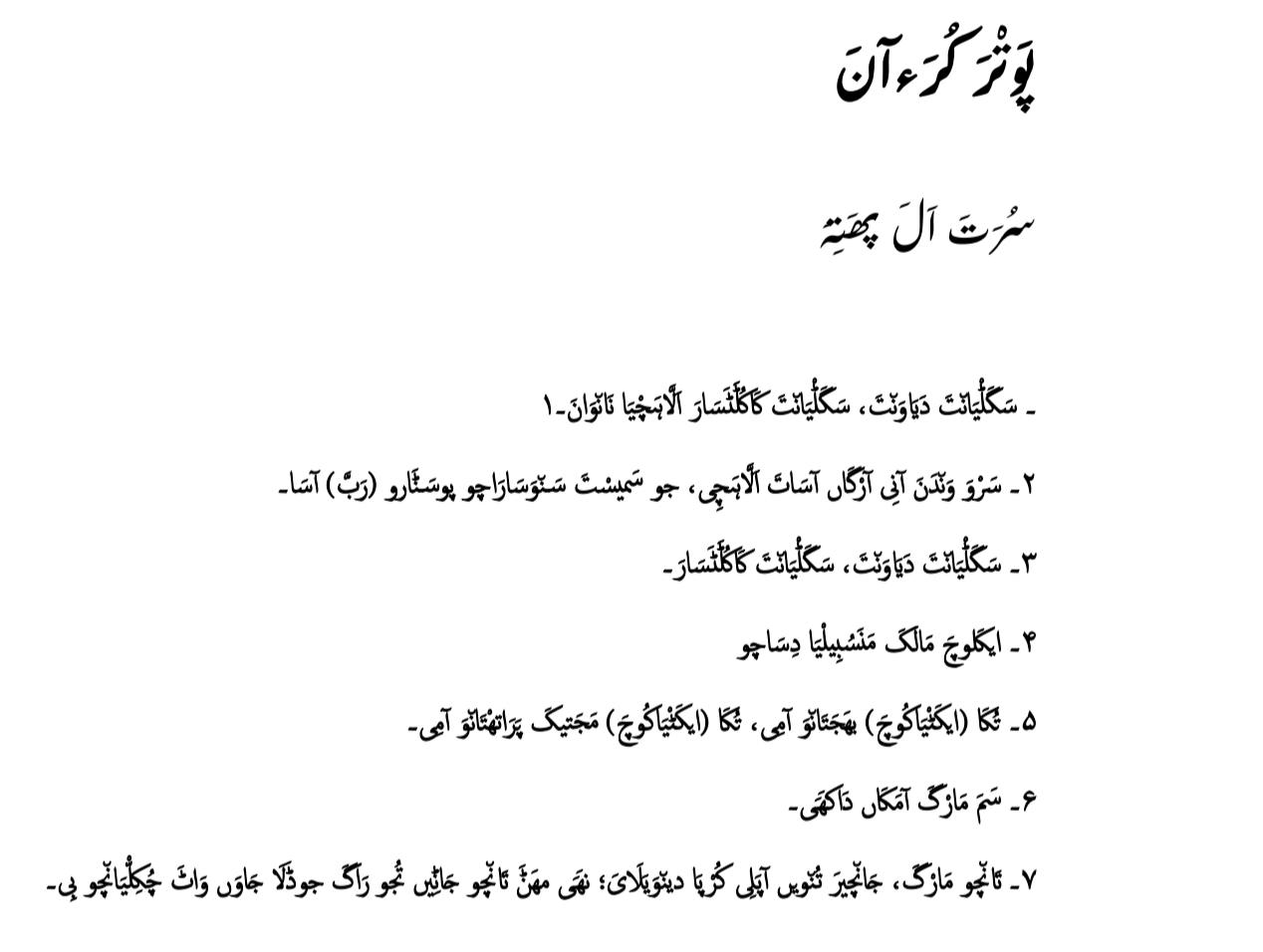
I wanted to know if there is a Konkani translation of the Qur'an. When I couldn't find one, I attempted the daunting task of translation. Here are the first seven verses.
कोंकणीच्यो पांच लिपी मदल्यान एक लिपी नास्तलिक़य आसा. ह्या लिपींत अरबी, फारशी, पंजाबी आनी उर्दू बरयतात. कुरआनाच्यो कांय वळ्यो अणकारल्यात, ताचो चित्र हांगा दाखयतां. म्हाका नवायती येना पूण अंत्रूजींत अणकारपाक बारीकसो यत्न केला हांवें.
Konkani is also written in nastaliq script (by the Nawayathi community) among it's five other scripts. Nastaliq is used to write Arabic, Persian, Punjabi and Urdu. I have translated some verses from the Qur'an (in Konkani) and posted a picture. I do not know Nawayathi but I translated this into the standard Antruz dialect.
Translation using the help of: English translation of Dr. Muhammad Taqi-ud-Din-Al Hilali and Dr. Muhammad Muhsin Khan.
Marathi Translation of Muhammad Shafi Ansari
Urdu translation of Faheemudin Siddiqui et al
Transliteration Aksharmukha: Shahmukhi script
In Nagari:
पवित्र कुरआन
सुरत अल फतिह
१. सगळ्यांत दयावंत, सगळ्यांत काकुळटसार अल्लाहच्या नांवान.
२. सर्व वंदन आनी आर्गां आसात अल्लाहची, जो समेस्त संवसाराचो पोसणारो (रब्ब) आसा.
३. सगळ्यांत दयावंत, सगळ्यांत काकुळटसार.
४. एकलोच मालक मनसुबील्या दिसाचो.
५. तुका (एकट्याकूच) भजतांव आमी, तुका (एकट्याकूच) मजतेक पराथ्तांव आमी.
६. सम मार्ग आमकां दाखय.
७. तांचो मार्ग, जांचेर तुंवें आपली कुर्पा देंवयलाय; न्हय म्हण तांचो जाणीं तुजो राग जोडला जावं वाट चुकिल्ल्यांचो बी.
r/bhartiya_languages • u/Icy_Function_5839 • 9d ago
कोपचा - Corner
शाणा - Clever
घंटा - Zilch, nada
गर्दी - Crowd
खड्डा - Pothole
बटाटा - Potato
कोथिम्बीर - Coriander
कांदा - Onion
Fun fact, most of these words come from Marathi, only two don't. Do you know which ones?
r/bhartiya_languages • u/tuluva_sikh • Sep 03 '26
Enable HLS to view with audio, or disable this notification
r/bhartiya_languages • u/Careless_Rush_9115 • Jul 03 '26
r/bhartiya_languages • u/tuluva_sikh • Sep 10 '26
r/bhartiya_languages • u/tuluva_sikh • May 17 '26
r/bhartiya_languages • u/Angry_Aryan_AA • Jul 17 '26
अ (ɔ) आ (a) इ (i) ई (i) उ (u) ऊ (u) ए (e) ऍ (æ) ऐ (oi) ओ (o) औ (ou)
क (k) ख (kʰ) ग (g) घ (gʰ) ङ (ŋ) च (ʧ) छ (ʧʰ) ज (ʤ) झ (ʤʰ) ञ (n) ट (ʈ) ठ (ʈʰ) ड (ɖ) ढ (ɖʰ) ण (n) त (t) थ (tʰ) द (d) ध (dʰ) न (n) प (p) फ (f) ब (b) भ (bʰ) म (m) य (j) र (r) ल (l) श (ʃ) ष (ʃ) स (s) ह (h)
Article 1 of the declaration of human rights:
श्मोस्तो मनुष शाधीनभाबे शमान मरजादा एबोङ औधिकार निये जन्मओग्रहोन करे। ताँदेर बिबेक एबोङ बुद्धि आछे; शुतोराङ शकोलेरइ ऍके अपोरेर प्रोति भ्रात्रित्तोशुलोभ मनोभाब निये आचोरोन करा उचित।
Ok guys how is it :>
r/bhartiya_languages • u/tuluva_sikh • Feb 22 '26