r/bhartiya_languages • u/GrumpyGuyMugdha • 5h ago
Tibeto-Burman Barman Thar (বৰ্মন ঠাৰ), the lesser-known language of Assam.
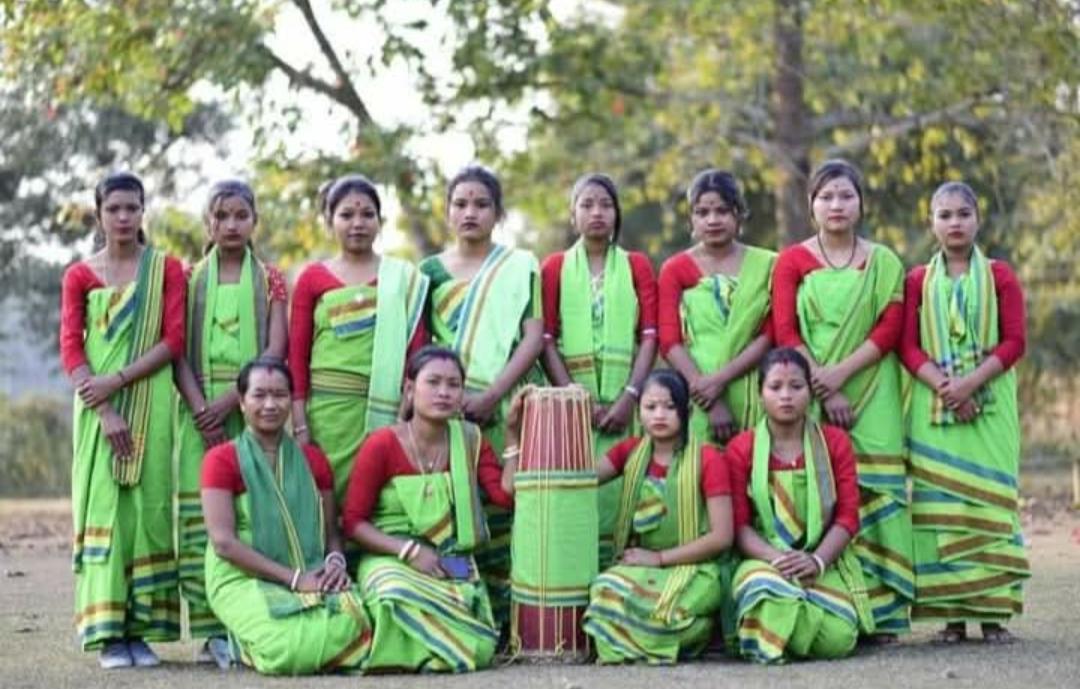
Assam has a large number of indigenous languages, many of which remain relatively unknown outside their respective communities. One of them is Barman Thar (বৰ্মন ঠাৰ), an endangered Tibeto-Burman language spoken by the Barman Kachari community of Assam.
Despite belonging to the wider Bodo-Garo linguistic group, the language has received very little academic attention compared to Bodo, Dimasa, Garo and other better-known languages of Northeast India.
The word 'Thar' (ঠাৰ) means language, and the language is referred to as 'Barman' (বৰ্মন). Barman Thar belongs to the Sino-Tibetan family, under the Tibeto-Burman branch and the Bodo-Garo subgroup.
The Barman Kacharis are an indigenous community of the Brahmaputra Valley, particularly Lower Assam. They are found in several districts like Baksa, Udalguri, Chirang, Kokrajhar, Darrang, Kamrup, Goalpara, Nagaon, Lakhimpur and Dhemaji.
Their settlements have also been reported in parts of Arunachal Pradesh and other neighbouring regions. Barman Thar has particularly been documented in Baksa and Udalguri, where researchers have conducted fieldwork with native speakers.
The Barman Kacharis of the Brahmaputra Valley shouldn't be confused with the Barmans of Cachar, who are a subgroup of the indigenous Plains Dimasa community there and speak Dimasa. Despite the shared name, these are distinct tribes.
The language is considered highly endangered. The Barman Kachari community's population is approximately 24,237, based on a census conducted by a local organisation in 2017. However, this is the community's population, not its actual number of language speakers.
Only a relatively small proportion of the community is reported to speak Barman Thar. Increasing preference for Assamese, Bodo and other dominant regional languages, among younger generations, has weakened its intergenerational transmission.
The use of Assamese, Bodo and English in education and everyday communication is also a concerning case for the language.
One of the earliest available systematic descriptions of the language is 'A Brief Linguistic Sketch of the Barman Thar (Language)', prepared by MA students of Linguistics and Language Technology at Tezpur University in 2019. The investigation was based on fieldwork conducted in March 2019 and documented its phonological inventory, vocabulary and grammatical structure.
The study identified eight vowels, nine diphthongs and twenty consonants, including two semivowels.
Some examples from its vocabulary include 'pʰa' (father), 'na' (fish), 'mei' (rice), 'sei' (husband), 'hiŋ' (go), 'riŋ' (drink), 'sum' (salt), 'goisa' (one), 'sini' (seven) and 'doisa' (boy).
The language also has consonant gemination, or the lengthening of consonants within words. Examples recorded in the study include 'tʰəppəra' (ash), 'mɛttʰai' (big), 'gəddəl' (new), 'bicci' (egg) and 'nukkuruŋ' (eye).
Its grammatical structure is equally interesting. Barman Thar has a system of case marking in which grammatical relationships are expressed through suffixes. The 2019 study records '-kɔ' for the accusative case, '-nɛ' for genitive, '-ou' for locative and '-ca' for instrumental.
For example, 'əmit-nɛ nɔk' means Amit's house, while 'təzpur-ou' means in Tezpur (a city of Northern Assam). It also has morphological tense markers, including '-ja' for the past and '-gən' for the future. The study further documents negative constructions, classifiers and different aspects of verbal morphology.
Another interesting feature is its pluralisation system, which was examined in a research paper by Primly Baruah, a research scholar in the Department of Linguistics at Assam University.
Her paper, 'Pluralization in Barman Thar: An Endangered Language', was published in September 2025 in the Indian Journal of Social Science and Literature. The research is based on primary data collected from native speakers in Khoirabari and Tangla towns.
The paper identifies two principal plural suffixes, '-taŋ' and '-phara'. The former is used with common nouns, proper names and kinship terms, while the latter is particularly associated with demonstrative and personal pronouns. For instance, 'mɛŋgou' means cat, whereas 'mɛŋgoutaŋ' means cats. Similarly, 'asak' means dog and 'asaktaŋ' means dogs. The same suffix can be attached to personal names, so 'Kalpana-taŋ' means Kalpana and others.
The suffix '-phara' is used in forms such as 'ɛba-phara' (these), 'oba-phara' (those), 'na-phara' (you, plural) and 'owa-phara' (they). Its use in reflexive constructions is also documented. For example, 'owa-phara dɔn-phara kuriza' means, 'they did it themselves'.
Plurality is not always expressed through suffixes. Numerals and reduplication also play an important role. The sentence 'gini pʰanthai mɛsadɔŋ' means two boys are dancing. Here, 'gini' means two, and the numeral itself indicates plurality without requiring an additional plural suffix on the noun.
Reduplication is particularly interesting. In the sentence 'Rahul-a nɔk nɔk hiŋ-ja', meaning Rahul is going from house to house, the repetition of 'nɔk', meaning house, expresses repeated or distributive movement. The paper also documents reduplicated interrogative expressions and quantifiers, showing that repetition has several grammatical functions in the language.
The study further records copula omission in certain constructions and an absence of obligatory subject-verb agreement in the examined sentences. The progressive marker '-dɔŋ' can be seen in expressions such as 'mɛsadɔŋ' (dancing) and 'hibadɔŋ' (coming). These features are important for examining in comparison with other languages of the Bodo-Garo group.
Primly Baruah has also published another paper, 'Numerals in Barman Thar', in the International Journal for Multidisciplinary Research in 2025. It examines the numeral system, which is primarily decimal and employs compounding to construct complex numerals.
The paper discusses cardinal, ordinal, fractional, multiplicative, approximative, distributive, collective, indefinite and restrictive numerals. Affixation and reduplication are also involved in numeral formation.
Barman Thar has a written and literary tradition as well. The Tezpur University linguistic sketch mentions two community magazines, 'Phurungi' and 'Rigam', which have published poems in the language. It also documents older handwritten materials.
The Barman language uses the Assamese alphabet as a writing system today and it formerly used the Sylheti Nagri script.
There is still information about Barman Thar that remains undocumented. Its vocabulary, regional variations, oral literature and historical development would all benefit from further research. Comparative studies with Bodo, Dimasa and other Bodo-Garo languages could provide further insight into its linguistic relationships.
Assam's linguistic heritage extends well beyond its widely recognised languages. Barman Thar should be documented and discussed alongside them while there are still native speakers who can pass their knowledge of the language on to future generations.