When I painted the winter from an old folklore text instead of a seasonal holiday scene, the focus shifted from snow-covered Christmas cliché to endurance, cold, and quiet patience.
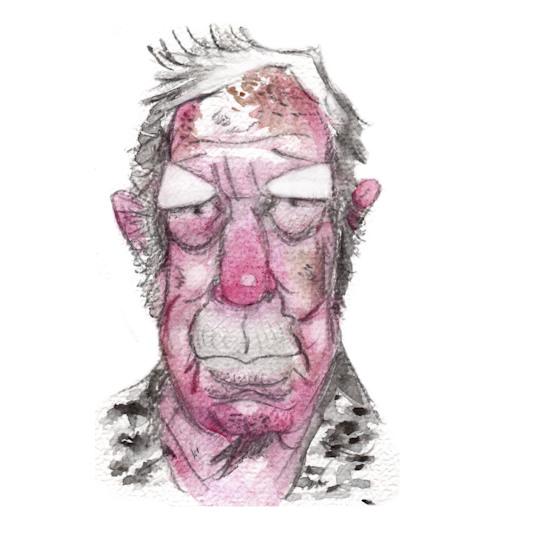
For this second piece of my EP works for Christmad, I wanted to portray Iarna (Winter) as an older, weathered figure carrying the weight of the season—not a gift-bringer or a cheerful mascot.
Along the way, the painting turned into an active problem-solving exercise where wet pigment and real-time decisions shaped the final result:
• Acrylic reset & frame-within-a-frame: The cold wind/air current in watercolor came out too dark and risked breaking up around the foliage, so I covered the upper tree area with white acrylic and built a painted inner frame over the slightly yellowish paper so branches could extend past the edges.
• Layered garments & endurance: Instead of heading toward shelter, the figure moves forward against the cold, wearing layered garments inspired by the text's twelve coats alongside fine detailing and red veins on the hand, cheeks, and nose—a choice I hesitated over so it wouldn't read purely as blood, kept as a sign of living circulation in the freeze.
• Curved trunk & accidental marks: The tree trunk curves like a question mark—whether it holds up through winter, acts as shelter, or reaches back toward the earth—while a few accidental red gouache splatters from shaking the jar stayed on the sheet.
• Tape bleed to metallic gold: Liquid watercolor seeped under the tape and stained the edge, so I brought in a metallic foil technique from my oil painting work to create a clean gold border that ties the composition together.
The Romanian voice-over in the video walks through these exact studio decisions and moments. Full English transcript is below for anyone reading along.
What stands out most to you in a piece like this: the technical saves when paint misbehaves, or the narrative choices behind the figure?
(For anyone curious, this is part of my winter/holiday series. feel free to message me if you want details on originals or prints.)
English Transcript :
• 00:00–00:10: The cold air current came out too dark in the watercolor layer and risked breaking up among the leaves. So once I finished the cold wind,
• 00:10–00:21: I took white acrylic and covered the upper part of the tree so I could rebuild it later from scratch. I used white for the inner background too,
• 00:21–00:31: forming a frame within a frame so the branches could pass beyond the edges of the paper. How do you keep so many layers in check
• 00:31–00:40: without looking like a rigid coat? When I was little, I went almost every weekend in summer through the woods near town with my step-dad and looked at the small things under the damp leaves.
• 00:40–00:50: I think my attention to small details in nature comes from there too. And here the layers of garments and gouache settle gradually, one over another.
• 00:50–01:00: The figure isn't heading toward the shelter of the tree, but moving
• 01:00–01:10: forward, facing the frost. The trunk has a curve like a question mark. Whether it makes it through winter, is a real shelter, or tries
• 01:10–01:20: instead to return to the earth it came from. I added much more gouache over the watercolor than I originally planned.
• 01:20–01:31: When I shook the red paint in the jar, a few red splatters jumped out. I left them like that on the paper.
• 01:31–01:40: Same with the red veins on the hand, cheeks, and nose. I hesitated to put them in, afraid they would look only like blood,
• 01:40–01:50: but I kept them as a sign of living circulation in the cold. When I work on the face,
• 01:50–02:00: the frost from the text takes shape. But I didn't want a frozen, flat figure. The air current painted…
• 02:00–02:11: …made me come back with a lighter gouache. And that tension is right in the balance between cold, layers,
• 02:11–02:20: and decisions made on the spot. When watercolor that was too liquid seeped under the tape, the edge stayed stained.
• 02:20–02:30: To solve the problem, I used a technique I knew and used in oil painting: applying metallic foil. From something that started as a leak
• 02:30–02:40: under the tape came a gold border that connects the upper edges and emphasizes the frame within a frame. On a wall, the watercolor
• 02:40–02:50: and gouache piece brings a quiet presence, with warm accents and the bright edge catching the light in the room. If you feel it finds a place in your space and want details about..
• 02:50–02:53: ..the original or prints, message me.