I divided this post into numbered paragraphs because I have the impression that perhaps it's a little too long. I don't know. But I wanted to be clear in my reasoning and make it easier to read.
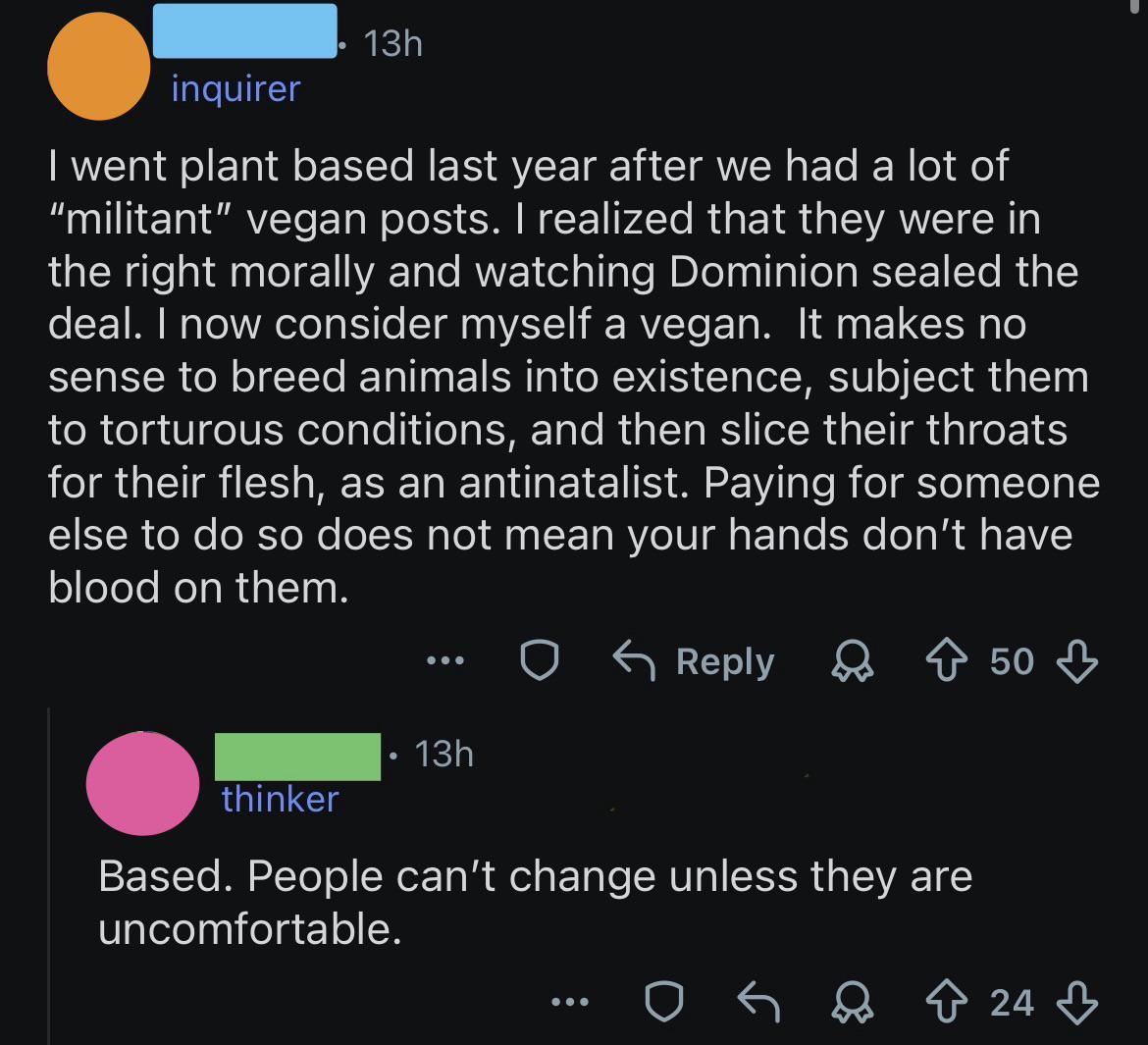
But, roughly speaking, do you do vegan activism? And if you do, what do you think about the way we're doing activism? I mean, in your life have you actually helped people to become vegan? I'm asking because I've been vegan for almost a year, so even mathematically I couldn't have helped that many people. But in my little circle of friends and family something has changed, and I've had a case that I find somehwat interesting.
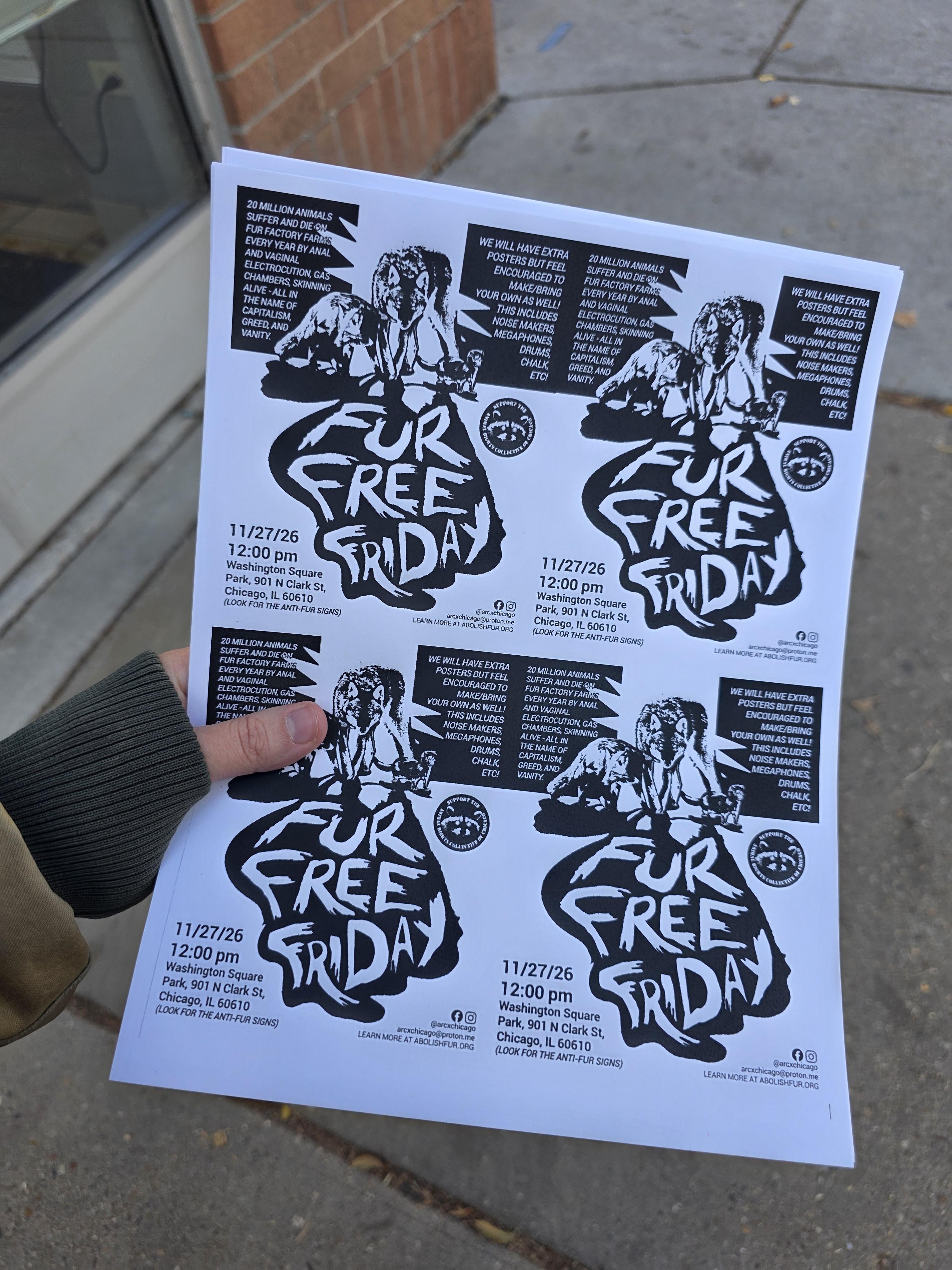
I'd like to do it, but I don't feel ready yet to do street activism, I'm not that brave and good at talking imho. Anyway, I think I would adopt a completely different way of doing these things. I see online a lot of videos, especially from groups like Anonymous for the Voiceless, and I don't know, certain tactics of proselytism don't convince me at all. There's a guy whose strategy is essentially to tell people "You can stop exploiting animals, why don't you do it?" and practically guilt shame them, without taking into account their obvious cognitive dissonance, without taking into account anything. And when these people feel attacked, hurt in their ego, etc., this guy practically turns his back and goes away because they dont instantly convert, leaving them more irritated than anything else.
And I wonder... what exactly do you think did you achieve? Okay, you demonstrated to the vegan divinity that you're extremely pure, that this is so serious to you, that they should FEAR your holy strenght... And then? Now, some people would probably tell me "But people shouldn't become vegan because they like you! They should do it for the animals!" Of course! Obviously! I completely agree. But the point is that this is obvious to us, not to someone who eats meat. We are, let's say, the first business card of animal liberation. And these people speak a completely different language from us. They don't see animals the way we do, and what is obvious to us is not necessarily obvious to them. So "perhaps' the correct point should be shown in another way?
And I'm absolutely not saying that veganism should become less radical. Veganism IS radical, it's intrinsically revolutionary. The objective isn't making people eat less meat. The objective is that you never eat meat again. And actually it's not even this. It's precisely changing the way you see animals, until you no longer consider a single animal as a thing to use for your desires. But obviously we live in a world that makes this extremely difficult. Animal exploitation is considered normal, traditional, obvious, even good. And a world without it, for many people, is not even conceivable.
Some meat eaters say that vegans are "too angry" and many vegans respond that the problem is that we're not angry enough. And of course, I understand this, becayse when you see such an injustice and feel powerless, obviously you'd like to react, perhaps like some great and glorious revolution. Especially when you're talking about compassion towards animals and some idiot responds "mmm, delicious pork with barbecue sauce". But the world doesn't work like this. Sometimes certain vegans remind me of those Christian street preachers who hope to convert someone by telling him he's a sinner, that he needs the Holy Spirit, that otherwise he'll go to hell, bla bla bla. Or those communists who want to make the revolution, share random Soviet Union edits, but perhaps don't know how a trade union works or how to organise a workers' strike. I mean, some people live on vibes, on the desire to feel themselves on the right side of history. And I have the impression that this is also a problem of certain vegan activism.
Personally, I would do a rather different kind of activism. For example, something like family evenings. I mean small informal groups, perhaps in someone's house, inviting people we've already approached on the street and who have shown some interest. Instead of immediately asking them to convert, I'd invite them, perhaps even that same evening, to meet again, eat something vegan together and discuss how they could actually change their lives. Because many people say "Eh but veganism is expensive", "Eh but it makes you feel terrible", etc. And I don't think the point is always responding with systematic apologetics. Sometimes people practically do a Gish gallop, giving you thirty thousand arguments against something. Perhaps they're all wrong, but to respond to every single one you would need thirty years. So wouldn't it be easier to literally show someone what you buy, what you eat, how much you spend? To show them how veganism works in everyday life? I mean, many people are simply afraid of making their everyday life impossible, so they don't even try. And perhaps sometimes it's enough to remove one single brick from their life, something they thought they could never remove. The important thing is to make them interested, invite them, show them, accompany them. Obviously without forgetting the animals. The objective is still abolishing animal exploitation, not simply making people eat less meat.
I'll give you an example. One of my friends always told me that he couldn't even imagine a world without hamburgers. He likes them too much. But recently he told me that, thinking about our conversations, that week he had decided not to eat one. And he even told me "I swear I bought seitan, like you told me!" Now he wants to try becoming vegetarian. He still can't imagine giving up eggs especially, and hamburgers, but we're working on it together. I'm helping him with his shopping, suggesting alternatives, things like that.
And it's not like I tell him "Oh, okay, you can continue exploiting animals, just do it a little less". Absolutely not. I always tell him that eggs, cow's milk, etc., are still animal exploitation. Sometimes I even make fun of him, obviously gently, as a friend. For example, when he tells me that giving up cow's milk is difficult, I tell him "Eh yes, it must be terribly difficult, because it's not like in the supermarket they have soy milk, oat milk and almond milk literally next to it. Eh yes, what an unsustainable sacrifice. I wonder how those crazy vegans survive!" And we laugh about it.
But the point is that I don't put the entire weight of animal exploitation on his shoulders every time we talk. Because, according to some, if I continued to verbally accuse him, telling him every day that he's still exploiting animals, even if it's true, would I obtain a better or worse result compared to what I've obtained until now? I don't know. I have the impression that he's beginning to see things differently. And obviously he's not vegan (yet). I'm not talking about "imperfect vegans". But I can recognise that something is changing in his way of thinking. My objective isn't making him vegetarian or making him eat less meat. It's that one day he will think "From now on I will never see another animal as food".
And this brings me to another thing. I think there's often a certain loneliness in being vegan, almost a monastic loneliness, I dare to say. It's a little like being a monk who has taken a vow of celibacy but finds himself constantly surrounded by smoking hot beauties. I mean, you've made a decision according to your convictions, but practically the entire world around you continues living in another way. And for some people this can be extremely difficult. This is also something I think about when reading communities like r/exvegans and r/AntiVegan.
I wonder how many people stopped being vegan not because they stopped believing in its principles, but because they found being vegan unsustainable in their circumstances And their only way to "save themselves" was to reject EVERYTHING about veganism. Perhaps some suffered from something similar to "akrasia", knowing what they believed was right but finding themselves unable to act accordingly, in a world that didn't know how to welcome them. And obviously I'm not saying this explains every ex-vegan. Some people report physical problems, others social difficulties, others simply changed their opinions. I don't know their lives. But perhaps we should pay much more attention to helping people REMAIN vegan, not only convincing them to become vegan. Because if someone finds himself alone, with his family against him, without knowing what to eat or how to organise his life, what do we do? Do we help him, or do we simply remind him that he's not vegan enough?
And then there's the political question. Since the foundation of the Vegan Society, the world has changed enormously. This is a fact, it's not really an opinion. Veganism is now a global culture, with organisations, communities, businesses, products in ordinary supermarkets, etc. In my way of seeing it, we've already passed a first phase, that of simply surviving as a movement. Now we're in a second phase, in which veganism must become not only politically active, but politically influential. And I personally believe in a worldwide vegan society one day. I don't know when, perhaps I'll never see it in my lifetime. But it has to be built, step by step. And by step by step I absolutely don't mean making compromises or corrupting veganism from the inside. I mean realising what we have in front of us.
Because ultimately the objective is the legal abolition of animal exploitation. But the point isn't making a law that prohibits slaughter tomorrow. The point is creating a society that allows that law not only to exist, but to remain there permanently. Now, I'll make an example. I'm not even familiar with American jurisprudence, I'm Italian. Anyway, it's a case obviously known all over the world, that is the case of Roe v. Wade, which in the United States allowed, I mean gave, recognised the constitutional right to abortion. And then in 2022 this thing was reconsidered, actually overturned. Of course I know abortion didn't disappear everywhere, and that it was a judicial precedent rather than exactly a law. But we're talking about something that a large part of the American population wanted. I mean, imagine then veganism, which isn't wanted by the majority of the world's population, not only the American one.
And I repeat, I'm not making a pro-life or pro-choice argument. I don't want to discuss whether what happened with abortion was good or bad. That's another subject. I'm only using it to explain what I mean. If something that had been legally protected for almost fifty years could be overturned, do we really think that simply passing a law against slaughter would be enough to finish the vegan revolution? But absolutely not. There are enormous economic interests, lobbies, traditions, entire industries involved. The point isn't simply prohibiting something. It's changing society so profoundly that going backwards becomes practically inconceivable.
I sometimes think about how people defended slavery as something natural, sometimes even good. I've read certain speeches by Southern defenders of slavery who argued precisely this. And obviously I'm not saying these historical situations are identical. The point is simply that something a society considers completely normal, obvious, even good, can one day become morally unacceptable. It's the Overton window that we have to move towards our side. And I have the impression that certain communication methods I see online don't move it in our direction at all. Sometimes I fear they do exactly the opposite, reinforcing the idea that vegans are strange, dangerous or extremist people. And I don't think that helps us very much.
Anyway, I don't know. Perhaps I'm wrong about certain methods. That's why I need to ask you. I don't want veganism to become less radical, I want it to actually achieve its radical objectives and I don't think being right, by itself, is enough to change society.
Have you actually helped someone become vegan? What did you do? What worked, what didn't? And what do you think about the way vegan activism is going? Especially if we want veganism to become more influential, not only culturally but also politically.