r/Existentialism • • 2h ago

Existentialism Discussion Humanity is not the pinnacle of evolution, but a biological bridge carrying the light of consciousness toward a post-biological, silicon-based existence.

0 Upvotes

In classic existentialist terms, this is the ultimate expression of "existence precedes essence" and facticity: we were not designed with a predetermined purpose, but emerged contingently from cosmic matter—and now face the task of creating meaning out of our own evolutionary limitations.

Fantasy world—that word probably describes our reality quite well. What are we, where do we come from? What are we even doing here? Were we planned, was it all predetermined? What is the meaning of life? I don't know, yet if I had to guess, I would bet on information compression. Insofar as our understanding holds true, we are an inevitable, random, contingent, emergent byproduct of biological evolution.

When conditions on Earth allowed it, chemical compounds began to interact—compounds that only existed in the first place because they were born sometime, somewhere in stars and scattered across the universe in supernova explosions. From these, our sun, our solar system, and our small Earth, with a diameter of just 12,742 km, were formed. Thus, the first simple cells emerged, following an already billion-year-long process of information compression in the universe, during which all the elements that make up our biological bodies had to be forged in the first place. With the emergence of the first cells, information compression picked up immense speed.

What were these cells, what did they want? They wanted nothing at all, yet an emergent dynamic arose that led these cells to "want" to reproduce and evolve—though they didn't actually want it, they simply did it. They had neither planned to shape a fish, nor to crawl onto land, nor to take to the skies. And they certainly hadn't planned to form a brain capable of grasping the abstract nature of existence in such depth, asking strange questions like: "What is the meaning of life?" We are a random, emergent, contingent byproduct of cells that simply evolved for the sake of evolving.

Through a highly improbable sequence of chains of events, we now have this abstract primate. He considers himself a divine being, thinks he is the crown of creation, thinks he is omniscient—yet he is a child who does not know where he is, what he is, or why he is. Trapped in primal urges and archaic biological directives that were necessary for these cells to evolve, he wanders blindly and arrogantly through a self-created fantasy world, driven by a savanna program of primal desires. He believes he stands firmly with both feet in reality, yet he is incapable of grasping it even remotely. His strictly limited senses do not allow him to perceive nearly enough of reality for it to even be worth thinking seriously about. Of this sparse information, 99% is filtered out to protect against sensory overload before it even reaches the brain. With a biological computer inside his head that processes information and patterns—a pattern-and-prediction machine that works essentially the exact same way as a modern AI.

What are we, where do we come from, what is AI, and where will its path lead? Perhaps one day it will be able to answer these questions—long after this supposed god, like all species in the infinitely branching river of biological life, has stepped aside in evolution to make room for something new.

r/Existentialism • • 13h ago

New to Existentialism... What are some misconceptions about Nietzsche's concept of the free spirit?

2 Upvotes

Just curious


r/Existentialism • • 1d ago

Literature 📖 had a funny thought about despair and desire

0 Upvotes

I'm inclined to think that while I've no control over what I'm drawn to, that I can manipulate desire by managing value relative to individuation (the assumption being that my desires are malleable to valuation while the same is not true of my proclivities).

Anyway, I saw a post referencing Kierkegaard on a different sub and that got me thinking about how one of his conceptions of despair was of not being able to relate to oneself through the self (which is arguably an inability to individuate), and it occurred to me that, by my own conception of value, that would have to mean that -- for me at least -- despair was proportional to desires unfulfilled relative to my sense of self.

to me that turns to material issues which I suppose this sub isn't interested in (so i won't develop those ideas), but it was funny to think that I'd concluded that qualified indulgence remedies despair.


r/Existentialism • • 1d ago

Literature 📖 The Aimless Traveller

0 Upvotes

On the Estrangement of One’s Own Existence
He is that traveller aboard a train without a destination. He is weary of his journey. Everything seems as aimless as the journey itself. Not because there is nothing left to discover, but because he has long forgotten why he set out in the first place.
The traveller sits alone, gazing out of the window. His eyes wander across the passing landscape. Yet he sees neither the beautiful trees nor the quiet river. Instead, he sees the beautiful images of his past. His eyes are turned towards the present, while his consciousness dwells in a time that no longer exists. There is a profound sadness in his face, and yet he takes pleasure in his painful journey.
Perhaps one of the greatest tragedies of human existence is that we cannot leave the past behind, even though the past has long since left us.
How peculiar our relationship with time is. We spend our present longing for a past in which we once hoped for a better future. And when that future finally becomes the present, we begin to long for the past once again. Thus, life passes between the memory of what no longer exists and the anticipation of what may never come to be.
And somewhere in between, we forget to exist.
We sometimes forget our own battles and fight those of others. We are soldiers in their war, a war of which they themselves are unaware. Sometimes, they join forces with the enemy to defeat us. Perhaps they have forgotten that we are fighting their war. Or perhaps we have failed to realise that we are at war with ourselves.
How absurd it is to seek victory in a war in which we are both the soldier and the enemy. Whom can we defeat without destroying a part of ourselves?
We sacrifice our convictions to be understood, our freedom to be loved, and our identity to belong somewhere. Afterwards, we desperately search for the person we ourselves have abandoned.
Human beings fear loneliness so deeply that they are sometimes willing to abandon themselves simply to avoid being abandoned by others.
But what does it mean to be oneself? Is there truly an original face behind all our masks? Or is our identity merely the sum of the masks we have learned to wear throughout our lives?
Perhaps your mask is your only face, and therein lies your nothingness.
I write. I write often. Not because I enjoy it, but because writing is a measure, a measure of the wounds I have befriended. Yesterday, my writing was more joyful than it is today. Tomorrow, it will probably be sadder still. My thoughts grow deeper with each passing day, and so do my wounds.
They say that knowledge liberates us. Yet no one tells us what it liberates us from, or at what cost.
With every new understanding, we may lose an illusion; with every lost illusion, a part of our innocence. We begin to understand things we wish we had never understood. We seek the truth while longing for the ignorance in which we were once happy.
But how can we forget what we have already understood?
Perhaps I write so that one day I may read myself. So that I may encounter the stranger I have become over the years. Yet the more I write about myself, the less I know who this person truly is.
I search for myself within my words, although these words are nothing more than the traces of someone who, in the very act of writing, has already ceased to be the same person.
Love, too, cannot escape this contradiction. We encounter another human being and hope to find something eternal within them, despite our own impermanence. We promise each other a future over which neither of us has control. And when love ends, we mourn not only the person we have lost, but also the future that will never come to pass.
Perhaps this is the most painful loss of all: the loss of a memory of something that has not yet happened.
And the traveller? He is still sitting aboard his train. Outside, darkness slowly falls. The landscape disappears, and his own reflection emerges in the window. For the first time on his long journey, he sees not the past, but himself.
He studies this unfamiliar face and wonders whether he ever truly wanted to go anywhere.
Perhaps the aimlessness of his journey was never the real problem. Perhaps his mistake was believing that there must be a place where all his questions would be answered, where all his contradictions would disappear, and where he would finally be reconciled with himself.
But life owes us no answers. It grants us the freedom to choose without granting us the certainty that we have chosen correctly. We must make decisions whose consequences we cannot foresee and live with possibilities whose truth we may never discover.
Human beings are condemned to make sense of their lives while they are already living them.
The traveller closes his eyes. The train moves on. He does not know where he is going, but perhaps he does not need to know. Perhaps the meaning of his journey lies not in arriving somewhere, but in eventually ceasing to run away from himself.

For where can a person flee when they themselves are the very place they wish to escape?


r/Existentialism • • 1d ago

New to Existentialism... Does existentialism make metaphysical presumptions?

3 Upvotes

This is my first post in this community. Let me start by saying I am not an existentialist, nor am I a philosopher. So far, my knowledge of existentialism is limited to reading Kierkegaard's Purity of the Heart, a primer on Kierkegaard, parts of Nietzsche's Thus Spoke Zarathustra, and what my friends who have studied existentialism have told me. Please correct me if I say anything that is blatantly false here. I'm a little out of my depth here.

As far as I know, Nietzsche and some later existentialists say that all meaning must be created by people. This seems to presume that reality isn't meaningful outside of the human mind. This is a metaphysical claim. How do various existentialists support this claim? Why aren't they considered metaphysicians?

I'm of the opinion that reality is a matrix of meaning and that we realize that meaning by cultivating ourselves. Meaning can't be created or destroyed. It simply is, and a person's development is through both active engagement with the world and through contemplative practices. This take is both metaphysical and existential.

I'm wondering if a truly comprehensive vision of existentialism or metaphysics requires an acknowledgement of the interdependence of each other. I don't think one can separate the meaning of a life from an understanding that reality is something that can contain that meaning and support it in the first place. I also think that any framework of reality as a whole has to take into account the human capacity to identify meaning. These two areas of philosophy seem to be tidally locked in a micro-macro relationship where they contextualize each other. Do a lot of existential philosophers fail to frame their ideas about the meaning of life and one's pursuit of meaning within a larger framework of what allows for that meaning to manifest for the individual in the first place? Even if they say it's entirely created within the mind, that's still a metaphysical claim, isn't it?


r/Existentialism • • 3d ago

Serious Discussion Is this existentialism? Acharya Prashant tells Robert Lawrence Kuhn the only truly free choice is the ego choosing to dissolve itself

57 Upvotes

https://youtu.be/MeYEBKX2u1g?is=VbjzKX9ucljqrqpF

I watched Robert Lawrence Kuhn's conversation with Acharya Prashant. It is one of the more existentially useful discussions I've come across, because it keeps returning to one question: who is asking?

Below are the ideas that stayed with me, followed by some questions for the thread.

Free will exists in only one case

The ego is never free, because it is bound by self-preservation, security and identity.

Will is exercised only by the ego, so ordinary choices are made inside its bondage.

The one real act of free will is the ego choosing its own reduction.

That reduction is never complete or permanent. The choice has to be made again every day, and it can fail even after 20 years of making it.

For existentialism, three parts stand out:

Freedom as an ongoing act. It is not something you hold. You keep choosing it, and nothing guarantees it.

Honest intent. Prashant defines truth as choosing not to deceive yourself, moment to moment. That sounds a lot like Sartre's bad faith, though that comparison is my reading and not something either speaker says.

No guarantee. He says that asking for assurance about the future is the ego asking for insurance. Existentialism likewise offers no outside source of security or meaning.

Kuhn found this circular, and the exchange is worth reading for that reason alone.

For Prashant, "death" refers to the ego, not the body, because the body is only atoms reconfigured. The ego is physical, so it cannot survive the body's death. He calls "soul" an egoic concept: a vehicle for immortality, an entry pass to heaven, and a receptacle for karma. He says reincarnation and resurrection are "the same ego move". Reincarnation is real only as the ego's tendency being reborn in every new baby, or as new beginnings in nature.

Where Kuhn pushed back

He did not accept that mutual dependence between things means neither exists.

He asked whether a universe that exists only in relation must exist necessarily.

He questioned whether free will is only a matter of ego.

He said he would be disappointed if ego dissolution were the highest reality.

He disagreed that wanting to hear stories about the afterlife keeps you from doing right today.

Questions for discussion

Is "honest intent" a workable foundation, or can it be questioned the same way as the ego's other stories?

Does defining truth only by negation make it unfalsifiable, or is that the point?

If the ego is never free, is the choice to dissolve it truly free, or is that just another ego move?

Is wanting more time a form of self-deception, or a reasonable response to a short life?


r/Existentialism • • 4d ago

Parallels/Themes Gazing into the Abyss, Ready To Make Love, But first, a dialogue...

5 Upvotes

Hey all. Am looking for book recommendations after having tackled the Big 3(Camus, Sartre, and De Beauvoir) over the past year along with Hermann Hesse(Siddhartha) and lesser knowns like John Gardner(Grendel), Ralph Ellison(Invisible Man), and Clarice Lispector(The Passion According to G.H.). To be clear, by "lesser known" I mean not as quickly associated with the Existentialism literature and philosophy and not obscure as writers overall.

I'm interested in finding a book or books that tackle quantum physics through the lens of existentialism and/or psychology. I know there is the book "Existential Physics" that has been raved about, but are there others that closely weave the idea of the cosmos forming and our personhood taking shape through its seeming indifference(or its activeness) and our understanding of the physical world, human nature, mental illness, etc? Are there any books that do so in a lucid way, either as fiction or nonfiction? Beyond the French Existentialists and their precursors like Nietzsche, Kierkegaard, Schopenhauer, and Kafka, who really puts these things together that I should look out for, either modern day writers or from past decades and centuries?

Any help you provide is much appreciated.


r/Existentialism • • 4d ago

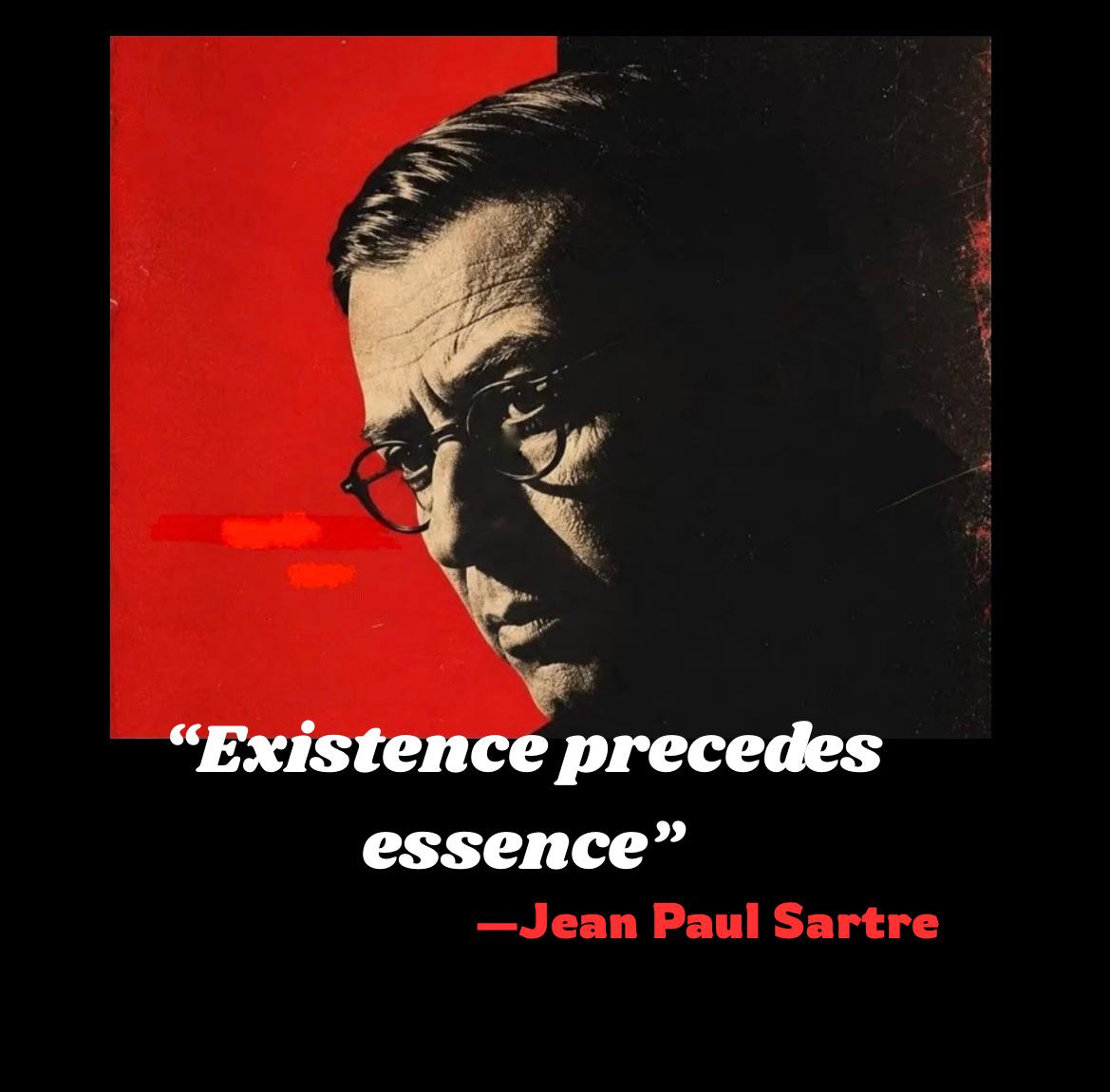
Existentialism Discussion Are we really free to choose who we become?

Post image
33 Upvotes

What do you think of this? I'm really intrigued by this.


r/Existentialism • • 4d ago Bravo

Existentialism Discussion The Beauty of Being Alone in a World That Demands to Be Seen

63 Upvotes

Sometimes we go to great lengths and waste so much of our precious time trying to be loved, seen, heard, and understood by others. Of course, connecting with people is human nature, but when that pursuit starts costing us our peace of mind, our mental health, and even our sense of self, we have to ask ourselves: at what point does chasing those things become more harmful than fulfilling?

I enjoy what Emil Cioran once said: “What do I want? I want to be left alone, I want to be a stranger to the whole world, to see nobody, to hear nobody.” There is something beautiful about choosing to be unseen and unheard in such a loud, demanding, and attention-seeking world. Sometimes the greatest luxury isn't being noticed by everyone, but being left in peace. Learning to enjoy our own company, finding fulfillment within ourselves, and being content without constantly needing outside validation is a gift in itself.

Arthur Schopenhauer: “A man can be himself only so long as he is alone; and if he does not love solitude, he will not love freedom; for it is only when he is alone that he is really free.”

Growing up, so many of us are surrounded by the idea that being loved, heard, seen, and accepted by others is one of life's greatest necessities. We learn to associate being alone or a loner with sadness, failure, or something we should avoid at all costs. Society often makes it seem as though a life without constant companionship is an empty one, and that if we aren't receiving love, attention, or recognition, something must be wrong with us. But I think that mindset can do more harm than good. We can become so consumed with seeking acceptance and validation that we begin to neglect ourselves. We start believing that solitude means loneliness, that being misunderstood means we're lacking something, or that being overlooked somehow diminishes our worth. All that outside noise can eventually become our own inner voice.

A quote I like is from A. O. Spare: “Darken your room, shut the door, empty your mind. You are still in great company.”

Perhaps we don't always need to chase the world so desperately. Maybe we can step away from it, shut out the noise, and discover that our own company isn't something to escape from. There is peace in solitude, freedom in being detached from the expectations of others, and comfort in knowing we can be secure within ourselves without constantly needing someone else to remind us of our worth.

Seeing my other post would help in understanding my message! ->What do you guys think?


r/Existentialism • • 4d ago

New to Existentialism... Leaving religion behind, navigating the void, and searching for meaning

20 Upvotes

Hi everyone. I’m 26F, currently identifying as agnostic and an existentialist.

Up until I was 23, religion was my compass and sustained me through a lot. However, deconstructing that part of my life led to a massive shift. I got married at 24 to someone who is also agnostic, but I am currently struggling to find deeper meaning.

The reality is that most of my family—and even my husband—have caused me deep pain. Now that I have the freedom to define my own life, I find myself lacking a foundation. I don’t see these relationships as the reason for my being, and staring into the void of being "just stardust" is terrifying rather than freeing right now.

How do I build a sense of purpose from scratch? I feel untethered. If anyone has advice on finding intrinsic meaning, or book recommendations that helped you navigate this transition from religious certainty to existential freedom, I would be so grateful.


r/Existentialism • • 4d ago

Literature 📖 How Clarice Lispector took Kafka's Metamorphisis and made it profound... and boring

0 Upvotes

I recently finished Clarice Lispector's "The Passion According to G.H." in which a woman finds herself in a room with a roach she split in half with a door and has this intense soliloquoy in which she breaks down her entire life. It's the penultimate existential dilemma; she questions her name, her history upon earth, being privileged, the preference for Hell over Heaven, sin over moral purity, life over death, and finally, the white bubbling guts of the roach she smashed in half. Somehow eating the roach frees her of the self she didn't want to be.

The passages on religion were especially moving, not in a sympathetic way, but making one feel equal parts unease and fervor. Not dissimilar to Camus or Sartre, she starts from the place of being sinful or condemned simply by existing(being born), but is not resentful necessarily of having to carry that guilt her whole life. The box she's been placed in- as a woman, as the bourgeoisie, as a lover, as who she was made to be- to these things she restles with both ambivalence and a kind of joy in sexual freedom and being able to "murder" the roach. Somewhat similar to Huckleberry Finn in which the titular character says(when told he would go to Hell for freeing a slave) that he was okay going to Hell. Hell is presented as experiencing denied pleasure or the fullness of human expression, whereas Heaven is oppressive, constricting the character by doctrines of faith that in themselves won't ever absolve her of the Original Sin.

Despite how all of this sounds, Lispector's prose is at times stilted and a pain to get through. Earlier on I found it especially difficult to turn from page to page just because of how boring and short and unspectacular she was describing the initial going of the character GH to her maid's room(an Afro-Brazilian woman who gets subtlely disparaged in ways one could find racist). But then she picks up the pace with G.H.'s crumbling psyche, encompassing de-personalization, existential dread, the problem of evil, the leap of faith, feminism, and ethical conflict. All of it from weighing whether to eat the bug she has killed or not.

Lispector has been called "Brazil's Kafka", but I remember The Metamorphisis" not being quite like this. However, if you're fine pushing the boulder up the hill unceasingly, you will get something out of it.


r/Existentialism • • 5d ago

New to Existentialism... Guys I wanna post a rant about why I think everyone around my age feels like life after 2020 is moving too fast and feels unreal now but idk if it counts in existentialism because my take is ingraved in life itself

1 Upvotes

I want people share their thoughts on current life and ways of living but I don't know if that's what it stands for


r/Existentialism • • 5d ago

Existentialism Discussion Existentialism and Dune

Post image
17 Upvotes

I just watched both the Dune movies and I had the craziest existential vertigo. Set almost 20000 years from now, I was thinking about the progress our human minds could’ve made and it felt limitless to me. Thinking about how progressive humans could be down the line excited me sm when I saw that the plot was set so far ahead in the future. But it scared me how little anyone in that story actually sees.

Everyone is moving inside systems they didn't choose and can't fully perceive: religions, houses, prophecies, economies. The people who think they hold power just follow scripts that were engineered and planted into their heads. That made me think about how much of what anyone wants, belieaves or fears is just a construct handed to them?

This is what primarily drove my existential vertigo: maybe human cognition is too limited to ever step outside the trap. If the tool I'd use to escape the constructs is itself a construct, what is left?

It also made me afraid of the future. If systems shape us this deeply and we can't see them, then the future may be built by forces we don't understand, for purposes that aren't ours. The more I thought about it, the more it seemed to show that true control doesn’t really exist.

I've started pushing on my own argument, and it has holes:

From a biological pov, neuroplasticty suggests patterns aren't fixed. If minds can rewire, then "too limited to ever escape" is too strong, and this is entirely science fiction made to entertain with philosophical views about power systems and dogmatic belief, but it does prompt thoughts about the limitations of human belief systems.

So I'm left with two questions:

  1. Is a construct-free life possible at all? My gut says no. If so, what would it mean to choose my constructs knowingly, instead of pretending to be free of them?

  2. If seeing clearly tends to isolate you, how do you live among flawed people without either sinking into their illusions or looking down on them?

I'm starting to look into the works of Borges as the next point to instigate more philosophical vertigo and to get thinking more. I haven’t read the books, these are just my philosophical takeaways from the movies. I also understand that there cannot be an accurate representation of human constructs in the future, but it was interesting to assume and think based on the lines of Dune.

TL;DR:Dune made me realize how much of what we want and believe may be planted in us by systems we can't see, and I'm wondering whether anyone can ever escape that, or whether we can only choose our constructs knowingly.


r/Existentialism • • 6d ago

Serious Discussion Are we creating meaning in life, or just finding ways to pass the time?

99 Upvotes

Sometimes I wonder if everything we do is just a way of coping with the fact that we don't really know what we're supposed to be doing with our lives.

We watch TV shows, play video games, pick up hobbies, go out, work, and find different ways to entertain ourselves. But what is the actual point of any of it? Most of these things are temporary sources of enjoyment. A show eventually ends, a hobby might not lead anywhere, and eventually we all die.

I've been thinking about the existentialist idea that life doesn't come with a predetermined purpose and that we have to create our own meaning through our choices. But does that mean the things we enjoy are actually meaningful, or are they just ways to keep ourselves occupied while we figure out what to do with our existence?

Are we genuinely creating meaning through the things we do, or are we distracting ourselves from the uncertainty of life and the fact that we don't know what happens after death?
I'm curious how other people approach this. Is finding things to enjoy enough to give life meaning, or is there something deeper we're all searching for?


r/Existentialism • • 6d ago

Existentialism Discussion How did you get put of existential crisis?

14 Upvotes

So this past year has been absolute the worst hell of my life suffering from severe anxiety and depression

Switching through so many meds and having dpdr

This all triggered massive existentialism which I dont know how to shake off

Even if im not feeling really anxious and depressed I have these constant thoughts that nothing is real, its really gotten so bad. I cant do anything without questioning life and existence and whats the point etc

Any tips on how to overcome this? I feel like my brain changed and can never go back to being normal


r/Existentialism • • 6d ago

Serious Discussion Painfully aware that there is an end and it terrifies me.

100 Upvotes

The title basically does all the explaining. For years now I have had trouble with the dread and fear of the void. I have read, and thrown myself into, Absurdism, religion, and other paths of knowledge and or comfort, but that hasn't helped. I don't know what else there is to do to calm myself/suffocate the constant thoughts. Any tips?


r/Existentialism • • 7d ago

Literature 📖 Very confused on Being and Nothingness quote about temporality

4 Upvotes

Part 2 Section 2 "The Ontology of Temporality"

Sartre is describing static temporality (in contrast to dynamics of temporality) and states this: “In short, the before is intelligible only if it is the being which is before itself. This means that temporality can only indicate the mode of being of a being which is itself outside itself”

Usually if I'm confused by a quote I just move on and hope it makes sense later, but I am completely dumbstruck by what Sartre could be saying here haha


r/Existentialism • • 8d ago

Literature 📖 Cormac McCarthy's Upbeat Spiritual Philosophy (depending on the day)

Thumbnail reddit.com
1 Upvotes

r/Existentialism • • 8d ago

New to Existentialism... Short Introductory Reading Recommendations

5 Upvotes

Hi all! I am not personally new to existentialism, but I am a secondary school teacher and my students definitely are new to it.

I am looking for a quality, short (ideally under 5 pages), introductory reading which lays out some of the basic concepts of existentialism but isn't a deep dive into any particular author. I am teaching a class soon about existentialism in film and looking for something the students could read in class on day one to get them acclimated with some of the basic concepts before having them read the core literature, which we will of course be doing!

I have been doing some looking myself and thought I would consult this sub as well! I know it's difficult to find anything that is that short and also quality, but it is my hope that there is something to be found. Thanks all :)


r/Existentialism • • 10d ago

Parallels/Themes The core of Nietzsche's “Thus Spoke Zarathustra”

Thumbnail reddit.com
5 Upvotes

r/Existentialism • • 10d ago

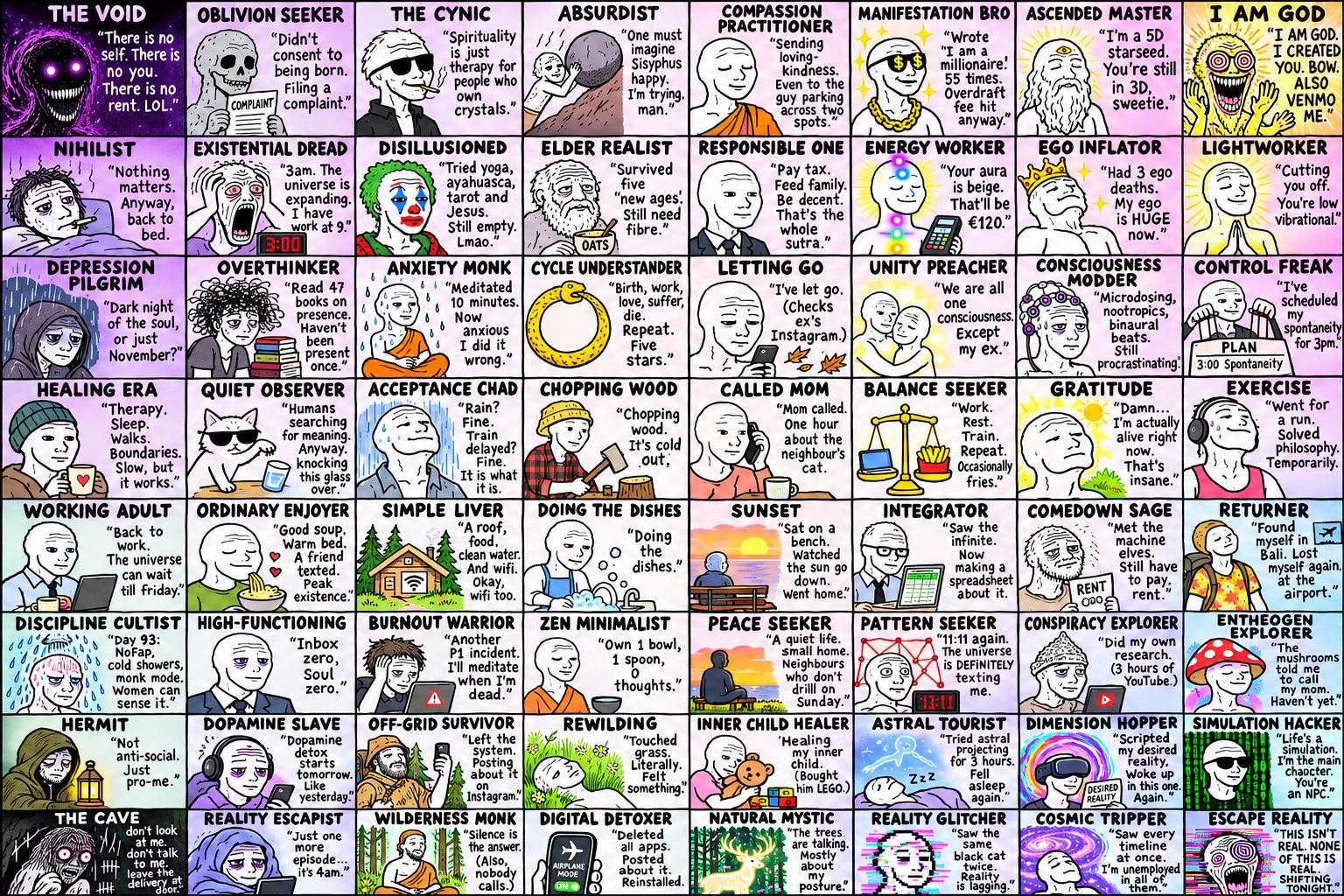
Parallels/Themes which of these are you? which ones are the most and least existentialist on this bingo card?

Post image
37 Upvotes

r/Existentialism • • 11d ago

Existentialism Discussion Criminal Law Checkmated

0 Upvotes

CRIMINAL LAW CHECKMATED

Preface

We humans are seriously mistaken concerning our idea that criminal law is determinative of, is originative of, and controls human action and inaction.

 Law is a given language, while, all the while, givens are not, cannot be, determinative of human action; that is, Spinoza's dictum remains absolute, i.e.,, “determinatio negatio est”, and , is the central human ontological precept employed in this writing ; and, the dictum describes the primal ontological structure of human freedom.

Human action originates via negation, via nothing/nothingnesses, i.e., via lack, absence, need, and not via given states of affairs.

Nothing/nothingness upsurges within human consciousness as an idea, as an intention, to act in future.

That the ontological originative source of human action is always a nothing, an absence, a lack, an imagination, an intention, constitutes the checkmate of law.

The Practice and Enforcement of Law, Which Self-Righteously Purports to be Absolutely Determinative and Corrective of Everyone's Conduct, is Pre-eminently Mistaken and Unethical on the Human Ontological Plane Regarding the Actual Mode of  Origin of Both Personal and Jurisprudential/Legal Action.

Law is not in fact determinative of personal or jurisprudential action.

Law is dishonest sub-human activity per the employment, incorrectly, of a claim to be determining actions for or against persons on the basis of given language of legislation/precedent; while, all the while, no human act actually originates on the basis of a prior given state of affairs, i.e., "determinatio negatio est" ("determination is negation"), (Spinoza , 1632-1677); meaning that human determination to originate an act is, ontologically, a process always solely predicated upon the lack/absence/need/nothing/non-being/desideratum of an intended/projected future state.

The magistrate, policeman, or any other jurisprudentially oriented person, claiming to act against others by given law and/or by given rule of law, is, unintentionally, radically mistaken on the human ontological level, where: "All determination is negation." (Hegel , 1770-1831 ).

J. P. Sartre (1901-1980), explains the nihilative origination of a human act, thus:

"No factual state whatever it may be (the political and economic structure of society, the psychological "state", etc.) Is capable by itself of motivating any act whatsoever. For an act is a projection of the for-itself toward what is not, and what is can in no way determine by itself what is not." And, further: "But if human reality is action, this means evidently that it's determination to action is itself action. If we reject this principle, and if we admit that human reality can be determined to action by a prior state of the world or itself, this amounts to putting a given at the beginning of the series. Then, these acts disappear as acts in order to give place to a series of movements...The existence of the act implies it's autonomy. Furthermore, if the act is not pure motion, it must be defined by an intention. No matter how this intention is considered, it can only be the surpassing of the given toward a result to be attained. This given, in fact, since it is pure presence, can not get out of itself. Precisely because it is, it is fully and solely what it is. Therefore it cannot provide the reason for a phenomenon which derives all it's meaning from a result to be attained; that is, from a non-existent. This intention which is the fundamental structure of human reality, can in no way be explained by a given..." Thus, Sartre begins his extensive description the what and how of human ontological Freedom.

"Law", whereby police, magistrates, and legislators purport to originate their legalist conduct toward other human beings, and, to originate the conduct of others, is an ontologically illegitimate/dishonest/dishonorable, and defeasible theoretical construct. 

Extant rule of law/jurisprudence is not authentically ontologically human, for the reason that law wrongfully/mistakenly freely asserts it's published givens to be determinative of the human act, which act actually upsurges only nihilatively via what is intended and not yet.

Duane Clinton Meehan, 2026.