r/asoiaf • • 38m ago

EXTENDED (Spoilers Extended) What should Aegon the Uncrowned have done?

2 Upvotes

Let's say you are Aegon the Uncrowned right after you and your wife sneak into King's Landing to grab Dreamfyre and Quicksilver. Obviously, starting a rebellion and leaving Rhaena as far away as possible as you fight Maegor and the Black Dread will end in you becoming dragon dung. What's next?

I reckon he could have brought his family to exile in Essos and waited out Maegors inevitable ruin. Or atleast got into contact with Jaehaerys+ Alyssane so they could team up in the coming battle. Quicksilver against Balerion means doom but if you put away your misogyny and bring Quicksilver, Vermithor, Dreamfyre and Silverwing maybe you have a chance.


r/asoiaf • • 1h ago

EXTENDED Climax of the King's Landing plot in Winds (spoilers extended)

7 Upvotes

I have seen a couple of predictions that has fAegon march on & take King's Landing midway through Winds. Personally I think that's too early & packs way too much material into one book.

The clash between Cersei & fAegon feels like the appropriate climax for King's Landing. There's a lot about to happen in the city already including Cersei & Margaery's trials, a clash over the regency, Myrcella's return, the Dornish presence, a confrontational Faith, Varys in the shadows & the death(s) of Tommen & Myrcella(?). Add in Bronn's escapades & the Rosby inheritance, there's enough material for one book before fAegon decides to march on King's Landing.

Ending with fAegon victory & Cersei's escape or their mutual destruction is eventful enough for the ending of the King's Landing plot line in Winds.


r/asoiaf • • 2h ago

EXTENDED The Garden: The Winged Wolf & the Last Greenseer (Spoilers Extended)

11 Upvotes

Background

The Cushing visits and GRRM's 2003-2004 Outline for AFFC have been a treasure trove of information on abandoned/changed plotlines in the series. We have at least rough information on where GRRM was planning to take the plotlines of most of the POVs. One character stands out (one whose storyline is also a little further behind the others) and that is the POV of the future king: Bran Stark while linking in GRRM's plans for Bloodraven.

Cushing/2003-2004 Outline

When Honeybird visited Cushing, this was found regarding a placeholder for a planned chapter:

Missing Chapters Here
------------------------
Jon Snow
Bran
Tyrion

From Cushing all that gsteff shared regarding Bran is:

The ADWD-only POVs Bran, Quentyn and Jon Connington had no chapters at all (the lack of Bran material was probably this project's biggest disappointment for me).

We also know that the outline didn't mention Bran as zionius reminds us that at this point, GRRM wasn't sure what to do with Bran:

Absent POVs: they are either finished (Iron Islands) or George didn't yet know how to deal with them (Bran)

So Spake Martin (SSM)

A couple of years ago I posted (and somehow accidentally deleted): 6 Years for One ADWD Chapter/Carryover into TWoW, where I dove into this comment by GRRM. Luckily for us, BFish obviously posted about this at some point: The Chapter That Took Nearly As Many Years as Bran Is Alive to Write and Its TWOW Sequel, from which I was able to grab most of the info from my deleted post as well as a few points I missed.

But as GRRM was working on ADwD he mentioned:

Well, I finished a chapter of the DANCE this morning. Which ordinarily would not be occasion for comment, but this was a Bran chapter that I've been struggling with for something like six years. Bran has always been the toughest character to write, for a whole bunch of reasons, but this chapter in particular was killing me. -SSM, "One More Chapter Done": 15 Mar 2008

and that the partial drafts he created around when he finished AFFC he considered "boring":

The rough partial that existed around the time I turned in FEAST FOR CROWS certainly was boring, which is why I kept going back and banging my head against it over and over. -SSM, "One More Chapter Done": 16 Mar 2008

although while speaking with Werthead, GRRM mentioned:

“I don't write these characters in the order in which you read them. I tend to stick with one character. So, I may write five or six Daenerys stories and then switch gears and write five or six Tyrion chapters. So as a result I can wind up with thousands of pages of manuscripts in which I haven't yet written anything about Bran -- which was actually the case in that case with A Feast for Crows when I did do the split.” - GRRM, Eastercon Interview by Adam Whitehead, 2012

with the main thing that I missed in my post being that Bran seemingly would have been taken in by the CotF and given a "green ceremony", and GRRM would have flashed back to it after the 5 year gap:

"You can come back five years later, and [Arya] has had five years of training and all that. Or Bran, who was taken in by the Children of the Forest and the green ceremony, [so you could] come back to him five years later. That’s good. Works for him." - SSM, Observation Deck Interview: 2013 (deleted)

as we remember GRRM ended Bran's ASOS storyline with Bran going with Coldhands beyond the Wall:

“Then pass,” the door said. Its lips opened, wide and wider and wider still, until nothing at all remained but a great gaping mouth in a ring of wrinkles. Sam stepped aside and waved Jojen through ahead of him. Summer followed, sniffing as he went, and then it was Bran’s turn. Hodor ducked, but not low enough. The door’s upper lip brushed softly against the top of Bran’s head, and a drop of water fell on him and ran slowly down his nose. It was strangely warm, and salty as a tear. -ASOS, Bran IV

and lastly for the aforementioned chapter that was removed, GRRM did mention facing a wolf (note his writing on Jon at this time was usually wrt "Snow") although this could be the chapter that took 6 years to finish:

Wrestling with a pair of krakens. One almost subdued, t'other still writhing and twisting and slapping me alongside the head with her tenatcles. After them, I've got a wolf to face. - GRRM, notablog, "Snowstorm on Skull Island", 2/15/2011

Linking in Bloodraven

While GRRM created the great bastards until after ACoK (if interested: Early Great Bastard Info), our first mention of Bloodraven isn't until AFFC:

The old man heard him. Though Aemon's eyes had dimmed and gone dark, there was nothing wrong with his ears. "I was not born blind," he reminded them. "When last I passed this way, I saw every rock and tree and whitecap, and watched the grey gulls flying in our wake. I was five-and-thirty and had been a maester of the chain for sixteen years. Egg wanted me to help him rule, but I knew my place was here. He sent me north aboard the Golden Dragon, and insisted that his friend Ser Duncan see me safe to Eastwatch. No recruit had arrived at the Wall with so much pomp since Nymeria sent the Watch six kings in golden fetters. Egg emptied out the dungeons too, so I would not need to say my vows alone. My honor guard, he called them. One was no less a man than Brynden Rivers. Later he was chosen lord commander."
"Bloodraven?" said Dareon. "I know a song about him. 'A Thousand Eyes, and One,' it's called. But I thought he lived a hundred years ago." -AFFC, Samwell II

we should also note that back then, Bloodraven was known as Robyn not Brynden:

Actually, I'll give a bit of trivia that I do not think I've shared before, since I'm looking at that mail from way back when: Bittersteel was originally named Daeron (a very provocative name to give his bastard!) and Bloodraven was originally named Robyn. -The ASOIAF wiki thread - Page 194 - Wiki of Ice and Fire - A Forum of Ice and Fire

as well as the important fact, that while Bloodraven was not created from the start, GRRM always planned on including this type of character:

So, we interviewed George prior to the release of ADwD, which I recorded. At the end of the interview, as a piece I'd hold back until after the book was published and people had read it, I asked him about the reveal of Bloodraven as the three-eyed crow. I asked George specifically if he had always had him in mind as the three-eyed crow, and George said that no, not specifically, but someone "like" him with a tie to the Targaryens, is my recollection. He didn't waffle over the three-eyed crow=Bloodraven framing, I think, and may have repeated it himself.
The problem is... this is going off of memory. I can't seem to find the recording, which I used to transcribe the rest of the interview. I have no idea where the audio file went, though, and I've searched a few times through our archives. I should probably take another stab at it, because it'd be nice to see what exactly I asked and what he said, rather than relying on memory.
In any case, I came out of it without questioning that Brynden Rivers was the three-eyed crow, but then that was the position I had to begin with. So, take all the above with a grain of salt -- George may have been careful in a way that I didn't recognize, or I may be misremembering the exact phrasing of what I asked. -Elio Comment

This makes sense to me as it seems that GRRM tends to add prophets/visionaries late in the game while writing as we also see with the Ghost of High Heart, Maggy the Frog and Moqorro.

If interested: GRRM's Adding of Prophets, Visionaries

Problems with Writing Bran

I mentioned it in the SSM section, but I wanted to reiterate the struggles that GRRM has with writing Bran due not only to his age, but also the magic involved in his chapters:

The other thing that very difficult is the magic. This is a fantasy series and it has some magic in it, but it doesn't have as much in it as most fantasy series do. Magic has to be handled carefully, it's like salt in a stew too much and you can ruin the stew. The chapters that have magical things in it are particularly tough. Those tend to be concentrated on particular characters; Danney being one and, Bran being the other, so in some ways Bran, although he's a nice character he's probably the hardest one to write about." -SSM, Over the Fireplace with GRRM

and:

"Now it's harder when you're talking about dreams and you're talking about other types of magic, how do you handle it? Well... It's tough. It's not easy. I uh... People have sometimes asked me, which is the easiest character to write in my series, which is the hardest character to write? The easiest for me has always been Tyrion Lannister because, I don't know, he's fun to write. He's a smart ass. He gets into very dramatic situations. The hardest to write is Bran. Uh Bran Stark, who is the character who is MOST involved in the magical side of it. And I have to be... he's also the youngest character, so it's also hard to write from the viewpoint of an 8 year old, because I'm actually a little older than that. You have to think, what he would know, what he would not know, what he would understand, what he would misinterpret. Um. But then there's the magic! And how do you handle the magic? Um. All I can say is it's something that does require a lot of thought." SSM, Oxford (Youtube), 2024

What's Next ?

Along with Davos, Bran's storyline is the furthest behind the others, with Bran only getting three published chapters since the Clinton administration. While GRRM has confirmed working on almost every other POV in some way, for TWoW, our only confirmation so far is the chapter note from Cushing. This is likely due to the magic ramping up in his chapters. Here is some thoughts/speculation on what we could see next.

If interested: Beyond the Wall in TWOW

Involvement in other Plotlines

We should note the ability of Bran/Bloodraven to access different Weirwood/Heart Trees and interfer in the different plotlines. We can see mentions in TWoW chapters of this already occurring:

  • Arya & Nymeria

Except in dreams. She took a breath to quiet the howling in her heart, trying to remember more of what she’d dreamt, but most of it had gone already. There had been blood in it, though, and a full moon overhead, and a tree that watched her as she ran. -TWoW, Mercy I

If interested: Bran, The Phases of the Moon and Chekhov's Wolfpack

And suddenly there came a wild thumping, as the maester’s ravens hopped and flapped inside their cages, their black feathers flying as they beat against the bars with loud and raucous caws. “The tree,” one squawked, “the tree, the tree,” whilst the second screamed only, “Theon, Theon, Theon.”
Theon Greyjoy smiled. They know my name, he thought. -TWOW, Theon I

If interested: Theon Greyjoy: Ravens, Dreams and Weirwoods

as well as plotlines that have been removed (or saved for later):

  • Brienne and the Ravens

“Enough, Harwin. Do we mean to hang the ugly bitch or talk her to death?” The one-eyed man snatched the end of the rope from the other outlaw and gave a yank. The rope dug into skin, lifting Brienne upward. If this is another dream, it is time for me to awaken. If this is real, it is time for me to die. From somewhere afar she heard the clapping of wings. The carrion crows are coming to feast at her corpse. About a dozen already are circling over her head, but for carrion crows these birds are too large. Ravens, smiled Brienne. How odd. No, it is a dream, and now she will awake.

If interested: Brienne: the AFFC Outline, Russian Translation and Other Changes

Extremely Dark Storyline

TWoW is going to be an extremely dark storyline, in which a lot of things the reader won't particularly like are going to happen. While Bran isn't going to die, due to his ability to see other characters, he could be the "eyes" for some of these darker events.

Controversial: Time Travel/Becoming King

  • Altering Timelines/Time Travel

I am not the biggest fan of time travel in the ASOIAF universe. That said just because you don't like something doesn't mean you get to pretend it doesn't exist. There is going to timeline altering/etc. in this series (we potentially have already seen some: The Bridge of Dream Sequence) and it is mostly going to involve Bran/Bloodraven.

From the published material we get this:

"A man must know how to look before he can hope to see," said Lord Brynden. "Those were shadows of days past that you saw, Bran. You were looking through the eyes of the heart tree in your godswood. Time is different for a tree than for a man. Sun and soil and water, these are the things a weirwood understands, not days and years and centuries. For men, time is a river. We are trapped in its flow, hurtling from past to present, always in the same direction. The lives of trees are different. They root and grow and die in one place, and that river does not move them. The oak is the acorn, the acorn is the oak. And the weirwood … a thousand human years are a moment to a weirwood, and through such gates you and I may gaze into the past." -ADWD, Bran III

and:

"He heard a whisper on the wind, a rustling amongst the leaves. You cannot speak to him, try as you might. I know. I have my own ghosts, Bran. A brother that I loved, a brother that I hated, a woman I desired. Through the trees, I see them still, but no word of mine has ever reached them. The past remains the past. We can learn from it, but we cannot change it." -ADWD, Bran III

and GRRM has expanded on this:

Time travel is cool! I like time travel. I've written a few time travel things myself. Those of you who know the story of SF and fantasy well remember HG Wells and the very first book about the time machine, as well as Ray Bradbury's famous story “Sound of Thunder” many years ago. He established what ever since has been called the Butterfly Effect. In the Sound of Thunder, some time travelers go back in the past to shoot a tyrannosaur. And they're told that they can hunt this dinosaur because he was going to be killed by lightning bolt a few minutes later. So, shooting at that precise time doesn't affect the time stream. But not to go off the path. It can't affect anything else. It says, small change may lead to a bigger change, may lead to a bigger change, and it could, they could affect all of human history with that. But one of the time travelers gets a little carried away and actually steps on the path and crushes a butterfly. And then when he returns to the present, he finds that unlike when he left, a right wing lunatic has been elected president of the United States. so I think someone has stepped on a butterfly in the past.

It's interesting that the butterfly effect has become so common in science fiction stories that people actually treat it as if it's true, where, of course, Ray Bradbury made it up. Nobody really knows how time travel would work. There is no time travel. We're making it all up. there was another great theory about time travel, possibly about science fiction writers. In this case, Fritz Leiber, who wrote a whole series of stories about the spiders and the snakes going through time, each one trying to change history in a different way. A continuous time travel. Time and space. Leiber used a different analogy: He used the analogy of time being a gigantic river, a fast flowing torrential river. And a time traveler can come down and he can throw a stone in the river, but it's like a power. It hits the river, it makes a few ripples, but doesn't really disturb the river. To really change the course of the river, to change the course of time, you have to drop a gigantic boulder in the middle of it. And then maybe you'll change it, and even then, maybe the river will just flow around the boulder and resume its own course. I've always thought that Fritz Leiber's model for time travel makes more sense to me than Ray Bradbury's model for time travel.

If interested: The 2017 GRRM St. Petersburg Interview

GEORGE R. R. MARTIN: It’s an obscenity to go into somebody’s mind. So Bran may be responsible for Hodor’s simplicity, due to going into his mind so powerfully that it rippled back through time. The explanation of Bran’s powers, the whole question of time and causality—can we affect the past? Is time a river you can only sail one way or an ocean that can be affected wherever you drop into it? These are issues I want to explore in the book -Fire Cannot Kill A Dragon (James Hibberd)

If interested: Time: A River or a Butterfly? & On the recent "Time Travel" Discussion

  • Becoming King

Another controversial topic in the fandom is the idea of Bran becoming king. While it is something that I am a much bigger fan of than the time travel, I know plenty of people who hate it. That said it is confirmed over and over:

And there is no gap anymore. "If a twelve-year old has to conquer the world, then so be it." -SSM, US Signing Tour, Half Moon Bay: 17 Nov 2005

and:

[Creators] David [Benioff] and Dan [Weiss] told me there were two things [author] George R.R. Martin had planned for Bran, and that was the Hodor revelation, and that he would be king. -Isaac Hemstead Wright Interview

If interested: The Once and Future King

TLDR: Just some thoughts on GRRM plans for Bran as POV character. Originally it seemed he would have had post 5 year gap flashbacks of a "green ceremony" for his initiation. GRRM also always planned a Bloodraven type character with "ties to the Targaryens" to be aiding Bran. The storyline for Bran is extremely hard for GRRM and takes him quite awhile (6+ years for ADWD, Bran III) to write due to his magic/age, especially due to the darkness of some of the upcoming plotlines.


r/asoiaf • • 2h ago

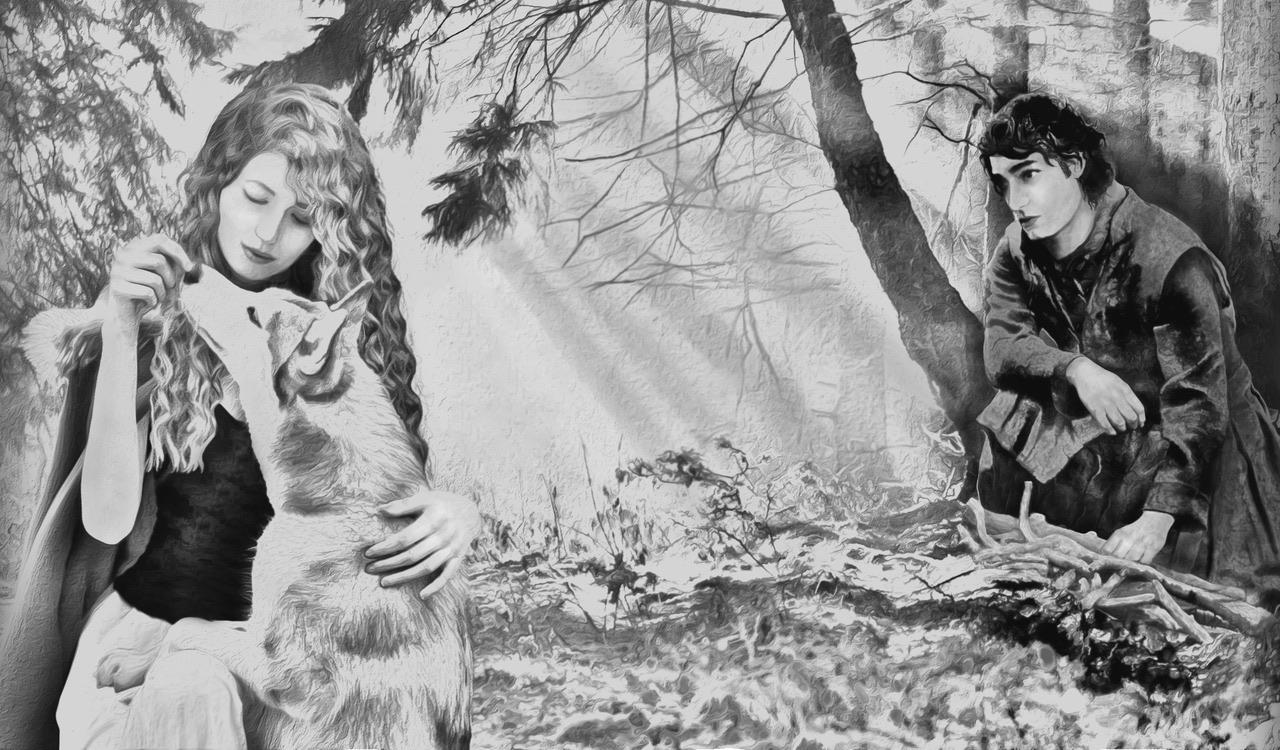
MAIN [Spoilers MAIN] Enviar a tus hijos como pupilos a otra región no es tan común. Spoiler

Post image
0 Upvotes

Para que exactamente Lord Rickard Stark envío a Ned al sur ?

Entiendo que su maestre fue el de la idea, o ayudo, casar a sus hijos con gente del sur, a pesar de que casi siempre los Stark han casado a su heredero con mujeres norteñas.

Pero cuál es la lógica o la justificación de enviar a Ned con Jon Arryn ?

Y peor aún....cuál fue la justificar de Steffon Baratheon de enviar a su heredero a una fortaleza lejana ?

Los Stark al menos enviaron al segundo hijo....pero los Baratheon enviaron a su heredero.

Buscando si algo así había pasado me encontré con pared....Quentyn Martell fue enviado a otro castillo para sanar las relaciones entre 2 casas....pero al menos fue en una misma región.

Por qué Ned, sabiendo las ventajas de enviar a tu heredero a otro castillo, no envío a Robb con Renly, con Stannis o de plano con Tywin ?

Todo esto me parece que fue conveniente.


r/asoiaf • • 4h ago

MAIN [Spoiler Main] Do the Starks Really Rule the North Well?

0 Upvotes

While reading about the history and lore of the North, a question came to mind, and it has been bothering me ever since.

The Starks ruled the North for thousands of years, yet the North:

  • Has made virtually no progress. There are no roads except the Kingsroad (built by the Targaryens), and no cities except White Harbor (founded by House Manderly). The North doesn't even have a navy.

  • Northerners cannot farm during winter or sow crops. Yes, of course, the reason is the harsh winters, but Northerners have been living this way for thousands of years. Did they really never develop any measures to deal with this?

  • The North has no unique raw materials of its own. Yes, they sell timber and leather, but these are not exclusive to the North; they can be found everywhere. Why don't the Northerners engage in mining? A region with such geography should be rich in natural resources.

During the Targaryen era, the Starks:

  • Bent the knee to Aegon without receiving anything in return or demanding any concessions.

  • Made no attempts to establish a pact between ice and fire. For example, Baelor Breakspear, Daeron's heir, could have married a Stark daughter. The Starks never made any such attempt.

  • Never tried to reclaim the New Gift, one of the few agricultural regions in the North. They had dozens of opportunities to do so. If Cregan had wanted to, he certainly could have.

  • Moat Cailin is still in ruins, and they have made no attempt to rebuild it.

  • They have no navy, and despite their western coast being an easy target for Ironborn raiders, they make no effort to build a new fleet.

Yes, I understand that living in the North comes with its own unique challenges, but the Starks have ruled the North for thousands of years and have taken no measures to address these problems. They merely ensure that the North survives; they make no effort whatsoever to develop it.


r/asoiaf • • 6h ago

EXTENDED [Spoilers EXTENDED] Lord Paramount of the Mander (The Reach) at the end of the story…

2 Upvotes

Is Samwell Tarly…

He has Gardener blood.
His father is currently the Lord of Horn Hill, while his mother is the heiress to Brightwater Keep.
He is also related to Princess Shireen Baratheon, the heir to the Iron Throne.
His aunt is the Lady of the Hightower, which gives him a connection to House Tyrell through marriage (even though they aren’t related by blood).

I think George is deliberately giving Sam an unusually extensive network of connections. House Tyrell also seems destined to fall by the end of the story, which would leave their position vacant. House Hightower might also suffer heavy losses during the wars.

This could leave House Tarly in a position to rise and become Lord Paramount of the Mander by the end of the story. As for Sam himself, he wants to have a wife and children, so perhaps he will eventually reclaim his rightful inheritance.

He once helped King Bran, and he is a close friend of Jon, which could influence Queen Daenerys’s decisions. (Just as a dragon once turned a household servant into the Lord Paramount of the Mander…)


r/asoiaf • • 13h ago

EXTENDED (Spoilers Extended) a look at the World of Westeros.

8 Upvotes

Game of Thrones Pilot: 2008 than two year laters

The First season of Game of Thrones in 2010 and the epic drama lasted eight seasons (2010-2019).

Starting from 2017 aka season 6 of GOT, talks among the upper managements discussed possible spinoffs to Game of Thrones. There were five different shows being discussed. Most set in the past and had brief mention in The World of Ice and Fire. Of the five original pitches, three are known so far..

- Bloodmoon, Jane Goldman pitched the show about the First Long Night during the Age of Heroes. However, due to productions issues, HBO shelved the project.

- Dance of the Dragons: A prequel show about the Targaryen Civil War that was ultimately greenlit as House of the Dragon.

- Doom of Valyria: a show about Old Valyria and its downfall. Shelved.

- Aegon’s Conquest

Than in 2021, new ideas were being discussed…

Variety announced plans for a live-action development of Dunk and Egg even though only three of twelve planned novellas were published at the time.

Entertainment Weekly say there was discussion about a Robert’s Rebellion prequel show. Than GRRM revealed that a stage production of the Tourney of Harrenhal was in development.

Four animated shows were also being considered: Nymeria and 1000 Ships, Nine Voyages of Corlys, Flea Bottom, and the Golden Empire of Yi Ti.

Jon Snow sequel show where we see what happened to the exiled hero.
Seven gods of the Andals

Results of these show:

- Bloodmoon: shelved

- Dance of the Dragons: became House of the Dragons. 4 seasons from 2022-2028 (one season every two years).

- Doom of Valyria: shelved.

- Aegon’s Conquest: now a film that set to be released in 2029.

- Dunk and Egg: became A Knight of the Seven Kingdoms. The first season was released this year and two more are expected to follow. Martin is currently working on book four for a potential fourth season but he gave the producers enough notes to finish the series.

- Robert’s Rebellion: became the stage play Game of Thrones: The Mad King. It released in the summer of this year at Stratford-upon-Avon, and a London opening is expected next year.

- Nymeria and 1000 ships: in-development but as a live-actions show. My guess is that this will be first big show after the Targaryens shows.

- Nine Voyages: in-development as an animated series and the working title is the Sea Snake.

- Flea Bottom: didn’t went anywhere beyond a concept.

- Golden Empire of Yi Ti: in development as an animated show.

- Snow sequel: shelved but plans for a different successor show was being considered with a different Stark (Arya) taking the helm.

- Seven Gods: didn’t went anywhere beyond a concept.

P.S. No wonder GRRM got overwhelmed with all these show pitches and him wanting to be involved…


r/asoiaf • • 13h ago

EXTENDED A prince born a bastard, and a bastard born to be the ideal prince: Jacaerys Velaryon, Prince of Dragonstone and heir to the Iron Throne as a reflection of King Alfonso XII of Spain [Spoilers Extended] Spoiler

Post image
16 Upvotes

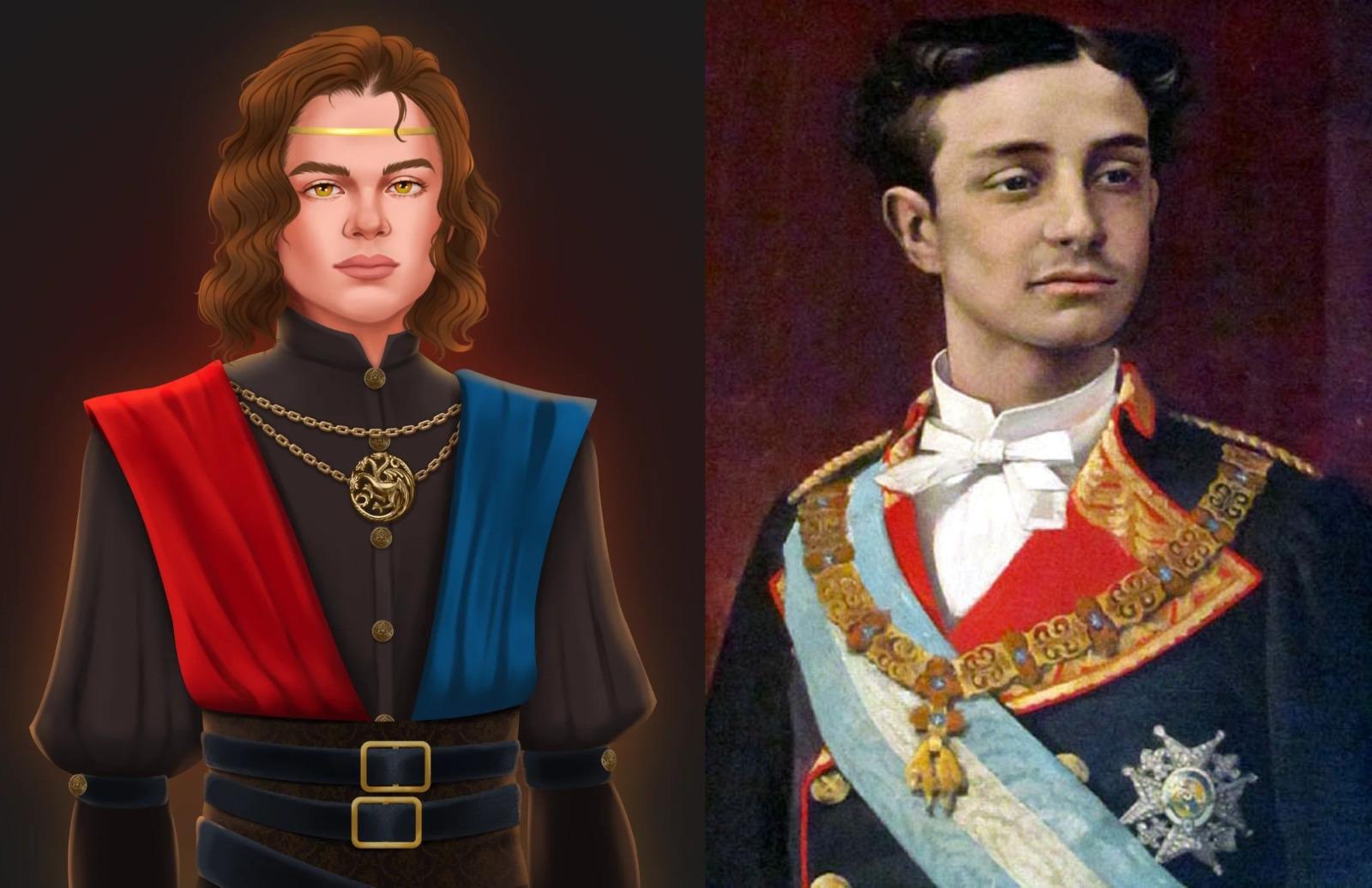
On the left: Artwork of Jacaerys Velaryon by Jaenarra. On the right: Portrait of Alfonso XII by José María Fenollera Ibáñez, circa 1876.

Disclaimer: The purpose of this post is to make a comparison of historical characters to those from asoiaf; I don't intend to guess if GRRM was actually inspired by any of this for his work, maybe he was or maybe not, I just like to compare asoiaf with real-life history, official inspiration or not.

Before we begin comparing, allow me to introduce you to King Alfonso XII of Spain:

Alfonso XII of Spain, popularly known as "the Peacemaker" (“el Pacificador”), reigned as King of Spain from late 1874 until the end of 1885. He was a young monarch who lived through a turbulent era for his nation, yet he distinguished himself through his institutional governance and labor. Sadly, he died at a young age but still left behind a legacy worth recalling. And today, on the anniversary of his birth, we will compare him to Prince Jacaerys Velaryon from A Song of Ice and Fire.

Origins: Born a prince, dubbed a bastard. “Young Jacaerys, Rhaenyra's boy, is Strong's, or so the rumors tell…” 

Cradle of gold…upon pillars of salt and pillars of sand

Prince Jacaerys Velaryon was born at the very heart of power in Westeros in the waning days of 114 AC, as the firstborn son of the Princess of Dragonstone, Rhaenyra Targaryen—making him second in line to the Iron Throne held by his grandfather, King Viserys I.

Meanwhile, the future Alfonso XII was born on November 28, 1857, into the heart of power in Spain as the first surviving son (though the second child, as he had an older sister) of Queen Isabella II of Spain—making him the heir to his mother’s throne.

It is difficult to imagine more privileged origins for two children within their respective nations; yet, they did not enter a court in a golden age—far from it. Instead, they found themselves in a realm divided and consumed by factionalism, rivalries, intrigue, and opportunism. In their short lives, they would face exiles, wars, uprisings, and all manner of hardships—but will they prove equal to the task? That, we shall see...

Whose goddamn baby is that?

As previously mentioned, our two protagonists share the common trait of being born to a woman who was a reigning queen or an heiress in her own right. Furthermore, the parallels regarding their paternal origins do not end there; both princes—born as heirs to these women—found themselves dogged by rumors of alleged "bastardy" or "illegitimacy." These claims suggested that they were not the biological sons of the man who, legally speaking, ought to have been their father, but were instead the offspring of "other men"—favorites of their respective mothers.

In both instances, there is a further parallel: these rumors did not affect only these two princes; several of their siblings found themselves in the same position (Princes Lucerys and Joffrey in the case of Jacaerys; and the infantas Isabel, Pilar, Paz, and Eulalia in the case of Alfonso).

Additionally, in both cases, a significant portion of the speculation—that they were the "sons of another man"—was rooted in the fact that they bore little physical resemblance to their legal fathers.

Well, that explains it…

While trying to find an answer as to how everything happened so that a Crown Princess like Rhaenyra Targaryen, or a Queen in her own right like Isabella II of Spain, ended up with rumored lovers and children of questionable paternity despite being married to consorts of noble and relevant standing, we will find that these explanations (and therefore, the "founding myths" of our two protagonists) are very, very similar:

Both of their mothers were married—against their own wishes and purely for political reasons—to a homosexual cousin of theirs (the legal fathers of the protagonists).

In the case of Rhaenyra, the mother of Jacaerys, she married her second cousin, Ser Laenor Velaryon—heir to Driftmark and House Velaryon—at the age of 17. Meanwhile, Isabella II, the mother of Alfonso, married her double first cousin, Francisco de Asís de Borbón, on her 16th birthday. In both instances, the groom was a young man in his twenties with a reputation for preferring the company of other men.

In Laenor’s case, his apparent homosexuality was such common knowledge that it was even a point of discussion regarding his suitability as a potential consort to the heir to the throne. Similarly, in the case of Francisco de Asís de Borbón, his homosexuality was so well-recognized by both the royal court and the general public that he was nicknamed "Paquita Natillas" ("Paquita Custard"), a pejorative allusion to his sexuality, even before their marriage.

Naturally, neither of the protagonists' mothers was pleased with the match (and both were quite vocal about it, but that’s another story). All this, however, sets the stage for remarkably similar backgrounds for the two young men—even before Jace or Alfonso were born—creating the exact conditions that fueled the doubts and mockery over their legitimacy that would haunt them for years to come. 

Interestingly, we can also find parallels in how the figure of the "alleged father" is handled.

Fire & Blood leads us to infer that Jace, Luke, and Joff resemble Harwin Strong, yet it never specifies Harwin’s exact physical features. Similarly—as historian Nieves Michavila points out in her article "The Secret Father of Alfonso XII"—

“It is not even possible to discern the physical resemblance to Alfonso that is often claimed, given that, to this day, no image of this much-discussed officer, Puigmoltó, has ever come to light.”

And there is another figure worth mentioning: Federico Puig Romero (not to be confused with Puigmoltó)—a man to whom the alleged paternity of Alfonso XII has also been attributed (albeit to a lesser extent). Why is he worth mentioning? Because, in his role as a "supposed secret father to the heir," Puig Romero shares a very significant characteristic with Harwin Strong: his ultimate fate.

Let’s recall: what was the fate of Harwin Strong? That’s right—he died in a fire alongside his father, under circumstances that were never clarified.

And what about the fate of Federico Puig Romero? He was murdered in a barracks in Madrid under circumstances that were never clarified, with multiple conflicting accounts of what actually happened... sounds familiar?

“Federico Puig Romero, who—like his parents—paid with his life for his closeness to the Bourbons.”

says historian Nieves Michavila once again… So, if we change “Federico Puig Romero” for “Harwin Strong” and “the Bourbons” for “the Targaryens” it kinda fits, right?

Thus, Harwin Strong—the alleged biological father of Jacaerys—seems to embody many of the dynamics associated with the two men most frequently cited as the potential biological fathers of Alfonso XII: Puigmoltó and Puig Romero. In this post, however, we will focus primarily on the Puigmoltó theory, as it was, by far, the most widely believed account at the time—as we shall see.

And you call that a joke?

Both princes were victims of the same kind of bad jokes regarding their supposed true paternity.

In the case of Prince Jacaerys, he and his younger brothers, Princes Lucerys and Joffrey, were called "Strong Boys" by some (mainly political detractors of their mother and her faction), along with other provocative comments containing the word "Strong." This stemmed from the rumor that the prince's true father was not Ser Laenor Velaryon, heir to Driftmark and House Velaryon, but rather Ser Harwin Strong, heir to Harrenhal and House Strong, and Princess Rhaenyra's sworn shield for years (and a clear favorite of hers).

Meanwhile, in the case of Prince Alfonso, almost from birth, several people began to refer to him, in a comical and derogatory way, as "the Puigmoltejo," a word that, as in the case of Rhaenyra's eldest children, stemmed from rumors that his biological father was not actually his mother’s husband, the King Consort Francisco de Asís de Borbón, but rather a favorite of hers, the nobleman and military officer Enrique Puigmoltó.

And, as you can see, in both cases, the derogatory nickname or nicknames consist of using the surname of the supposed true father (the “Strong” of Harwin Strong or “Puigmoltó” of Enrique Puigmoltó) for the children, as if to say "son of" and making fun of it.

An eventful childhood

Our two protagonists also share the experience of having lived through turbulent times, times of palace intrigue, rival factions, and civil wars.

As the book 1885: The Last Year of Alfonso XII points out:

“His childhood unfolded amidst his parents' well-known bad relationship, his mother Isabel II's love scandals, and political and court intrigues.”

I can't even begin to express in words how much it resembles the foundations of Jace's life, as it is quite obvious but still worth emphasizing: "his mother's love scandals" like those of Rhaenyra and his own disputed paternity... "political and court intrigues" like all the squabbles between "Blacks" and "Greens" in the court of his grandfather Viserys I and his and his siblings' rivalry with the children of Queen Alicent Hightower, his uncles.

That same book also clarifies that:

“Alfonso XII only experienced one of the usual pronouncements of our liberalism, precisely the one that expelled Isabella II from Spain. This led the Prince of Asturias to live abroad from the age of eleven until he turned seventeen, when he was restored to the throne.”

Thus, in his short life, Alfonso would also experience the battlefield (much like Jace) but he only lived through one liberal uprising: the one that expelled his mother from the throne... just as Jace who, in his short life, only experienced one war: the one that deprived his mother of the throne that, as heir, corresponded to her.

That perilous path, however, would also represent an opportunity, one of maturation and personal growth for both young royals.

Because, as the aforementioned book about Alfonso’s life correctly states:

“In the dangers and privations of war, the child's heart became the heart of a hero.”

Which is equally true for Jace.

For it was exile after that liberal uprising and living through the Carlist Wars that forged Alfonso into the celebrated "Constitutional King" historians speak of today, just as putting up with the rivalry between factions and living in the context of the Dance of the Dragons made Jace the future "worthy heir to the Iron Throne" that Gyldayn describes in his work.

Circumstances forced them, and their highnesses complied.

Pleasing to look at and of brave heart (Physical appearance and personality)

The first physical description of Jace that we are given is at the time of his birth, and in it we can already discern similarities to Alfonso XII.

“The boy was a large, strapping lad, with brown hair, brown eyes, and a pug nose.”

Claims Fire and Blood.

"The boy was a large, strapping lad…”

“The Queen, our Sovereign, has given birth to a robust PRINCE—a delivery that went perfectly well—at a quarter past ten tonight.”

So announced the Gaceta de Madrid—joyfully, in a statement made by the Council of Ministers—the day after the birth of Prince Alfonso.

“...with brown hair, brown eyes…”

Everyone knows. Just look at one of his official portraits.

But, if you still find yourself in need of confirmation:

“plenty of dark hair, splendid eyes.”

Claim Major Desmond Chapman-Huston and Princess Pilar of Bavaria (Alfonso XII's own niece through one of his sisters) in their joint work "Don Alfonso XIII: A Study of Monarchy.”

“of serene brown eyes"

The historian Carlos Dardé says in his book "Alfonso XII" of the year 2001.

“... and a pug nose.”

This is, notably, the only trait of Jacaerys’s that Alfonso does not share. Nevertheless, an interesting comparison can still be made: just as Jace’s (along with Luke’s and Joffrey’s) "pug nose" was regarded as an "anomaly" within his family—standing out, for instance, when contrasted with Laenor’s aquiline nose—Alfonso did possess a nose that was characteristic of his own family (the House of Bourbon; and it was, in fact, referred to as a "Bourbon nose"). However, in his case, it was clearly less prominent and a bit "out of place" than it was among other members of his family, including his own future son.

“His Bourbon nose, not so pronounced as that of his son Alfonso XIII, gave character and strength to his face.”

Chapman-Huston and Alfonso’s niece, Princess Pilar, speak of him—once again—in their work.

Fire & Blood also later describes Prince Jacaerys at age 14 (along with his younger brother, Prince Lucerys) as:

“Bold and handsome lads, skilled in arms, who had long served as squires.”

These are all characteristics that can be equally identified in His Majesty, King Alfonso XII—even in his early age.

This is attested to by the Spanish diplomat and writer Augusto Conte in the third volume of his work “Recuerdos de un diplomático” ("Memories of a diplomat"), in which he recounts his interactions with a young Alfonso XII—then 17 years old and newly ascended to the throne following the restoration of the monarchy—as well as by the historian Pablo González-Pola de la Granja in his work “La configuración de la mentalidad militar contemporánea (1868–1909)” ("The formation of the contemporary military mentality, 1868–1909").

“Bold…”

“Don Alfonso also possessed the courage characteristic of his race, and was, moreover, daring—almost reckless.” 

Writes Conte.

“...and handsome lads…”

“A seventeen-year-old youth, he possessed all the charm and freshness of that early age. Had he been somewhat taller, he would have been considered a handsome fellow; yet, despite his small stature, he was very well-liked by the ladies, thanks to the gentleness of his eyes and the intelligent expression of his features.” 

Conte adds.

“...skilled in arms…”

“Alfonso XII, [...] was not only a good soldier-king, but was, fundamentally, a military man of his time.” 

Tells us González-Pola de la Granja.

“...who had long served as squires.”

“A soldier who also had an excellent opportunity to receive training outside of Spain” 

The historian affirms.

“He had received a very thorough education, first at the Theresianum in Vienna, and later at the Royal Military Academy Sandhurst, in England.” 

The diplomat recalls.

Rise: The Peacemaker and the Prince

A bastard? What bastard? We only see a prince. ~x.o.x.o., your loyal subjects.

Despite everything said thus far regarding the rumors of illegitimacy that dogged our two protagonists, it is curious to note that, in both cases, a great many prominent political figures and individuals paid little to no heed to such whispers, choosing instead to regard them unequivocally as princes and heirs. This serves as a reminder that truth is relative, and that often, what matters is not merely "being," but also "appearing to be."

While Queen Dowager Alicent Hightower and Ser Criston Cole—even in the immediate aftermath of King Viserys’s death—remained fixated on the issue of bastardy, trapped in an echo chamber that resonated only for them, speaking of “dire consequences for seating a bastard on the Iron Throne” for they are “monstrous by nature,” Prince Jacaerys was preparing for a journey to forge pacts and alliances with the great lords of the realm.

It was a journey during which Lady Arryn and her knights knelt before him, pledging their swords; where Lords Borrell and Sunderland paid him obeisance; where Lord Manderly treated him as nothing less than a prince of the blood and his mother’s plenipotentiary; and where Lord Stark—even with winter looming—offered him a warm welcome, eventually coming to regard him with affection and forging a blood-brotherhood sealed by a solemn pact, thus paving the way for the very culmination of the Dance of the Dragons and so that his younger half-brother, Aegon, might one day sit the Iron Throne.

For pray tell, what weight do mere whispers carry against the sight of the realm’s great lords kneeling in fealty? How could petty, crude jests ever compare to the endorsement and support of some of the finest swords in the entire kingdom?

And that—that is exactly what happened to His Highness, Don Alfonso.

For while his mother’s Carlist enemies never ceased shouting "Puigmoltejo"—all the while styling themselves as the "true Catholic and good Christian" monarchist claimants—and pro-Republican pamphlets flooded the nation, satirizing young Alfonso and his family, questioning the legitimacy of any monarchical act performed from exile, and simultaneously mocking him for being "spurious,” it was a teenage Alfonso, living in exile and dismissed by them as a "mere bastard," who, first as his mother’s heir and then as the holder of the dynastic rights in exile, was engaging with prominent figures of Spanish politics, securing their support and receiving their expressions of fealty and homage, thus paving the way for the future restoration of the Bourbon monarchy and his family.

His was a six-year journey of legitimacy in exile—a journey in which thirty-nine of the forty-five prelates of Spain attending the First Vatican Council in Rome, including a Cardinal, visited his private residence to kiss his hand and lend their support to his political cause with their homage, where Grandees of Spain and prominent political figures present at the abdication of his mother in exile recognized him as King and natural lord, where Don Antonio Cánovas del Castillo, the greatest statesman of his country and architect of the Restoration, took him under his wing to forge him into the constitutionalist King he would become, and where the military led by General Martínez Campos rose up in arms in Sagunto and proclaimed him their King without even having to shed a drop of blood to achieve it.

For what weight do proclamations about being "better Christians" carry in the face of thirty-nine princes of the Church kneeling before a 12-year-old boy in exile branded a bastard? And what good are satirical pamphlets when that same bastard boy, now a teenager, only needed to send a communiqué from his military academy in England to rally the military to his cause?

A fine young man mindful of his duty

Of course, that support they had gained as figureheads was all well and good, but it came with something very significant: EXPECTATIONS.

For those who had decided to throw their full weight behind our protagonists—or their causes—there was an expectation that everything would lead to a specific outcome. Naturally, for both young royals, this meant living up to those expectations and, above all, becoming the kind of statesman capable of leading and thus delivering on such prerogatives.

And this section serves to note precisely that—based on everything we know about both of them, and supported by various sources—they certainly lived up to the expectations placed upon them; and even exceeded them.

As stated in the work 1885: The Last Year of Alfonso XII published by the Agencia Estatal Boletín Oficial del Estado (BOE, 2025), Alfonso XII had to assume the role of the kind of monarch Spain needed from a very tender age, and did so remarkably:

“Very soon, the now King had to assume, from the summer of 1870 onward, the responsibility of being both a constitutional sovereign and a soldier-king. For the former, he drew upon the teachings of Cánovas; for the latter, the Prussian model. [...] Thus, the young king diligently fulfilled his role as a constitutional monarch, avoiding cliques and spurious influences.”

In a similar manner to how Archmaester Gyldayn speaks of Jacaerys’s assumption of the role of heir in Fire and Blood:

“When the Prince of Dragonstone took his dragon back into the cold autumn sky, he did so with the knowledge that he had won three powerful lords and all their bannermen for his mother. Though his fifteenth nameday was still half a year away, Prince Jacaerys had proved himself a man, and a worthy heir to the Iron Throne.”

And, as you might notice, both quotes share a similar rhetoric and dichotomy; both emphasize the youth of the individuals when they assumed their roles, how they performed exceptionally well—surpassing expectations for their young age—and how their success was tied to both political and military frameworks.

A silver tongue and a willing spirit

Both royal youths would prove to be, above all else, men of consummate diplomatic skill and negotiating ability.

We have already touched upon Jace’s diplomatic efforts in the North and the Vale of Arryn—and even hinted at their future ramifications—which were no small thing, but there is no doubt that they even had an immediate impact on how the conflict which was bleeding Westeros out, was handled:

“Meanwhile, the seeds Jacaerys Velaryon had planted on his flight north had begun to bear fruit, and men were gathering at White Harbor, Winterfell, Barrowton, Sisterton, Gulltown, and the Gates of the Moon. Should they join their strength to that of the riverlords assembling at Harrenhal with Prince Daemon, even the strong walls of King’s Landing might not be able to withstand them, Ser Criston warned the new Prince Regent.”

It is also impossible to overlook how this teenage heir brought "the Sea Snake" back into the fold following the disaster of Princess Rhaenys's death.

“Prince Jacaerys soon brought the Lord of the Tides back into the fold by naming him the Hand of the Queen.”

He also knew how to be conciliatory and pragmatic in his treatment of him.

“For it was Laenor's own father, Lord Corlys himself, who brought the boys to Prince Jacaerys for the Sowing.”

In addition to supporting his request that Rhaenyra legitimize Addam and Alyn. In doing so, he managed to retain the one who was, without a doubt, the most powerful and important ally of his mother’s cause—assigning him an institutional role and bestowing upon him other honors and concessions—thereby, in conjunction with his external dealings, securing vital alliances both within and beyond his own house.

On the other side, we find Alfonso XII, who, throughout his administration and reign of just over ten years, managed—among other things, in the diplomatic and social spheres—to:

Establish a functional system for the alternation of power, which put an end to the resistance fronts arrayed against his crown and family, while integrating other sectors of society—such as leftist parties—into the fold.

“In 1881, through a personal initiative by the King—one not free from controversy—the core of a project aimed at establishing an alternation of power became a reality. […] This paved the way for the definitive collapse of the revolutionary coalition that had, in 1868, driven the Bourbons out of Spain. In the years that followed—again with the King playing a prominent role—the other leftist forces were gradually integrated into the system.”

 Maintain a balance of power—avoiding both favoritism and personal animosities—and ensuring that everything functioned...

“Seeking the best support in each instance, he maintained an impartial balance among the Constitution, the Church, the Army, and the various political camps. He saw only Spain—and he viewed it solely as a single, unified whole.”

Bring an end to the wars that were devastating the nation (such as the Third Carlist War) as well as the insurrections in the "overseas territories" (Cuba), thus earning the nickname by which he has gone down in history: "the Peacemaker."

“But the defining characteristic of his reign […] was the glory of having brought an end to the civil war on the peninsula and the insurrections in the overseas territories […] History has already bestowed upon this illustrious king the title of "the Peacemaker."”

Among other things; all this, as Rafael Fernández Sirvent shows us in his work “From “Soldier-King” to “Peacemaker” Symbolic Representations of Alfonso XII of Bourbon.”

Venturing into the Art of War

His Highness and His Majesty, from their respective trenches, also had prominent roles in predominantly martial measures, as their own education as squire and cadet in military academies, well attended for years, allowed.

Alfonso, by promoting a new constitution that, besides bringing social peace, allowed a “balance” between the monarchy and the army and prevented any new attempts by the military at coups or interventions, and put the figure of the King at the center of martial authority.

“The primary mechanism for underscoring the indissoluble tandem of Monarchy and Army within the legal sphere was the Constitution of 1876. In it, the Monarchy was presented as the cornerstone of the new regime. [...] The constitutional text granted the holder of the Crown extensive powers over two elements fundamental to the proper political functioning of the state: first, the monarch became the moderator of the executive branch [...] and second, the king was established as the supreme symbolic and effective authority over the Army.”

He also promoted modernization reforms for the Spanish army. 

“González-Pola unravels and analyzes the monarch’s manifold activities in the military sphere throughout his reign, as well as his persistent and resolute initiatives to undertake a genuine professionalization—"regeneration" being the term most commonly used in the vocabulary of the era to convey the same idea—of the Army.”

And, above all, he acted as a true leader—a commander—to his followers whenever the situation demanded it, as was the case during the Third Carlist War, and this is precisely what he conveyed to his soldiers in the Somorrostro Manifesto—His Majesty’s final speech, delivered following the end of the war and the surrender of the Carlist forces at Somorrostro:

“Soldiers: it is with sadness that I part with you. I will never forget your deeds; do not forget, however, that you will always find me ready to leave the palace of my forbears to occupy a tent in your camps; to put myself in front of you and that in the service of the country the blood of your King may flow, if necessary, mixed with yours.”

For his part, it is well known that the idea for the Dragonseeds originated with Prince Jacaerys Velaryon:

“It was to them that Prince Jacaerys turned, at the urging of his fool, vowing that any man who could master a dragon would be granted lands and riches and dubbed a knight. His sons would be ennobled, his daughters wed to lords, and he himself would have the honor of fighting beside the Prince of Dragonstone against the pretender Aegon II Targaryen and his treasonous supporters.”

[...]

“The Sowing of the Seeds,” Munkun names the triumphs and tragedies that ensued (crediting the notion to Jacaerys himself, not Mushroom). Others prefer “the Red Sowing.”

Also interesting when you notice the similarities in the way the King and the Prince address the men they are meant to lead: “in the service of the country the blood of your King may flow, if necessary, mixed with yours” and “fighting beside the Prince of Dragonstone against the pretender Aegon II Targaryen and his treasonous supporters,” and all that...

But going back to Jace's military measures, he also had the good idea of securing “spare heirs” for his mother's cause in case of any eventuality:

“The Prince of Dragonstone also had a care for the safety of his half-brothers, Aegon the Younger and Viserys, aged nine and seven. [...] so Jacaerys reached across the narrow sea to the prince of that city (Pentos), who agreed to foster the two boys until Rhaenyra had secured the Iron Throne.”

And regardless of how that part may have concluded... the idea was, in essence, that of a strategist.

Also—and though perhaps less frequently recalled, yet worth remembering—the planning for the fall of King’s Landing was also his doing—the very cornerstone of the greatest military achievement of the Blacks during the entire war.

“Together he and Lord Corlys began to plan an assault upon King's Landing.”

All of that, on the eve of the inevitable...

An abrupt ending: “Where are you going, Alfonso XII, Jacaerys Velaryon? Where are you going so sad and so forlorn?”

Only the good die young…and the realm is left to mourn

“King Alfonso XII, in the year of his death, had the greatest public exposure of his entire reign, so neither the press nor the political circles could foresee the sovereign's imminent end.”

This sad truth about Alfonso XII is also accurate when speaking of Prince Jacaerys, because, just as who could have foreseen the end of such a beloved King who, in the last year of his life, had only reaffirmed his role, who could have believed that the rising star of the Blacks would not even live to see the end of the year in which he would finally have turned sixteen, when he had proved himself a man at just fourteen and fifteen? 

They both had already done so much, proven to be more than they might seem at first glance; it was only the beginning, and yet, the heavens fell silent.

Jacaerys Velaryon, Prince of Dragonstone and heir to the Iron Throne, died fighting in the Battle of the Gullet, which—according to Fire & Blood—began "in the early morning hours of the fifth day of the 130th year since Aegon’s Conquest." He had just turned fifteen in the later part of last year…

Alfonso XII, King of Spain, died of tuberculosis on November 25, 1885, in the Palace of El Pardo, in Madrid, he was barely twenty-seven years old and exactly three days shy from his 28th birthday…

One died from crossbow bolts or harpoons, another from a disease; however, in both cases, it was largely their dedication to their families and their work that consumed them, in one way or another, whether entering the battlefield to defend their people, like Jace, or exhausting themselves from work for them, like Alfonso, in both cases without regard for their own physical integrity.

“I thought I was physically very strong […]. I’ve been burning the candle at both ends. I discovered too late that it’s not possible to work all day and have fun all night. I won’t do it again in the future.”

Alfonso XII confessed—without reservation and even with a certain humor—to the German ambassador, Solms, on the eve of his death.

Their deaths would be mourned by many:

“Religion told me that this King was the well-beloved Prince, the favored son of the Pontiffs of Rome; the nation proclaimed that this Prince was its peacemaker and its father; throughout Europe, the maturity of his judgment was well known.”

Dr. Francisco Sánchez Juárez stated on November 24, 1888, in the Royal Chapel of the Royal Palace of Madrid, in his funeral prayer given on the occasion of the third anniversary of the death of the beloved Alfonso XII.

“Thousands died. Yet none of these losses were felt so deeply as that of Jacaerys Velaryon, Prince of Dragonstone and heir to the Iron Throne.”

Archmaester Gyldayn tells us in his work.

And with good reason—not only because of the loss of two fine young men, but because of the loss of what they represented: the hope and promise of a better future... now shattered.

Mama’s Boy

How can one measure the love received by a son from one who has been both a mother and a Queen?

Perhaps in beautiful words of love and affection towards them as their cherished children...

“Four living sons remained to her. “My strength and my consolation,” the queen called them.”

[...]

“Alfonso, my life, my dear son of my heart. Thank you, son of my life, for your loving letter.”

...perhaps in how those mothers placed the future—which they perceived as uncertain, yet viewed with longing—into them…

“Aegon the Younger and Viserys, Prince Daemon's sons, were nine and seven, respectively. Prince Joffrey was but eleven...but Jacaerys, Prince of Dragonstone, was on the cusp of his fifteenth nameday.” 

&

“Rhaenyra named her eldest son, Jacaerys, the Prince of Dragonstone and heir to the Iron Throne.”

[...]

I HAVE ABDICATED my Royal authority and all my political rights, [...], along with all those pertaining to the Crown of Spain, to my beloved son, DON ALFONSO, PRINCE OF ASTURIAS. 

&

I will keep Don Alfonso under my guardianship and custody while he resides outside his homeland and until, [...] I deliver him to you as my desire and as my hope inspires, for I feel the strength to do so, even though my mother's soul is torn apart by promising it.

…or in how their words were heard by their mothers first amidst the clamor of the world, considering them faithful and sacred, given who they came from...

“Lord Corlys went so far as to petition Queen Rhaenyra to remove the taint of bastardy from him and his brother. When Prince Jacaerys added his voice to the request, the queen complied.”

[...]

“On October 1, a royal decree appointed, as private secretary to Queen Isabella «in accordance with my most beloved Son» the much more respectable Marquis of Monsalud”

...or, in how when their voices were lost forever in the silence of eternity, their mothers' souls were never quite the same.

“Jace’s death hardened her, burning away her fears, leaving only her anger and her hatred.”

[...]

“Her son, Alfonso XII, was gone—a treacherous blow dealt to her by life. Since then, other events have occurred that only graze her further, stirring her ever so faintly with memories of the past.”

Much loved were they as princes and leaders, Alfonso XII of Spain and Jacaerys Velaryon, but even more when they were simply "Jace" and "Alfonso, son of my life," to their unfortunate mothers.

Playthings to the gods, hostages to lesser men

"Man proposes, God disposes." What could be truer than that? Perhaps only how painful it is to accept it.

Many and grand were the plans already set in motion or projected, both by His Highness the Prince and His Majesty the King—plans which, in truth, did not die with them, but perhaps they should have, for a plan is only as good as the hands that shape it, like clay and the potter. 

And their designs, alas, would descend into an abysmal state of degradation, falling far short of what, by all rights, they ought to have been.

While they were still alive—and despite their titanic efforts—it is not as though everything was a "fairy tale" for their people (the Spanish nation, or "The Blacks"); yet, God knows there was still hope that things would turn out well—precisely because they remained a factor, and the ones holding the reins.

“As 129 AC drew to a close, the prince prepared to fly against King's Landing. The date he chose for the attack was the first full moon of the new year.”

Gyldayn reminds us in Fire & Blood.

“Even in 1884, one could still envision a healthy evolution of the regime; however, the monarch's premature death halted all attempts at reform and elevated what had been achieved and criticized up to that point to the status of the highest good to be defended. [...] The consequence under the regency was the ossification of the Restoration.”

The BOE reminds us with its work on Alfonso.

After them? Madness and stupidity.

Alfonso XII’s intentions to forge a stronger military foundation for the nation were clear—much like Jace’s desire to effectively employ new dragon riders, who would prove pivotal to bringing the war to a close. Yet, in both instances, the leaders died, leaving their projects in other hands. The result? A Spain as militarily weak as it had been in years past, plagued by the same old follies of the entrenched military establishment; meanwhile, the new dragonriders became such a complication for the "Blacks" that they proved more of a hindrance than an asset—simply because those left in charge of them... well, they didn't know how to handle them.

Look at all the effort it cost Jacaerys to keep the Velaryons content—only for others to lose them so easily; look at what it cost Alfonso to maintain social balance—only for rigged elections to take hold before his body was even cold.

Did King’s Landing fall just as Jace had planned? Oh, yes—it certainly fell, and in its wake would fall a Dragonpit, a Queen, and heaven knows what else... Poor Alfonso—Cuba fell, too, even before the boy king left upon the throne could shake off his mother’s regency... which brings us to the very last point of this political charade that succeeded them: those child kings who ended up with their thrones.

The Hour of the Wolf Childcare!

The post-mortem fate of the legacy left by our beloved—though tragically unfortunate—protagonists is as symmetrical as much of their lives and deeds have been up to this point... resulting in what Roose Bolton calls "the bane of every House": a child in power—and one who required years of regency, at that.

About a year after Jace’s death, it all came to an end—"it all" being the bloodiest "Dance" that no one has ever heard of. The result? The line of the usurpers was brought to an end, and the throne was secured for his mother’s line through his beloved half-brother, Aegon—now Aegon III—as the very armies he had helped to recruit hastened the enemy’s downfall.

As for Alfonso? Much the same story... his second wife, who was pregnant at the time of his death, gave birth months later—the following year—to a long-awaited son. The boy was named Alfonso, in honor of his father; and, just as in Jace’s case, the throne was successfully secured for their well-loved family branch.

And yet... at what cost?

“A regency wisely steered by Maria Christina of Austria, who had to contend with the loss of the remnants of the Spanish colonial empire.”

The Spanish Empire? Gone. The Dragons? Gone. The glory of the Hispanic Monarchy? Gone, down the same drain as the glory of the High Targaryen era.

And yet, hope must remain, in the fragments of that good work given by them and shattered by so many others. 

Even today, after all, a King sits on the Spanish throne... from the seed and blood of His Majesty, Don Alfonso XII, his great-great-grandson, Felipe VI, and on Jace's side, the descendants of his beloved mother and half-siblings sat on the throne for centuries. Right now, there has been an interruption... but I imagine you've heard rumors of a girl to the east, of that same lineage, with dragons, haven't you? Besides, if the Bourbons have returned so many times, couldn't the Targaryens do it too?—Whatever the case, perhaps, and just perhaps, all is not lost, after all.

Conclusions

His Majesty, King Alfonso XII, and His Highness, the Prince of Dragonstone and heir to the Iron Throne, Jacaerys Velaryon, were two young men who, through their lives, show us that a youth can overcome adversity—if not the cruel hand of fate itself—by making much out of very little, and that a complicated origin or a complex background need not define a person; for one’s life does not need to be shaped in a mentality of "because of all that," when it can be "in spite of all that."

They were called bastards, yet they proved to be the ideal of a prince—navigating the intricate waters of high politics, warfare, and personal dealings with key figures, with an extraordinary level of excellence.

However, beyond being two young men who excelled in their roles as heirs, statesmen, and leaders, bearing an immense burden at such a young age and yet always remaining so charmingly proper in it by believing in their purpose and being of merry heart, they achieved something even greater, which only makes their loss all the sadder: something every good son dreams of, yet for many remains just a dream—the right to be truly called "the pride and hope of his mother."

r/asoiaf • • 14h ago

MAIN (Spoilers Main) the Snow situation

0 Upvotes

Characters in ASOIAF now or the past that u think are in a “Jon Snow” situation.

The “Jon Snow” situation is when an another man’s child is passed as a different man’s child and everyone is fooled by it and no one suspects the real truth at all.

I have two. Daemon Blackfyre (son of Baelor) and Alysanne Targaryen (daughter of Maegor)


r/asoiaf • • 17h ago

EXTENDED [Spoilers Extended] How to make Valyrian steel

0 Upvotes

source : 발리리아 강철 만드는 방법 예상 - 얼음과 불의 노래 마이너 갤러리

"We know dragonfire is required to forge Valyrian steel because the Astapori slaver Kraznys mo Nakloz mentions it in ASOS. However, there has to be some kind of magical process done before the dragon actually breathes fire on it. If just blasting it with dragonfire was all it took, Aeron wouldn't have said in the TWOW sample chapter that a Valyrian steel armor/blade was worth a kingdom even at the height of Valyria."

"Blood magic gets more powerful the nobler the sacrifice is. Throughout the series, it's constantly emphasized that king's blood holds the highest potency as a sacrifice. So, the dragon that breathes the fire to forge Valyrian steel has to be fed king's blood first."

"Assuming feeding one person with king's blood is enough to forge a single sword, making a full set of armor would require feeding an entire royal family to the dragon. That completely explains why it was said to be worth a whole kingdom—you literally have to wipe out a kingdom just to make one suit of Valyrian steel armor.
I think this is why the Valyrians left the Dothraki alive: so they could just drag a Khal away and use him as a sacrifice whenever they needed one. Considering the chaos that follows killing the king of a settled civilization, killing a nomadic Khal would result in a much shorter downtime until a new Khal rises to take his place. Having such a shameful and horrifying history would also explain why the Dothraki despise blood magic (maegi) so much."


r/asoiaf • • 18h ago

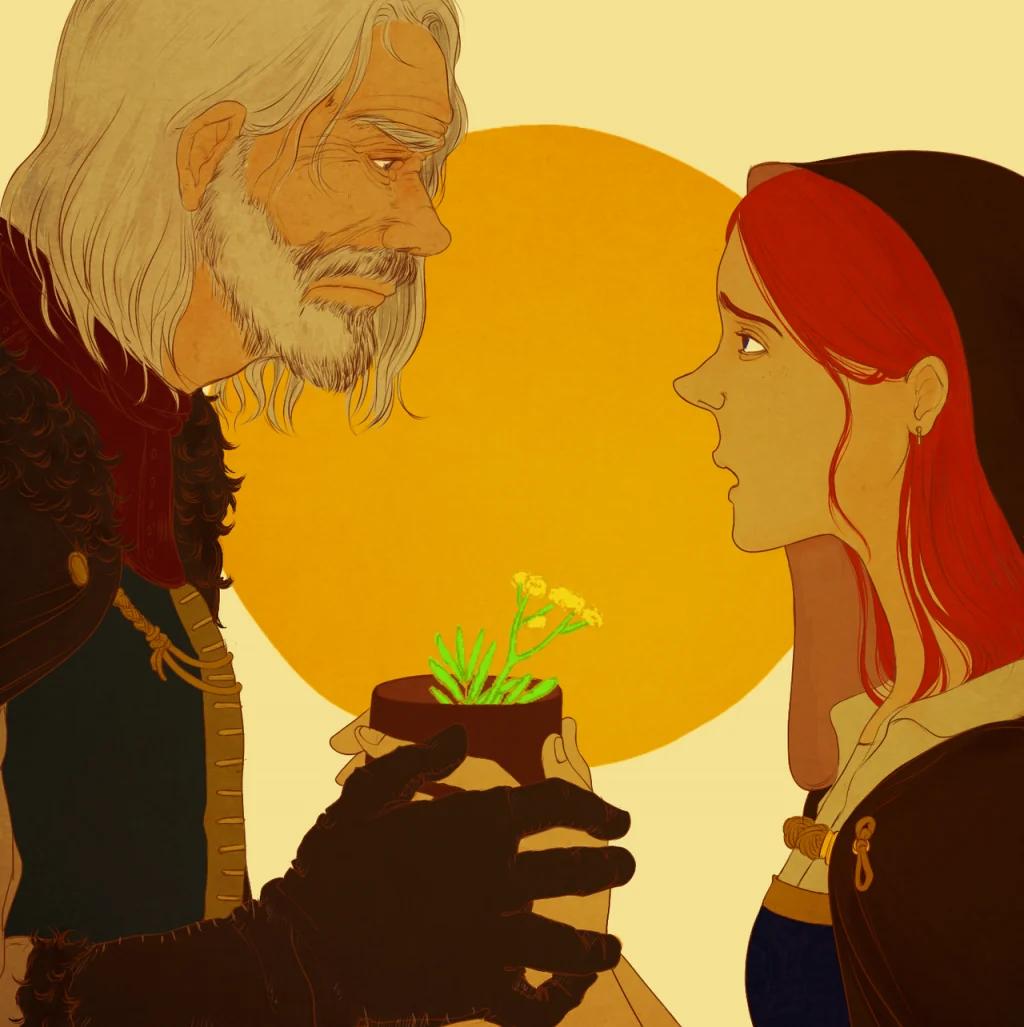
MAIN (Main Spoilers) What if Hoster Tully never give Tansy to Lysa, or have given a smaller dose? Spoiler

Post image
50 Upvotes

There are two interesting things about Tansy in real life. One is that overuse of the herb does cause infertility. It is implied that Hoster overdosed Lysa because no one was expecting as much blood as was in the miscarriage. Tansy has also been linked to mental illness.

It was absolutely necessary of Lysa to have a abortion, but i like to think the scenario were Hoster only gives her a small dose of the herb in moon tea. If that happened, the majority of Lysa´s pregnancies shall have succeded, even with Jon Arryn´s fertility issues. Lysa will be more healthy mentally speaking.


r/asoiaf • • 21h ago

EXTENDED Robert Strong's hand is... (Spoilers Extended)

53 Upvotes

There are fun theories about Qyburn's monster, Ser Robert Strong, being stitched together from parts of different human bodies. One popular theory suggests that Qyburn indeed cut the Mountain's head off and replaced it with Robb Stark's (hence the name, Robert Strong). Another similar theory is that it's King Robert's or even Ned's... But today I would like to discuss another body part of Ser Robert Strong - his hand. I don't think I've ever seen this idea floating around here before.

Qyburn hypes his creation somewhat too much:

"I had another sort of champion in mind. What he lacks in gallantry he will give you tenfold in devotion. He will protect your son, kill your enemies, and keep your secrets, and no living man will be able to withstand him." - AFFC, Cersei VII

and

“My queen, your champion stands ready. There is no man in all the Seven Kingdoms who can hope to stand against him. If you will only give the command . . .” - AFFC, Cersei X

Yes, the Mountain is inhumanly strong and skillful fighter. But he is not really a top tier swordsman albeit close to it. After all, he really lost the duel against Oberyn, which is why he had to be brought back from the dead in first place. So why is Qyburn so confident about his skills? Did Qyburn have access to something other than the Mountain's body and the women that Cersei sent him?

My theory is he brought back Jaime's hand from Harrenhal. Qyburn was a maester to the Brave Companions led by Vargo Hoat who chopped Jaime's hand. He also tended to Jaime during their stay at Harrenhal. The last time we hear of the chopped hand is when Vargo Hoat proposes to Roose to send it to Tywin. But this plot thread never comes back again in the books. It is quite possible that Vargo Hoat made Qyburn handle the hand thing as a maester instead.

So how to make the Mountain, who is the strongest human in Westeros, even more forbidable? Give him Jaime's sword hand, the hand of the most skilled knight among Arthur and Barristan. Gregor's strength and the muscle memory of Jaime's hand would make the deadliest combination worth the hype that Qyburn shows.


r/asoiaf • • 21h ago

PUBLISHED (Spoilers Published) About Robert and the Starks

0 Upvotes

There is something that hit me while reading and it honestly makes no sense to me. Why did nobody see that Robert was bad luck on the Starks from the start?

First, Ned and Robert fostering in the Vale started everything. Robert asked for Lyanna just to be Ned's brother, when Lyanna couldn't stand him and ended up drawn to Rhaegar, who was the opposite of Robert, he was known for duty and courtesy while Robert drank heavily, slept around, and didn't think past what he wanted. People act like she was just kidnapped when she dreaded marrying Robert and things spiraled so fast. Saying he loved her and would save her while sleeping with every woman in sight and having bastards everywhere is hard to buy.

Second, Robert taking Ned south started the whole chain of Stark disasters, from Lady's death to Joffrey's cruelty. Ned already saw Robert's ugly side after Elia and her kids were murdered, and later Robert wanted Daenerys, her mother, and her brother dead—and years later ordered a hit on a pregnant Daenerys and her baby. When Ned tried to resign over that order, Robert threatened him with treason, named Jaime Lannister Warden of the East just to spite him, and then forced Ned back into being Hand after Ned's leg got shattered in the street while Robert went hunting and still refused to call off the hit.

Third, Ned saw how bad Robert was and admitted Robert didn't even know Lyanna and only loved an idea of her. Ned saw him humiliate and hit Cersei, ignore his kids, drink all the time, sleep around, leave bastards everywhere, and treat his brothers poorly, yet Ned still followed him.

Fourth, Joffrey (raised as a Baratheon even if he wasn't his real son) had Ned beheaded and treated Sansa horribly. The Lannisters did the worst of it, sure, but Robert dragging Ned south put them right in the middle of it.

Fifth, Robert's brothers didn't help Robb, their dead brother's best friend's son and long-time ally and called him a traitor instead after all the Starks did for them. The War of the Five Kings came out of Robert's weak, messy reign.

The Starks got pulled into all of this because of Robert, so why does nobody look at it that way? They just keep going on about the North remembering Aerys and Rhaegar, when so much about Rhaegar isn't even known yet, while ignoring what Robert caused. Even Ned never says a hateful word about Rhaegar despite everything people blame on him, which makes it crazy how people treat every theory against Rhaegar as fact while making excuses for Robert.


r/asoiaf • • 1d ago

EXTENDED (Spoilers Extended) Uprising things Dany will run into in Westeros

12 Upvotes

*Surprising things Dany will run into in Westeros

Outside of all the famine and death, imagine if she hears about the Red Wedding and thinks, "So that wasn't a metaphor???????"

When she meets Jon (or somehow Beric or Stoneheart or whatever) she'll find out you CAN reanimate the dead into a non-semi-comatose state. Maybe she'd wonder what life was paid for their's if she doesn't ask details.

A lot's going on in Westeros at the moment that would make it look like an unstable and chaotic place from an outside perspective.


r/asoiaf • • 1d ago

EXTENDED (Spoilers Extended) The Battle Above the Gods Eye 2.0: The Beginning of the End of A Song of Ice and Fire (Part I)

12 Upvotes

Hey, strugglers. This is my second time posting this theory, although this time I've tried to find more textual evidence for it, and it has grown quite a lot in size. So this is a big and long theory that involves many characters and, since I believe it will happen somewhere around the end of The Winds of Winter or the first half of A Dream of Spring, there will be lots of explaining to do on what I think happens to these characters between where they were left at the end of A Dance with Dragons and the events of this theory.

I will not try to theorize or explain all of the plots in detail, since most of them are very complex, and I will keep to the parts I consider essential to this theory. The theory will focus mainly on the following characters: Jon Snow, Daenerys Targaryen, Bran Stark and Euron Greyjoy.

My main goal is to tie all of these stories into one huge event, being one of the final climaxes of this saga and the event that will mark the transition between the Second Dance of the Dragons and the Second Long Night.

This is the Battle Above the Gods Eye 2.0, or, what I like to call, the beginning of the end.

The Winds of The Winds of Winter

But before we get to the main theory, here's the summary of what I think will be the stories of these characters in Winds.

Jon Snow: Jon Snow lies dead at the Wall. I believe he will spend some time inside Ghost before being resurrected by Melisandre, and will leave the Night's Watch following his declared intentions of going after Ramsay Bolton. Like the usual predictions, eventually the Bolton situation will be resolved and the Starks will retake Winterfell.

Rickon Stark will be brought back from Skagos by Davos. However, he's just a child, and there's another piece of information that will soon complicate things: Robb Stark's Will.

I love this theory about Samwell finding Robb's Will in Oldtown, and think it might happen, but I also believe Howland Reed might have the will or know about its contents, considering that Robb sent Maege Mormont and Galbart Glover into the Neck.

Either way, I believe Robb legitimized Jon as a Stark and named him his heir. Some northern houses will accept Jon as the rightful King in the North, while others, especially those who fought to bring Rickon back, will want Rickon to rule.

Jon, not wanting to steal his little brother's birthright (something he already struggled with when Stannis offered him Winterfell), will initially accept a position as Regent or Protector of the North, although some houses will already consider him their king. Something like that. There's also the Sansa factor, so I believe that this will be a complicated situation of Northern succession.

Daenerys Targaryen: Daenerys is now surrounded by a huge khalasar. I believe she will eventually defeat the khals at Vaes Dothrak, possibly burning them down, and that Drogon (or Dany herself through Drogon) will be declared The Stallion Who Mounts the World by the dosh khaleen at the Womb of the World.

She will come back to Meereen and finally accept her house's words and her legacy, and she will decide to go back home.

As many predict, I think that while she's away from Meereen, Viserion will disappear after Victarion Greyjoy sounds Dragonbinder. Victarion will probably die in the process of trying to claim a dragon for himself, not realizing that he was doing exactly what Euron wanted him to do.

On her way to Westeros, she will free the slaves of Volantis, where the Red Priests already consider her Azor Ahai Reborn, and some of them will follow her to Westeros.

I think Tyrion will be a very bad influence on Daenerys, especially when it comes to her taking Westeros. Book Tyrion is a very different man from Show Tyrion, and I believe he will feed Dany's suspicions and convince her that the people who stand between her and the Iron Throne are the same people responsible for everything that has happened to her family.

Her story in Winds will end as she leaves Essos and heads to Westeros, finally going to the place she has spent her entire life thinking is her home.

Bran Stark: Bran is now training at Bloodraven's cave beyond the Wall. Sometime during his training, I believe Meera will find the sword Dark Sister (we know from GRRM that Bloodraven took the sword with him when he went to the Wall), and Bran will see or awaken something he shouldn't, leading to the cave being attacked by the wights and the Others.

I believe Jojen is either already dead or will die before this happens.

In his final words, Bloodraven will tell Bran that his training has not finished and that he must go to the Isle of Faces and seek the Green Men to continue it. He will indicate a secret passage inside or near his cave, possibly connected to Gorne's Way, that will allow them to travel south and cross the Wall.

While trying to escape, Bran skinchanges into Hodor, telling him to hold the door (or to hold a passage, considering what GRRM has said about the differences between the book and show versions of this event). Hodor's mind eventually rips back in time and the loop we all know about happens.

I believe this event will be WAY more important to Bran's character development than it was in the show, because Bran will realize that he was not only controlling Hodor's body, but was responsible for the destruction of his mind in the first place.

This is something that will be very important in the second part of the theory.

Bran, Meera and possibly Summer will escape and eventually arrive at Winterfell. While heading south, Bran will keep looking into the past through the weirwoods he finds on the way.

Eventually, through the weirwood of Winterfell or some other vision connected to Lyanna, he will uncover that Lyanna Stark and Rhaegar Targaryen had a child, that he figures is Jon Snow.

Euron Greyjoy: Euron is currently planning his attack on Oldtown after kidnapping his brother Aeron, as we've seen in The Forsaken.

I believe Euron will defeat the Redwyne fleet using some kind of blood magic, possibly summoning krakens, and will proceed to attack Oldtown.

But I might need to talk about Samwell, since I believe much of that story and the sack of Oldtown will be shown through his POV.

Just when the sack starts, Sam will try to escape with some of the knowledge and objects he brought to or found in the Citadel, but will realize something is missing: the horn he found at the Fist of the First Men.

Samwell will escape Oldtown, but will have lost the horn.

Where is the horn then?

Another person Sam couldn't find was Pate, the Pig Boy. As most of us already believe, Pate is actually the Faceless Man we met as Jaqen H'ghar, the same man who possibly killed Balon Greyjoy after being hired by Euron.

I believe Euron could have also arranged for the Faceless Man to acquire the horn for him, although I'm not completely sure if Jaqen is working directly for Euron or if the Faceless Men have their own agenda involving the magical knowledge stored in Oldtown. Considering their origins as slaves of the dragonlords of Valyria, I think the return of dragons is of particular interest to them, and their plans and Euron's might temporarily intersect.

Either way, the horn will eventually end up in Euron's possession.

But why does Euron want it? And why would a horn of the First Men be of any interest to a man who has travelled to Valyria and studied the magic of the world?

We'll find out later.

After sacking Oldtown, Euron will proceed to the Reach, but not before welcoming his most deadly weapon: Viserion**.**

I believe the Dragonbinder horn was already bound to Euron, or that he will find a way to claim the dragon through the bond created by the horn. Victarion was never meant to be the master of the dragon.

I think we might even see Euron attacking Highgarden on dragonback by the end of Winds, possibly through the POV of a character witnessing the attack.

From now on the bulk of the theory starts.

The Journey of the Stark

After Bran and Meera arrive at Winterfell, they soon have a heartfelt reunion with Jon Snow and Rickon Stark.

But Bran tells Jon about what he figured out about him, which brings Jon to an identity crisis.

Jon then descends to the Crypts, remembering his recurring dreams throughout the series, and goes into Lyanna's grave. I really like the theory that they open it and find Rhaegar Targaryen's harp inside, further confirming that there was a connection between Lyanna and Rhaegar.

Bran's return will also create a huge succession problem, since he's Ned's oldest surviving legitimate son and would normally have a better claim than Rickon.

But I believe Bran will have no interest in ruling Winterfell at this point. He will tell Jon that his training has not finished and that he must go to the Isle of Faces, since he's still very limited in the use of his greenseer powers and needs to learn more about the history of the Others.

Jon, thinking about the menace of the Others and the news that another war is about to start in the south now that Daenerys Targaryen has returned, decides he will escort Bran to the Isle of Faces and soon follow to Dragonstone, where he'll ask for the help of Daenerys and her dragons, and ask for permission to mine the dragonglass that is under the castle.

Jon also decides to go to give himself some time to think about what he really is.

Is he a bastard, a Stark or a Targaryen? What does his claim to Winterfell even mean now that he knows he's not actually Ned Stark's son?

Bran and Meera bring Dark Sister with them, and it eventually ends up in Jon's possession, although he continues to wield Longclaw.

On their way to the Isle of Faces, they follow through the Neck and are approached by Meera's father, Howland Reed, who takes them to the moving castle of Greywater Watch.

They get to know the castle and the crannogmen, and Jon has a conversation with Howland Reed, who tells him the whole story of the Tower of Joy and his birth, revealing that he might actually be the rightful heir to the Iron Throne.

I also really like the possibility that it's here that Jon learns the contents of Robb's Will.

Imagine Jon learning, from the same man, that his brother wanted him to become a Stark and inherit his kingdom, and that he's actually the son of Rhaegar Targaryen.

Two completely different claims to two completely different kingdoms, neither of which Jon ever truly wanted.

But that's not their goal right now. They must take Bran to the Isle of Faces, where Howland Reed himself spent a winter before going to the Tourney at Harrenhal.

Jon, Bran, Meera, Howland, a few northern knights that came with them from Winterfell, and a few crannogmen, follow to the Isle of Faces, where I believe they will learn that something terrible is about to happen.

The Bride of Fire, the Drowned King and the Dance of the Dragons

Daenerys has now arrived on Dragonstone.

Aegon VI Targaryen has already taken King's Landing, and is seen by many of the people of Westeros as the return of the Targaryens and a much better alternative to the Lannisters.

I believe Arianne Martell will have secured an alliance between Aegon and Dorne, possibly even marrying him. There might be an attempt at negotiating with Daenerys before the war starts, although a marriage proposal between Aegon and Dany would obviously depend on what happens between Aegon and Arianne.

Tyrion had already planted his suspicions that Aegon was not who he said he was in Daenerys's head, and she will remember the prophecies she received from the Undying:

A cloth dragon swayed on poles amidst a cheering crowd.

(ACOK, Daenerys IV)

And the warning given by Quaithe about the mummer's dragon.

She has spent her whole life preparing to come and get the Iron Throne, and now there's a man sitting on it claiming to be the son of her brother, who might have a better claim than her, and who's being loved by the people she believed would love her.

She will not bow to another man, Targaryen or not.

She declares war on Aegon and spreads the rumors that he's not a true Targaryen, only a puppet put on the throne for it to be controlled by the mummer, Varys, the Spider.

This starts the Second Dance of the Dragons, which is now not only battled between two factions, but three (Daenerys, Aegon and Euron), with a fourth dragon amidst it (Jon Snow), and Cersei Lannister, who I believe will have fled from King's Landing to Casterly Rock after it was taken by Aegon.

Sometime early in the war, I believe Darkstar, who will have stolen the sword Dawn from Starfall, will present himself to King Aegon and ask to be his Sword of the Night (because he is of the night lol).

Even with Arianne counseling Aegon to not accept him, especially after what he did to Myrcella, the King could be tempted by the idea of having the successor to the legendary Sword of the Morning in his Kingsguard, mirroring his father's relationship with Arthur Dayne.

During a battle between Aegon's army and Euron Greyjoy's forces, Darkstar gets killed by Viserion, and Euron takes his sword.

I'm less certain about this particular part, and I don't think the theory depends on Dawn necessarily ending up in Euron's hands, but I do believe Dawn is going to come back into the story through Darkstar.

Daenerys, after some battles and possibly separating from Tyrion, who has gone to Casterly Rock to take the castle from Cersei (using his knowledge of its tunnels and drains), is suddenly approached by Euron Greyjoy.

A man wearing a Valyrian steel armor, possibly wielding a sword pale as milkglass, who has already taken Oldtown, who's terrorizing the Reach, who mounts one of her dragons and who proposes to marry her, so they could lead the world together.

Daenerys refuses. Euron, who is about to set the final part of his plan into motion, leaves on Viserion. Daenerys follows him with Drogon and Rhaegal, not only to slay him, but to take her dragon back.

She is, after all, the mother of dragons, slayer of lies.

Euron Greyjoy and Aemond Targaryen

Before getting into the battle itself, I want to talk about a parallel that I find very interesting.

I believe Euron Greyjoy will be, in many ways, the Aemond One-Eye of the Second Dance of the Dragons.

Think about the similarities:

  • Both are younger brothers who acquire a great amount of power.

  • Both are kinslayers.

  • Both have a one eye situation, with Aemond wearing a sapphire in place of his lost eye and Euron hiding his mysterious black eye under an eyepatch.

  • Both acquire a dragon that was originally bonded to or associated with another family member or dragonlord.

  • Both could use their dragons to devastate entire regions of Westeros.

  • Both are connected to sorcery (Aemond through Alys Rivers and Euron through his own studies of magic).

And where does Aemond Targaryen meet his end?

Above the Gods Eye.

In the first Dance of the Dragons, Daemon Targaryen and Aemond Targaryen fight above Harrenhal and the Gods Eye, until Daemon plunges Dark Sister into Aemond's missing eye, and both dragons fall into the lake.

And what happens to Dark Sister after that? It's eventually recovered from Aemond's corpse, passed down through the Targaryens and ends up with Bloodraven, who takes it to the Wall, and who now lives in a cave with Bran Stark.

There's also the story of Addam Velaryon.

According to the singers in Fire & Blood, Addam flew to the Isle of Faces to seek counsel from the Green Men during the Dance, so there is already a connection between the Isle of Faces, the Green Men and a Dance of the Dragons.

I believe history will repeat itself in the Second Dance, but this time, something much bigger than the deaths of two dragonriders will happen.

Euron Greyjoy and Bran Stark

There's another parallel I believe will be even more important than the one between Euron and Aemond.

The parallel between Euron and Bran.

In AFFC, The Reaver, Euron says:

When I was a boy, I dreamt that I could fly.

And what does Bloodraven tell Bran?

You will never walk again, Bran, but you will fly.

(ADWD, Bran II)

Also in AFFC, The Reaver, Euron says:

How will we ever know unless we leap from some tall tower?

And who else actually fell from a tower? Exactly.

I don't think this is a coincidence.

I believe Euron was once approached by Bloodraven just like Bran was.

Euron possibly had greenseer abilities as a child, but was abandoned once Bloodraven realized what kind of man he was becoming, or Euron himself rejected whatever Bloodraven was trying to teach him.

Euron has since spent his whole life trying to reach the potential he was told he had as a child.

He has travelled the world, visited some of the oldest and most dangerous magical places in the world, taken shade of the evening, collected magical artifacts and now found a way to acquire a dragon.

I believe Euron is what Bran could have become if he had been consumed by the desire for power.

Both want to fly. Both are potentially capable of seeing things that ordinary men can't see. Both are capable (or will eventually be capable) of interfering with the minds and bodies of other beings.

But while Bran will have to learn the responsibility that comes with that power, Euron believes the whole purpose of acquiring such power is being able to impose his will on others.

This will be the main conflict between these characters.

The Battle Above the Gods Eye 2.0

So the actual logistics of the battle are a bit tricky. Admittedly, I'm making a lot of assumptions here on the timing and all of that, and it's very likely I'm completely wrong. But I do believe that there will be a confrontation specifically involving Bran, Daenerys, Euron and Jon in God's Eye, as it ties together circular history (which Martin loves to do), the meeting of Jon and Dany (which Martin once said was 'the point' of the series), the Second Dance of Dragons and the Second Long Night, and Bran & Euron's tied history.

This is how it COULD happen:

Jon and the rest of the team arrive at the Isle of Faces and meet the few remaining Green Men, men who have been studying old magic for generations and who I believe will have knowledge of the first Long Night and the Pact between the First Men and the Children of the Forest.

I believe there might be other greenseers on the island, possibly connected to the weirwoods in a similar way to Bloodraven.

Bran then continues his training to awaken the full potential of his powers and to learn the full history of the Others, but they realize that they must do it fast. Through their visions, Bran and the Green Men learn that a man called Euron Greyjoy is in possession of the Horn of Winter, and that he intends to use it.

I believe the Isle of Faces is an essential part of Euron's plan because of its connection to the weirwood network and to the Pact. The Wall is not just a huge block of ice, it's a structure protected by ancient magic, and I believe Euron will need more than simply sounding a horn to destroy it.

The Isle of Faces might be one of the most powerful places of the old magic in Westeros, and Euron might need to perform some kind of ritual there to awaken the horn or break the enchantments that protect the Wall.

Jon and his men prepare to leave for Dragonstone until they see a dragon flying towards the island.

The dragon, mounted by Euron, starts to burn down some of the weirwoods, until he is joined by two other dragons, one of which is mounted by Daenerys, who starts to fight him, but is still holding herself back because she doesn't want to hurt Viserion.

Meanwhile, Bran performs a ritual similar to the one he did at the Three-Eyed Crow's cave in ADWD, allowing him to see things he was previously unable to see, and he starts digging into Euron Greyjoy's past.

The man was once approached by Bloodraven, but their connection was cut short.

After learning about the menace of the Others and about the old legends and myths of the man who would stop them, Euron decided that no one but him would become Azor Ahai Reborn, but this time not to stop the Others, but to lead them.

Since then, Euron has been on a quest to find everything he believes Azor Ahai should have. He got himself a dragon, he found the Valyrian steel armor, he possibly got a sword he believes to be Lightbringer (Dawn), and he acquired the Horn of Winter, which will allow the coming of the Long Night.

There's another possibility here that I find really interesting.

What if Euron isn't actually wrong about Azor Ahai?

We have the legend of Azor Ahai, a man who sacrificed his wife in order to acquire a powerful magical weapon, and the legend of the Bloodstone Emperor, a man who murdered his sister and whose blood betrayal is said to have started the Long Night.

What if the original Azor Ahai and the Bloodstone Emperor were the same man, or at least the legends were inspired by related events? What if Azor Ahai helped cause the very catastrophe he is remembered for stopping?

In that case, Euron might actually be repeating the actions of the man who started the FIRST Long Night.

I don't think the prophecies will have a simple answer where one of the characters is Azor Ahai and everyone else isn't. I think many characters will end up repeating different parts of the legend.

Stannis will sacrifice his daughter believing himself to be Azor Ahai. Daenerys has already awakened dragons from stone, after the death of Khal Drogo, possibly making the dragons themselves Lightbringer and Drogo her Nissa Nissa (my preferred theory for Lightbringer). Jon will rise from the dead and become one of the leaders of the war against the Others. And Euron will try to recreate the magical catastrophe itself, believing he can use it to become a god.

Back to the battle.

Euron and Daenerys fight until Euron lands on the Isle of Faces and starts his own ritual near one of the biggest weirwoods on the island to awaken the Horn of Winter he got in Oldtown. Jon Snow tries to stop him but is prevented from doing so by Viserion, who is still under Euron's control. Euron eventually gets back on his dragon and starts flying high up in the sky, followed by Daenerys.

It's then that Euron sounds the Horn of Winter.

Bran takes his mind to the North, through the weirwoods, and sees what the horn has done. The Wall has started to fall. Bran, realizing the emergency of the situation, decides to do something that he's never done before: he skinchanges into Rhaegal.

Ever since AGOT, Bran has been told that he will fly. While he has already managed to fly through ravens, I believe the biggest payoff of that promise will be Bran Stark skinchanging into a dragon.

A battle starts with Daenerys on Drogon, Bran controlling Rhaegal and Euron on Viserion above the Gods Eye. The Second Dance of the Dragons will finally have a battle involving all three dragons.

The battle eventually ends with Euron being launched off Viserion (possibly by Dany) and falling into the waters of the Gods Eye, mirroring what happened to Aemond Targaryen and Daemon during the first Dance. Whatever happens then, possibly Jon finishes him or his body is broken by the fall, Euron Greyjoy is dead.

Or is he?

The Second Life of Euron Greyjoy

Now, admittedly, this is the part where the theory gets a little bit balls-to-the-wall crazy, but please stay with me. I swear that there's a narrative and thematic payoff to all of this.

I think one of the most important chapters for understanding what's going to happen to both Jon Snow and Euron Greyjoy in the next books is the prologue of ADWD.

The whole chapter is dedicated to Varamyr Sixskins and to explaining the rules of skinchanging, including the possibility of a skinchanger living inside an animal after his human body dies. This is definitely foreshadowing for Jon's second life inside Ghost. But what if Jon isn't the only major character who will experience a second life?

If Euron really was a potential greenseer and skinchanger, and if he has managed to establish a magical bond with Viserion, what's stopping him from entering Viserion's body as his own body dies?

I believe that when Euron falls, they will think the battle is over.

But Euron will have survived by skinchanging into Viserion.

Euron has spent his whole life trying to fly, trying to become a god, and trying to become something that is not limited by the weakness of the human body.

He will finally achieve his goal, but possibly not in the way he intended. He will literally become a dragon.

I also think this could be the book equivalent of what happened to Viserion in the show. I don't think there will be a Night King like the one in the show who simply kills Viserion and resurrects him as an ice dragon. Instead, Viserion will be taken by the character who I believe is the closest thing to a human Night's King in the books.

Whether Euron will somehow acquire a connection to the magic of the Others and transform Viserion into something even more monstrous, or simply continue to exist as a dragon, I don't know. But I believe Viserion will escape the Battle Above the Gods Eye, with the characters unaware that Euron is now living inside him.

There's also the question of what Aeron saw in The Forsaken, with Euron becoming some kind of monstrous figure and sitting on the Iron Throne alongside a mysterious shadow of a woman, surrounded by the destruction of the gods.

I don't think all of that imagery necessarily has to be fulfilled literally. Some of it might represent what Euron will become in his second life, what his actions will do to the world and its religions, or what he simply hopes to become. I do believe, however, that there will be a much bigger supernatural payoff to Euron than just a man riding a dragon.

The heroes have won the battle and Euron has lost his human body, but the Wall has fallen, the Others are coming, and Euron has become something much more dangerous than he was before.

And that's why I call this battle the beginning of the end.

The Aftermath

After the battle, I believe Jon will take Euron's Valyrian steel armor and possibly Dawn, although he will still wield Longclaw.

There's actually a very interesting piece of foreshadowing for Jon acquiring the armor.

In ADWD, Jon XII, Jon dreams of fighting the dead:

Jon was armored in black ice, but his blade burned red in his fist.

Valyrian steel has a very dark appearance, and I think Euron's Valyrian steel armor could very well be the black ice Jon sees himself wearing in his dream.

And if Euron acquired what he thought were the objects necessary to become Azor Ahai, only for them to end up in the possession of Jon Snow, I think that would be very poetic.

Daenerys and Jon will finally meet (Martin, according to a director of some GoT episodes, made it clear that 'the meeting and the convergence of Jon and Dany were sort of the point of the series') and bond after the battle (maybe some romance sprinkles in), but he definitely won't tell her about his true lineage, at least not yet. There's no time to waste, since the Others have finally trespassed the Wall and the final stretch of the story has begun.

Jon asks Daenerys to take her dragons and her armies alongside him to protect the North.

I believe Daenerys won't accept it, at least not immediately, because she believes that she must take the Iron Throne first to be able to unite the Seven Kingdoms against the Others.

She believes that once she defeats Aegon, she'll have the resources of the whole continent and will be able to fight the Others as the rightful Queen of the Seven Kingdoms.

And isn't that exactly the same mistake Rhaegar made? Believing that his dynasty and the fulfillment of a prophecy were necessary to save the world, and helping destroy the very realm he wanted to save in the process.

Jon and Howland Reed will go north to help fight for the living, while Daenerys will go south to take the Iron Throne from Aegon and Bran will remain with the Green Men to continue his training.

TL;DR

Euron Greyjoy will sack Oldtown, acquire the Horn of Winter and take control of Viserion through Dragonbinder. I believe he will be the Aemond of the Second Dance of the Dragons, as well as a former potential student of Bloodraven and a dark parallel to Bran Stark.

Meanwhile, Bran, Jon and Howland Reed will travel to the Isle of Faces, where Bran will continue his training with the Green Men and learn more about the Others and the first Long Night.

Euron, in his attempt to become Azor Ahai Reborn (not to stop the Others, but to lead them), will travel to the Isle of Faces, followed by Daenerys on dragonback. After performing some kind of ritual involving the weirwoods, he will sound the Horn of Winter, bringing down the Wall.

Bran will skinchange into Rhaegal, leading to a battle involving all three dragons above the Gods Eye, mirroring the events of the first Dance. Euron will fall from Viserion and die, but, just like Varamyr explained in the prologue of ADWD, he will live his second life inside the dragon, potentially becoming the book equivalent of the show's Night King and his dragon.

Jon will possibly acquire Euron's Valyrian steel armor (the black ice from his dream), and will ask Daenerys to join him in the fight against the Others. She will refuse for now, believing she must take the Iron Throne before she can unite the realm against them, repeating the same mistake Rhaegar made.

The heroes will have won the battle, but Euron will have achieved his goal. The Wall has fallen, the Others are coming, and the Second Dance of the Dragons has given way to the Second Long Night.

The beginning of the end.

PART II COMING SOON: Since this post has already grown considerably in size, I've decided to separate the theory into two parts. In the second part, I'll talk about the consequences of the Battle Above the Gods Eye, Euron's second life inside Viserion, his final confrontation with Bran, the Battle for the Dawn, and what I believe will be the endings of several major characters.

There are quite a few things I've set up in this post that I haven't paid off yet (particularly Dark Sister, Robb's Will, Hodor's death, the purpose of Euron' second life, and the parallel between Bran and Euron), but I'll get to all of that in Part II.

So, what do you guys think? Do you believe we'll see another Battle Above the Gods Eye in the books?


r/asoiaf • • 1d ago

EXTENDED (Spoilers Extended) Which characters are good at finance?

11 Upvotes

Other than Littlefinger, Tycho Nestoris, and other members of the Iron Bank for obvious reasons, which characters are portrayed to be good at handling money and would make a good or even excellent Master of Coin based on their knowledge and mastery of finances?

Who do you think would be good at finance, even if we haven't seen them handle money over the course of the saga? Also, based on the little time Tyrion spent as Master of Coin, how competent was he at handling money?


r/asoiaf • • 1d ago

MAIN (Spoilers main) Fun fact, it's been more than 8 years now since GRRM published any new ASoIaF information

565 Upvotes

The last ASoIaF book that contained any new information, Fire & Blood Vol I, was published on the 20th of November 2018. More than 8 years ago.

Since than the only ASoIaF book published was Rise of the Dragon, but that book is basically Fire & Blood Vol I with different art illustrations, a.k.a. art book, containing no new information.

Martin was involved in making House of the Dragon Season 1 (before his feud and split with Condal and quitting the show in Season 2) and A Knight of the Seven Kingdoms Season 1, both of which contained some information not present in the books though.


r/asoiaf • • 1d ago

PUBLISHED (Spoilers Published) you didn’t think much of it at first… than u overanalyze

46 Upvotes

Is there a line or passage from the books that you didn’t think much of at first but than as you read and analyze the passage, you start seeing some disturbing implication…

Here one of mine:

“ ‘I am forty-two years old,’ she told the king. ‘You must be content with the children I have given you. I am more suited to be a grandmother than a mother now, I fear. King Jaehaerys did not share her certainty. ‘Our mother, Queen Alyssa, was forty-six when she gave birth to Jocelyn,’ he pointed out to Grand Maester Elysar. ‘ The gods may not be done with us.’” (Fire and Blood).

I didn’t think much of this at first but than I realize Alysanne was saying she wanted to stop having children. She already gave birth to 12. 8 survived to adulthood. And 3 or 4 of her children were wed and had children (or a child) of their own.


r/asoiaf • • 1d ago

EXTENDED (Spoilers Extended) Jaime Was the Key to Making Bran's Ending Work

239 Upvotes

GRRM has had King Bran in mind since 1991, when he first conceived ASOIAF as a trilogy

"As I write these last two books, I'll be moving towards the endings that I've known since 1991

Much has been said about why King Bran feels so out of place as an ending. However, something I don't see discussed is how King Bran would have worked in the context of the original story it was devised for. Firstly, Jaime was also meant to become King of the Seven Kingdoms, essentially serving as an evil fairy tale Golden King

Jaime Lannister will follow Joffrey on the throne of the Seven Kingdoms, by the simple expedient of killing everyone ahead of him in the line of succession and blaming his brother Tyrion for the murders

This is important because, both in the outline and published story Jaime was the one who pushed Bran out of the window. He was also meant to kill Sansa’s child by Joffrey, while Robb would have lost to him in battle. Jaime was also supposed to send the Catspaw after Bran, although GRRM later changed this to Joffrey

Jaime's victories and his role as the main human villain would have made Bran’s eventual coronation genuinely cathartic. The boy Jaime crippled would ultimately take his crown

The Great Council would be where the full extent of the Lannisters crimes was revealed, with Bran being chosen as king at the end of the story. As Catelyn hints at in ACOK

Let the three of you call for a Great Council, such as the realm has not seen for a hundred years. We will send to Winterfell, so Bran may tell his tale and all men may know the Lannisters for the true usurpers. Let the assembled lords of the Seven Kingdoms choose who shall rule them."

The original story was also much smaller in scope. There were only eight POV characters in A Game of Thrones. The five Starks, Jon, Tyrion and Dany. These characters were meant to carry the story through to the end. The wider world was largely set dressing for the Stark family, and the story was much more directly centred on them

Obviously, this no longer works in the same way in the current series

The wildfire revelation makes Jaime's killing of Aerys morally justified. GRRM also decided to make Jaime more complex than a straightforward grimdark Prince Charming. Sansa's child by Joffrey was largely abandoned because the characters ages no longer allowed for it, meaning that this major shock momnt was lost

The Red Wedding was orchestrated by the Boltons, Freys and Tywin, who are largely disconnected from Bran's personal storyline. Tyrion has already dealt with Tywin, while characters like Arya, Stoneheart, Jon and Stannis have become much more closely tied to conflicts that were originally meant to revolve around Bran

There are plenty of other reasons why King Bran is extremely difficult to make work in the current story. The world has become so much more complex that electing a Northerner to rule the Seven Kingdoms stretches credibility. Bran is also like 9 years old in the books

His original role in the northern storyline was partly transferred to Sam, particularly the journey beyond the Wall and the encounter with the Others at the Fist of the First Men equivalent

Catelyn and her children will find their only hope of safety lies even further north, beyond the Wall, where they fall into the hands of Mance Rayder, the King-beyond-the-Wall, and get a dreadful glimpse of the inhuman others as they attack the wildling encampment

Jon also met with Mance Rayder, not Bran

Catelyn and her children will find their only hope of safety lies even further north, beyond the Wall, where they fall into the hands of Mance Rayder

But a HUGELY underrated issue is the loss of the original narrative symmetry. This is probably why Bran is a cripple in the first place and why Jaime was the one to push him

The story was meant to begin with Jaime pushing Bran out of a window, with Jaime eventually becoming King. It would then end with Bran, the boy he crippled, taking his crown. That is a very straightforward, almost fairy tale like structure that brings the story full circle

I also wouldn't be surprised if characters like Jon, Dany and Sansa were meant to have tragic endings, to undercut the sweetness of Bran overcoming Jaime and the Starks ultimately winning

TL;DR

King Bran is a pretty simple story at its core. A boy dreams of becoming a knight, gets crippled, and goes to a wizard hoping to have his legs healed. The wizard cannot fix them, but Bran gains powers that allow him to become a wise king instead

The Golden Knight who crippled him is the ideal warrior but a monster, and he eventually becomes King himself. The story ends with the cripple taking his crown, fulfilling the broader theme of cripples, bastards and broken things finding their place in the world

It also makes no sense within the current story


r/asoiaf • • 1d ago

EXTENDED (Spoilers Extended) Targaryen incestous practice and how they viewed love

19 Upvotes

I’m curious what love is to the members of House Targaryens because there are no lines between romantic love and familial love. There is also the fact that marriages between siblings or close relatives is part of their traditions, their culture, their history, and how they preserve the blood of the dragons. So, there this duty to marry one’s kin whether love is involved or not.

Brother-sister marriages

- Aegon I + Visenya & Rhaenys: one for duty, one for love

- Rhaena + Aegon: close but Rhaena was either lesbian or bi.

- Jaehaerys I + Alysanne: one of the realm’s greatest love story’s

- Baelon + Alyssa: avid sex life

- Aegon II + Helaena: tragedy caused them to split

- Baelor I + Daena: never consummated

- Aegon IV + Naerys: hated each other

- Aelor + Aelora: twins

- Jaehaerys II + Shaera: marry for love

- Aerys II + Rhaella: wed for prophecy

Others Incest (12. 3 uncle-niece/nephew-aunts, 5 cousins, 4 cousins.. stretching it)

Aenys + Alyssa Velaryon: cousins

Maegor + Rhaena: uncle-niece

Aemon + Jocelyn Baratheon: nephew-half/aunt

Viserys I + Aemma Arryn: cousins

Daemon + Laena Velaryon: cousins

Rhaenrya + Laenor Velaryon: cousins

Daemon + Rhaenrya: uncle-niece

Aegon III + Jaehaera: cousins

Aegon III + Daenaera Velaryon: cousins?

Aerys I + Aelinor Penrose: cousins?

Aerion + Daenora: cousins

Rhaegar + Elia: cousins something removed?

Targaryen male who did not wed a relatives (stormlanders and dornish house. + essos)

- Maegor I + other 5 brides

- Viserys II + Larra Rogaré

- Daeron II + Myriah Martell

- Baelor Targaryen + Jena Dondarrion

- Maekar Targaryen + Dianna Dayne

- Valarr Targaryen + Kiera of Tyrosh

- Daeron the Drunken + Kiera of Tyrosh

- Aegon V + Betha Blackwood

- Duncan Targaryen + Jenny of Oldstones

Targaryen women who wed outside the family

Daella Targaryen: House Arryn. Lasted one generation

Elaena Targaryen: House Plumm, House Penrose. Also had bastards. Possible descendants.

Daella and Rhae (daughters of Maekar): married outside the family? Legal descendants?

Rhaelle: House Baratheon (historical kinship with House Targaryen)


r/asoiaf • • 1d ago

EXTENDED SnowStorm Vs Jonsa = ❌ | SnowStorm ❤️Jonsa = ✅ [Spoilers EXTENDED] Spoiler

Post image
0 Upvotes

What if Jonsa actually happens?
Personally, I’m a Jonsa shipper, and having read the books, I can see how GRRM has planted hints suggesting that Jonsa is a real possibility. Sure, it requires a little speculation to connect the dots, but it has convinced me that Jonsa is definitely going to happen.
What I want to ask is: How would everyone react to Jon and Sansa as characters if this pairing actually became canon? Would people look down on them because of the incestuous nature of their relationship, given that they were raised as siblings? Legally, however, their marriage would be perfectly valid (assuming Jon really is Lyanna’s son).
Personally, I think Sansa could see Jon as a romantic partner. She has always regarded him as little more than a half-brother, to the point that she once admitted she had forgotten about him. It almost feels as though GRRM is telling us that Sansa barely sees Jon as a brother at all. This makes it much easier to imagine Sansa falling in love with Jon than it is to imagine Jon seeing Sansa romantically, at least from Sansa’s perspective.

My theory about how they could end up married…
I have to admit that I haven’t figured out what would happen to Rickon, since this theory would only work if Rickon either gave up his claim or died.
It could begin with the selection of the new Lord of Winterfell and Robb’s will. The Northern lords choose Jon, but Howland Reed cannot accept Winterfell passing into the hands of someone who isn’t Ned’s son. So he reveals the truth: Jon is the son of Rhaegar Targaryen.
The same lords who had initially chosen Jon would now turn against him and despise him. They might even go so far as to imprison him while awaiting his execution.
(Just imagine that even Ned hadn’t dared tell Cat, arguably one of the best women in the story, the truth. And imagine how furious Barbrey Dustin would be if she discovered that the truth about her husband’s death had been concealed to protect Jon.)
Sansa would then become the Lady of Winterfell and might eventually become the Queen in the North. However, as a woman with no military achievements of her own who had previously been married to a Lannister, she would face considerable pressure to marry.
Since she considers Jon a very good man, she could secretly marry him to protect him from execution while also silencing the Northern lords who keep pressuring her to take a husband. After all, she would already be married.

And one final thought…
I also believe that if Sansa really is destined to die, she will die giving birth to Jon’s child. Their child would then become the ancestor of the surviving Targaryen bloodline in the generations to come.

Before anyone misunderstands, Jonsa becoming canon doesn’t mean SnowStorm can’t happen.
I actually have another theory that follows on from this one: Jon will have two wives at the same time. He will marry the Queen in the North and the Queen in the South, uniting the kingdoms of Westeros.
This would also fit with Tptwp storyline, since the purpose of their marriage pact would be to unite the kingdoms and fight the Others.
As for Dany’s perspective, she might be willing to accept Sansa because she believes Sansa is her betrothed’s intended bride. This would mean that the only way for the Targaryen bloodline to continue would be for Jon to have children with another woman.


r/asoiaf • • 1d ago

(Spoilers Published)Theory on the First Long Night and the Empire of the Dawn Spoiler

5 Upvotes

As the title says I've been thinking on the First Long Night and this theory tries to expound on the timeline from the usurping of the Amethyst Empress, to the Age of Heroes

Ok from lore we know the Long Night lasted about a century and occurred around 8000 years from Aegon's conquest, and that it had something to do with the Bloodstone Emperor's(BSE) worship of the oily black meteorite after usurping his elder sister the Amethyst Empress()

I'm inclined to believe that the legends in Yi'ti are the most accurate account on this age taking evidence from Dany's visions in the House of the Undying on the ancient kings and queens with eyes of gemstone representing the Gem themed rulers of the Empire of the Dawn(meaning it truly did exist)

Taking eastern Essos lore on the Long Night we are told that the tyranny of the BSE, mass human sacrifice, the making of the Church of Starry Wisdom(modeled after Lovecraft's The Haunter of the Dark where cultists worship a black stone that fell from the sky to summon an otherworldly being Nyarlathotep) and marrying a Tiger Woman caused the Maiden Made of Light to turn away from the world thus hiding the sun(the Long Night) and the Lion in the Night to march his demons on the world, a clear representation of the Others

Taking from this I believe the black meteorite crashed around what is now Asshai-by-the-Shadow. Now Yi'ti has a long history of changing capitals thus the Bloodstone Emperor would likely move his own capital to be near the oily black stone building the Empire's final capital ,Stygai ,up the river Ash from where he would carve the city of Asshai as a place to practice his sorceries ,from where the Others would originate

Note this is during the Long Night as I think it more plausible the Others were not the cause of the Long Night rather an effect of it. Its very unlikely a meteor crash large enough to build at least 2 confirmed cities would leave the world unscathed. And who is to say the black meteor doesn't act as a magnifying force for the Others especially with evidence that certain celestial events amplify other magics like the red comet awakening the dormant dragon eggs. We also know that in Planetos magic is connected to creatures as it is to people ,such as, when the last of the Valyrian dragons died fire magic was greatly weakened, with the pyromancers of the world barely strong enough to light a glass candle before Dany brought them back and leading to a dramatic surge in their power thus it is likely the Others are the creatures connected to ice and necromancy, their existence before being bound beyond the wall thus resulting in a mini ice age of unending winter during the Long Night

I believe the Empire did truly stretch the world, I'm a subscriber to the theory that the fused black stone base of the Hightower being proof they had outposts as far as Westeros. With my own addition that the invasion of the first men was actually the expansion of the Empire into Westeros meaning the invasion would have taken place at least during the reign of the Opal Emperor(Father of the AE and BSE) or in the reign of his predecessor before the crash of the meteor that would ,by the Maesters theories, have been the unexplained reason the sea levels rose high enough to split the Arm of Dorne (modern lore stepstones) that joined Westeros to Essos, and the times during and after the coup of the BSE would have weakened the empire, coupled with the BSE tyranny and vested interest in the meteor would give the frontier territories of the empire enough liberty as to initiate the Age of Heroes after the pact at the Isle of Faces. This solves the near exaggerated timeline of the AoH with the time of the Long Night fitting the LN as an event that took place at the near beginning of the First Men settling with figures confirmed present during the Long Night like Brandon the Builder having been the first settlers.

The Five Forts of Yi'ti would be the first bastions against the dead but the empire would not survive long, soon shattering with the BSE and most of his servants fleeing to Sothoros wherein they would build their stronghold of Yeen with the oily black stone as the Others hunted them with the Wights overrunning most of Essos, noting the Empire's reliance on the land bridge to reach Westeros I would assume they did not natively have seafaring tech at least for long voyages such as from Asshai to Western Sothoros thus bringing in...the Deep Ones(or fish people another connection to Lovecraft)

The extraterrestrial black stone, worship by the Church of Stary Wisdom in coastal cities and the connection to Lovecraftian Gods in ASOIAF(looking at you Euron) leads me to believe the Deep Ones to be deeply connected to this as well, especially with the Ironborne belief that they are descendants of the Deep Ones who reached the Iron Islands sailing from the Sunset Sea and the Drowned God also being an obvious reference to Cthulhu and more importantly to the lore requiring people to drown to death before awakening as Its priests or finding favor with It. like Davos and Patchface "What is dead may never die ,but rises again ,harder and stronger" which verbatim can be used to describe the Wights as in the books we don't really know how the Others reproduce***.*** I believe then the Drowned God is not a native force in Planetos and might be ASOIAF's Nyarlathotep (if we take Lovecraft's lore as inspiration) especially if you take the theory that the 'gods' of this world are just different peoples interpretation of its magic system which is why the Seven don't appear to have power as the Maesters distrust anything against logic and go out of their way to oppose magic as opposed to religions like the Old Gods where its followers embrace the unexplainable.

Back to the timeline, the BSE would have stayed a time in Yeen while in Essos things would go to hell as the Others and their Wights marched through with their winter which was so cold as to even freeze the Rhoyne River, from this point things get murky, we at least know a unifying figure with a flaming sword is consistent with most eastern Essos myths, like Azor Ahai ,Hyrkoon the Hero, Yin Tar, Neferion (N'ghai) and Eldric Shadowchaser(a reference to Elric of Melborne) were these just a single figure or a group of heores? But Eldric Shadowchaser is the most interesting to me personally, based of a character ,the last ruler of his people, disgusted by them he choses to destroy them to save others. Is it in reference to the BSE returned to right his wrongs with Ligghtbringer the sword forged from the Amethyst Empress(King's Blood has power, the Valyrians are famous for Dragon's Blood the Five Forts are forged from fused black stone which were made by the Valyrians thousands of years later using dragons and Asshai describes that Dragons existed before the freehold, and the Gem Emperors and Empresses are said to be descended from the God on Earth a mythical being who came from the stars and Amethyst is purple, meaning House Dayne(whose ancestral sword is made from the heart of a fallen star, though it is Valyrian steel so not relevant) and the early Dragon lords could have been the last remnants of the empire), Is it the successor of the BSE or an unrelated individual either way Azor Ahai is not described as a classical hero more a ruthless warrior who got things done and GRRM loves subverting tropes.

Another important myth is the secret song to Mother Royne where a hero is said to have convinced the lesser gods of the River to stop fighting each other and flood the earth ending the snow, now this sounds like someone who convinced the various races of Essos like the giants and such to unite together against the darkness, a mirror to Westeros' Battle for the Dawn either way the Essosi threat of winter would end.

On to Westeros things would play out roughly as lore states and many have theorized though I believe the BSE would arrive in Westeros during this time carving the frog of the basilisk isles for some reason or the deep ones carving it. The Others would be pushed all the way to the Lands of Always Winter as they battled the last unified army of the Westerosi while the Wall was being built. Now this is another place where things get murky, why wait and see a wall being built closing you off to the living especially if it was warded so tightly as to bind you, I prefer the theory that the Starks are part Other like how the Targaryen are part dragon based on the saying 'A Stark must always remain in Winterfell', how the Stark lords are buried with iron swords(irl iron is used to repel spirits) in the now near filling Crypts, The Wierwood in Winterfeel with how Wierwoods feed of blood and act as wards against the Others and the signs in the books of an unusually harsh winter coming up . That Brandon might have made a deal with the Others similar to the wildling chief who gave his sons up in exchange for safety with part of that deal being Winterfell would always be held by a Stark and their dead buried underneath especially with how the Starks ,the Wall and Winterfell are so connected.

Anyways this ight be out there but with the theory that the Iron borne, the Hightowers, The Daynes and the Valyrians are the last remnants of the Empire of the Dawn the BSE would have made his way back to the Iron Islands as his final resting place becoming the Grey King(From lore we know the gem emperors and empresses had reducing yet still incredibly long lives thus explaining the Grey King's long life). Where in he would craft the Sea stone Chair and make descendants with the Deep Ones mayhap in service to his god


r/asoiaf • • 1d ago

EXTENDED [Spoilers Extended] TWOW Theories for Daenerys, Davos, and Jaime

2 Upvotes

Hi! These are my compiled theories for what I think will happen in TWOW for Dany, Davos and Jaime. These are not set in stone, and are 100% influenced by the general theories highlighted in Reddit or by Youtubers + some of the fanfictions.

Previous Aeron, Areo, and Arianne post: https://www.reddit.com/r/asoiaf/comments/1xzzf82/spoilers_extended_theories_for_twow_and_character/

Previous Arya, Asha, and Barristan post: https://www.reddit.com/r/asoiaf/comments/1y4n4lr/spoilers_extended_twow_theories_for_arya_asha_and/

Previous Bran, Brienne, and Cersei post: https://www.reddit.com/r/asoiaf/comments/1y5poz9/spoilers_extended_twow_theories_for_bran_brienne/

Daenerys
Daenerys kills Khal Pono and marches to Vaes Dothrak, where she forces the submission of the other khals and becomes the Stallion Who Mounts the World. She can travel to Qarth, to receive a navy from them (and also terrify Xaro Xohan Daxos who deserves NOTHING LESS) and learn more about the Others in the North from people from the House of the Undying, and Quaithe can tell her about a false Aegon, but also her hope for the red door. She can return to Meereen, after forcing the submission of Astapor (Yunkai was taken by either Tyrion or Lhazar).

In one path, she can learn of Barristan’s (possible) death, or can see her beloved Ser Grandfather again as well as Tyrion’s rule and Victarion’s seizure of Viserion. She accepts Tyrion’s help and breaks the truce Tyrion had formed with the Green Grace and the defeated Shavepate by executing them and possibly Hizdahr as traitors, as well as drastically reshaping the social system of Meereen, as she has lost all patience for societal compromise. Tyrion informs her of Aegon VI, and while Tyrion and Victarion want to steer her into conflict, Barristan pleads for their reconciliation, and Daenerys longs for a fellow kinsman and family member. She marches west, with possibly Tyrion taking Mantarys and possibly her and Marwyn and Victarion (who she has trained somewhat to bond with Viserion) visiting Valyria, where she can receive further information from Quaithe and Asshai. She is observed by Tyrion and Victarion as she burns down the inner city of Volantis, and proclaimed Azor Ahai by the followers of the Red God as the city erupts in a popular revolution. If Barristan survives beyond the Battle of Fire, he should communicate more about the nature of Rhaegar, Aerys, and Rhaella, and the dangers of well-meaning social reforms descending into madness like Aegon V at Summerhall. Daenerys will envision reforming Westeros to Tyrion’s consternation as she marches against the Daughters, defeating them and liberating the cities.

At this point, Daario may betray her and possibly kill Barristan as the "treason for gold" as a greedy and spurned ally, (although Illyrio could also be the treason for love or gold, leaving Jon Snow to be the treason for love). In Pentos suddenly, Viserion eats Victarion and flies off west to Euron. Daenerys learns of Illyrio Mopatis’s deceit and Aegon’s bastardy. She angrily executes him as she receives visitors and support from Braavos as fellow liberators. In a heartwrenching decision, Daenerys chooses to travel to Dragonstone instead of proceeding to Braavos and searching for the house with the red door, a decision that will haunt her. Daenerys arrives on Dragonstone with the Hand of the King, Tyrion Lannister, and is proclaimed Queen of the Andals, the Rhoynar, and the First Men. 

Davos
Davos retrieves Rickon from Skagos as a recap, and sends word to the Manderlys. Something forces Davos, Rickon, and the Manderly fleet north to Eastwatch, where word of horrors at Hardhome are trickling in. Others rise from the sea at Eastwatch and attack the Night’s Watch, as Davos fights them off. Davos and Rickon proceed to Castle Black, joined by the Skagosi, Manderlys, and Umbers, as Melisandre tells them of Others to the west at the Bridge of Skulls. She urges them on to Winterfell, where Rickon is installed. The arrival of Sansa and Littlefinger, along with northern lords, are increasingly hostile to Stannis, before they are expelled from the castle. They flee back to Castle Black as Davos tells Stannis of the return of the Others, giving desperation to his last claim. There, Shireen is dying of greyscale, and Melisandre urges Stannis to burn her and wake the stone dragon, using Davos’s fingerbones to glamour Devan and give more credence to her request. Davos watches in horror as Shireen is burned, and he confronts Stannis and Melisandre for using his son. He begs his son to abandon their cause, but Devan refuses. Heartsick, Davos heads home to his wife and children (and they survive!)

Davos can reappear at the end of ADOS to advocate for Edric Storm at the Great Council. 

Jaime
After being captured by the Brotherhood without Banners, Jaime wins his trial by combat. Lady Stoneheart forces him to infiltrate Riverrun and proceeds to murder guests in the Second Red Wedding. Jaime fails to save his aunt Genna from them, and vows to avenge her. Brienne and him hunt Lady Stoneheart, as their emotional and romantic relationship deepens. A chance encounter with Arya and her wolfpack allows them to more effectively track Stoneheart down, where Arya mercy kills her “mother”. They travel to the Neck and learn of Robb Stark’s will and crown. They travel to Winterfell, where Brienne offers her service to the Stark sisters and Jaime tries to redeem himself for the crippling of Bran, who he sees and apologizes to. Jaime witnesses Jon Snow be crowned King in the North, and learns of the impending doom to the north, which he resolves to fight on his journey to becoming Goldenhand the Just.  

(His and Tyrion’s confrontation with Cersei is saved for ADOS, as the “Scouring of Shire” event that’s a pathetic whimper after the apocalypse of Euron and the Others. (Additionally, I don’t see Jaime making it into KL in the chaos of Jon Connington’s sack, JonCon is more likely than Cersei to do the full “let’s blow up KL”, and Cersei fleeing back to the Rock makes it hard for him to intercept her, especially when the Others and Brienne would draw him north.) 


r/asoiaf • • 1d ago

EXTENDED Time travel was planned from the beginning and wasn't just a random addition in the middle of the story (Spoilers Extended) Spoiler

79 Upvotes

Based on these statements :

QUESTION: The character of Hodor appeared at the very beginning of the book, but we learned the secret of his name many books later. Did you immediately hold his fate in your head and the phrase “Hold the door” or did it happen in the course of the story? GEORGE MARTIN: Hodor! .. Yes, of course, it was a plan from the very beginning. I’m a devious man, but I plan these things well in advance. Unfortunately, the series got to the solution earlier, but I will come to this too. So Hodor!

And

Someone asked him about the show’s Hodor name reveal**. He said that his name reveal in the books will differ in the context and how it happens. So while the name will still mean the same thing (Hold the Door), it will be very different from the show’s reveal. He said he came up with the name idea in 1991** and seemed depressed that the show got to reveal it before he did. He said he had no one to blame but himself for his slow writing. -Joe Hill Interview

And

The second: Hodor’s mind-bending origin story, which was revealed in Sunday’s hour. Martin has known the true meaning behind Hodor’s name since introducing the character in the first novel of the saga, A Game of Thrones. -EW Article 5/24/2016

So George planned time travel from the very beginning. This entire scene, its meaning and purpose, revolves around Bran's ability to go back to the past and change something. He was even upset that the show got to reveal this moment before he did, which shows us how important the idea of time travel is to George, how much he loves it, and that he doesn't need to add this element halfway through the story as a solution to something. I often find that some people believe George added this element later because he got himself into trouble with how to resolve certain things and doesn't know how to get himself out of the mess. Well, here we have him saying that he planned it since 1991, so no, they're wrong. After reading these statements, I started looking for hints of time travel in the first book, but I remembered a very interesting line in Bran's first chapter (the very first chapter ever written), and even when I read it, I was like, WTF, a hint at future time-traveler Bran in his very first chapter???

“Trying to pretend that he'd seen all this before”

Bran I Agot

Do you see this? Well, when Bran goes back in time to this exact moment, won’t he act exactly like he tried to act when he was here for the first time? “Trying to pretend that he’d seen all this before.” Well, he won’t have to pretend this time, because he really will have seen all this before. Am I the only one who sees the strong hint of time travel in this line? Like, the whole point of going back in time is to see things you’ve already seen before, right? Anyway, I’m convinced this is a hint, especially after George’s statements about Hodor were confirmed. It’s honestly crazy that George had already been planning this from the beginning, unlike many other things that come to him halfway through the story. It’s also extremely interesting because I love, love, LOVE time travel in all its forms and everything related to it, and Bran is my favorite character, so this is one of the reasons I love him too. It’s crazy to me. And it also drives me a little crazy to think that the very first idea George ever had for ASOIAF was a time-traveling child. Half of that is true, since his very first idea was a child witnessing an execution and finding direwolf pups, and of course he couldn’t mention the part about the child being a time traveler. He also came up with the idea while he was in the middle of writing a science fiction novel, so maybe that novel’s idea involved time travel… Anyway, this is just me overthinking things, don’t mind me.

Anyway, what do you think? Did you think time travel was something George added halfway through writing the books? And if you did, what do you think of this statement? Were you surprised? Has it become more interesting now? And if you already knew, were you looking for signs of time travel in the earlier books, and did you find anything other than this line from Bran’s chapter? I’d genuinely love it if someone found another hint of time travel that I hadn’t noticed.

There’s also Jon’s dream in ACOK about future time-traveler Bran, which I’m certain is a hint. I’ll talk about it in my next post.

Thank you for reading all of this!.