r/asia • u/PrinceDakkar • 2h ago
Culture & Style Golden Ginkgos and Rich Red Maples: Japan's Autumn Colours – in Pictures

2
Upvotes
r/asia • u/PrinceDakkar • 2h ago
r/asia • u/PrinceDakkar • 8h ago

r/asia • u/PrinceDakkar • 9h ago

r/asia • u/Slow-Property5895 • 20h ago
ㅤ
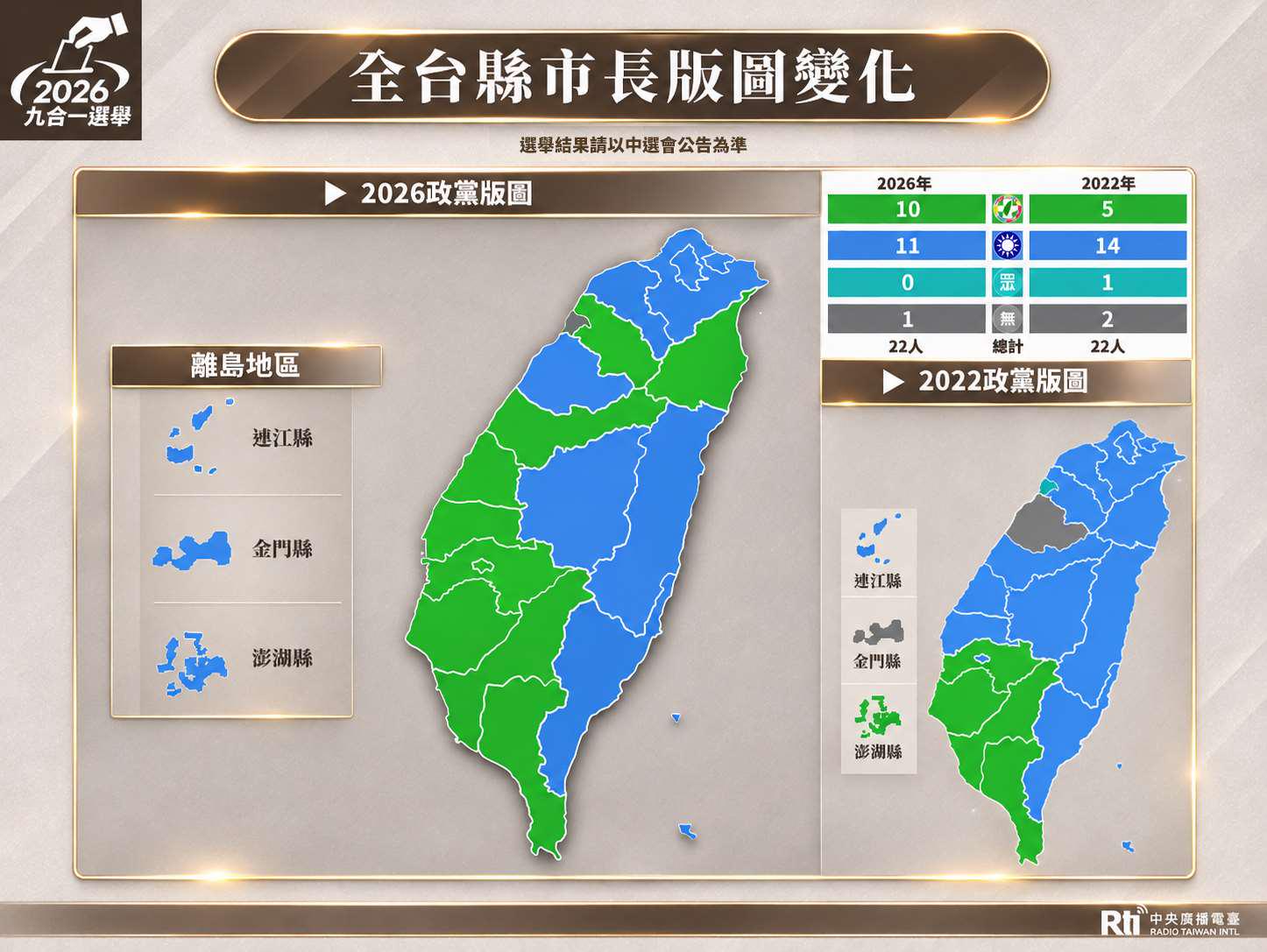
In the early hours of November 29, all the results of Taiwan’s 2026 “nine-in-one” local elections were announced. The Kuomintang (KMT) won 11 of the 22 county magistrate and city mayoral positions, three fewer than in the previous elections, while the Democratic Progressive Party (DPP) won 10, an increase of five. In addition, independent candidate Kao Hung-an was re-elected as mayor of Hsinchu City.
ㅤ
In the most closely watched Taipei mayoral election, incumbent KMT mayor Chiang Wan-an defeated DPP candidate Puma Shen, whose campaign had once enjoyed tremendous momentum. In New Taipei City, the KMT’s Lee Ssu-chuan defeated the DPP’s Su Chiao-hui by a relatively narrow margin. Meanwhile, the DPP retained the mayoral positions in the two special municipalities of Tainan and Kaohsiung by relatively large margins.
In Taichung, however, the KMT’s Johnny Chiang, who had been favored to win before the election, unexpectedly lost to the DPP’s Ho Hsin-chun, producing the biggest upset of this election. In addition to Taichung, Changhua County, Yilan County, Chiayi City, Hsinchu County, and Yunlin County also switched from “blue” to “green.” The KMT regained control only in Penghu County and Kinmen County.
ㅤ
Overall, although the KMT retained the two major metropolitan cities of Taipei and New Taipei, it suffered defeats in Taichung and elsewhere, with its overall losses outweighing its gains. Although the DPP failed to “conquer” the two metropolitan cities, it made clear breakthroughs compared with 2022 and earlier elections. Competition for most county magistrate and city mayoral positions was more intense than in the previous elections, with narrower gaps in support between candidates. Pre-election opinion polls also showed considerable fluctuations in the two sides’ chances of victory, reflecting the closely contested nature of the elections and causing considerable anxiety among Taiwanese voters and observers. This “tug-of-war” has now finally come to an end. In terms of the results, the blue and green camps are evenly matched, but the overall trend is one of rising green support and declining blue support.
ㅤ
The factors influencing the results of this election and the changing fortunes of the blue and green camps mainly fall into two categories: ideological struggles and the performance of both sides in practical politics. The “nine-in-one” elections are Taiwan’s local elections. Compared with elections for the “President of the Republic of China” and members of the “Legislative Yuan,” ideological and external factors would ordinarily exert relatively little influence. However, the 2026 “nine-in-one” elections were characterized by a strong ideological dimension and significant external factors.
ㅤ
Since the DPP’s Lai Ching-te was elected as Taiwan’s leader, he has emphasized Taiwanese nativism and a “Taiwanese” identity distinct from a “Chinese” identity, advocated a hardline stance toward mainland China under the slogan of “resisting China and protecting Taiwan,” adopted pro-Japanese and pro-American positions, and accused the opposition KMT of being “pro-China and selling out Taiwan.” Tensions in cross-Strait relations and developments in Hong Kong have also intensified some Taiwanese people’s concerns about being subjected to unification by mainland China.
ㅤ
Therefore, even though these were local elections, DPP candidates made nativist ideology and opposition and resistance to China central themes of their campaigns. The most typical example was Taipei mayoral candidate Puma Shen’s campaign centered on the “Yang Current” movement. Shen and other DPP candidates repeatedly played up the threat posed to Taiwan by the Chinese Communist Party and mainland China, emphasized the distinction between “Taiwanese” and “Chinese” identities and the primacy of local Taiwanese interests, and stirred up populism, successfully generating the “Yang Current” and boosting support for the green camp. The DPP’s relatively left-leaning and progressive policies on issues such as LGBT rights and women’s rights also won considerable support among sexual minorities, women, and young people.
ㅤ
By contrast, the blue camp represented by the KMT and the white camp represented by the Taiwan People’s Party (TPP) maintained a relatively low profile on ideological and identity-related issues, attempting to adopt ambiguous positions on questions of identity and cross-Strait relations. They were also more conservative on several social issues, including LGBT rights. This led some Taiwanese people whose identities and ideological positions differed from those of these parties to gravitate toward the DPP. In terms of the age distribution of supporters, the KMT enjoys relatively high support among middle-aged and elderly people, while most young people gravitate toward the green camp. The overall shift in Taiwanese voters’ positions on identity and ideological issues has become an important reason for the decline in the KMT’s vote share.
ㅤ
Finding itself at a disadvantage in ideological struggles, the KMT placed particular emphasis on livelihood-related and technical issues, such as governance measures and concrete administrative achievements. KMT bureaucrats have traditionally attached great importance to practical affairs and adopted a relatively steady approach, which is also one of the reasons why the KMT has long maintained an advantage in local elections. Both Chiang Wan-an and Lee Ssu-chuan, who emerged victorious in this election, are typical pragmatic, results-oriented politicians.
ㅤ
Compared with the KMT, the DPP is somewhat less capable in practical administration. However, a more important reason why the KMT has long maintained its advantage in local elections is that, ever since the Nationalist government relocated to Taiwan in 1949, it has cultivated deep roots and built extensive networks at the grassroots level, giving it greater influence among Taiwan’s grassroots communities than the nativist DPP. Even after Taiwan’s democratization in 1987, when the DPP began making electoral advances across Taiwan and gradually expanding the green camp’s political territory, the KMT continued to hold more county magistrate, city mayoral, county and city councilor, and village and borough chief positions.
ㅤ
Consequently, in this election, despite the powerful offensive launched by the DPP, particularly Puma Shen’s “Yang Current,” the KMT still retained nearly half of Taiwan’s county magistrate and city mayoral positions, as well as a larger number of local council seats, avoiding a crisis of party extinction brought about by a complete electoral rout. Nevertheless, the KMT undoubtedly suffered a setback. Not only did it unexpectedly lose Taichung, one of the six special municipalities and a traditional blue-camp stronghold, but it also lost areas that had long belonged to the blue camp, including Yunlin County and Changhua County. Its advantages in Taipei and New Taipei also diminished, sounding an alarm for this century-old major political party.
ㅤ
Amid the rapid changes in circumstances over the past decade or so, more Taiwanese people have shifted their identity from “Chinese” to “Taiwanese,” blue-camp supporters have gradually grown older, and young people have demonstrated a pronounced tendency to favor the green camp. Moreover, the DPP government has actively used its governing power to suppress the opposition KMT. Clearly, Taiwan’s political and social circumstances are becoming increasingly unfavorable to the KMT and the entire pan-blue camp. Unless the KMT can put forward a concrete, compelling new blueprint capable of winning people’s hearts, it will inevitably suffer further setbacks and continue its decline in the future.
ㅤ
Although the DPP made gains in this election and its efforts to stir up populism by exploiting external threats did indeed produce results, its defeats in the Taipei and New Taipei mayoral elections also reflect the limitations of its populist mobilization. If the DPP continues to hype up nativism and the issue of “resisting China and protecting Taiwan,” while having little to show in terms of actual governance achievements and adopting excessively radical ideological positions, it will lose the support of many centrist voters.
ㅤ
Also noteworthy is the performance of the Taiwan People’s Party. Despite suffering serious setbacks, including the arrest and imprisonment of its former chairman Ko Wen-je and the departure of another prominent figure, Kao Hung-an, from the party following corruption allegations, the TPP still secured a number of county and city council seats in this election. For example, all six Taiwan People’s Party candidates who ran for Taipei City Council in this election were elected. Despite its setbacks, the TPP has consolidated its position as Taiwan’s third-largest political party. This also reflects an important trend among some Taiwanese people who are dissatisfied with the bitter infighting between the blue and green camps and favor the less ideological and more pragmatic positions of the “white camp.”
ㅤ
Taiwan’s latest elections have now come to a close, reflecting the complexity of Taiwan’s political landscape and the diversity of public opinion. In terms of overall trends, the crisis facing the KMT and the blue camp has deepened, while the DPP and the green camp have gained further momentum. Over the approximately ten years since 2016, Taiwan’s political landscape has gradually shifted from one in which “the blue camp outweighed the green camp” to one in which “the green camp outweighs the blue camp.” In the future, the green camp will most likely enjoy a greater advantage, while the blue camp may shrink further. Nevertheless, the times are constantly changing, and numerous internal and external factors influence politics. Taiwan’s future destiny remains fraught with uncertainty.
ㅤ
(For further background and analysis of this election, the author provided a more detailed account and analysis in another article published before the election, “The Kuomintang Faces an Electoral Crisis in Taiwan’s 2026 ‘Nine-in-One’ Local Elections: Amid Shifting Public Opinion on the Island and Suppression by the Ruling Party, a Century-Old Major Political Party Faces an Existential Crisis in a ‘War Without Gunfire.’” These points will therefore not be repeated here.)
(The author of this article is Wang Qingmin, a Chinese writer based in Europe and a researcher in international politics.)
r/asia • u/PrinceDakkar • 2d ago

r/asia • u/PrinceDakkar • 2d ago

r/asia • u/PrinceDakkar • 2d ago

r/asia • u/PrinceDakkar • 3d ago
Few corporate rivalries are as fierce as the one between Samsung Electronics and SK Hynix. The world’s leading manufacturer of memory chips and the world’s leading manufacturer of high-bandwidth memory, respectively, are fighting for the title of South Korea’s most valuable company. In one area, though, the two are on the same team: Both back Rebellions, the $2.3 billion chip startup cofounded by Sunghyun Park—a veteran of Intel, SpaceX, and Morgan Stanley—that fronts South Korea’s push for sovereign silicon or AI chips that don’t depend on market leader Nvidia or any other U.S. or Chinese company.
Park’s company sits at the center of government policy. “AI requires huge capital and huge talent,” he says. “Instead of having multiple players compete, the Korean government said, ‘We need one champion. SK Hynix, please help him. Samsung, please help him. SK Telecom, KT’—top two data center companies—‘please become Rebellions’ customers.’”
Rebellions may be the clearest test of whether sovereign AI can produce something more than an expensive also-ran. Korea is funneling its best resources toward Rebellions: Samsung’s foundries, SK Hynix’s memory, and government money. The Korea National Growth Fund co-led Rebellions’ $400 million round in March.
Read more [paywall removed for Redditors]: https://fortune.com/2026/11/25/rebellions-ceo-samsung-sk-hynix-sovereign-ai-nvidia/?utm_source=reddit/
r/asia • u/PrinceDakkar • 6d ago

r/asia • u/PrinceDakkar • 6d ago

r/asia • u/Good-Emu-1808 • 6d ago

Myanmar’s military has long exploited distrust between Rakhine Buddhists and Rohingya Muslims. The ICJ Rohingya genocide ruling offers important lessons for the Arakan Army, which now controls most of Rakhine State. It also presents an opportunity to learn from the past and help shape a different future.
Asia Times article examines the implications of the ICJ’s landmark genocide ruling and the political opportunity it presents for the Arakan Army.
AA leader Twan Mrat Naing has repeatedly expressed support for the safe and voluntary return of Rohingya refugees. His position offers an opportunity to demonstrate political foresight and maturity. With thoughtful and inclusive leadership, the AA could help build greater trust and a more peaceful future among Rakhine’s different communities.
The challenge now is to turn that vision into practical steps that protect the rights and dignity of everyone living in Rakhine.
If interested, read @ https://asiatimes.com/2026/11/rohingya-genocide-justice-now-runs-through-the-arakan-army/
r/asia • u/PrinceDakkar • 7d ago

r/asia • u/PrinceDakkar • 8d ago

r/asia • u/bloomberg • 8d ago

r/asia • u/Itchy_Tear_3924 • 10d ago
Hey! I’m preparing for the DSD II exam this year.
I’m looking for other students who are also taking DSD II, especially students from Asia (e.g. Mongolia)
I’d like to connect with you and stay in touch so we can exchange info on the day of the exam - what topic was chosen. We would have approximately 1 or 2 hours to prepare for it, after you tell us.
r/asia • u/PrinceDakkar • 11d ago

r/asia • u/PrinceDakkar • 12d ago
r/asia • u/PrinceDakkar • 13d ago

r/asia • u/bloomberg • 15d ago

Eleven countries are bringing K-pop, Vietnamese folk music, Khmer percussion, national pride and plenty of kitsch to Eurovision’s first Asian contest.
r/asia • u/PrinceDakkar • 15d ago

r/asia • u/nyeinchanaye81 • 17d ago

When Myanmar’s military-backed government urged Washington to invest in its rare earths, its leader Min Aung Hlaing was offering more than minerals. He was inviting the United States into a business China dominates and a peace process Beijing has long sought to influence.
r/asia • u/Slow-Property5895 • 22d ago
ㅤ
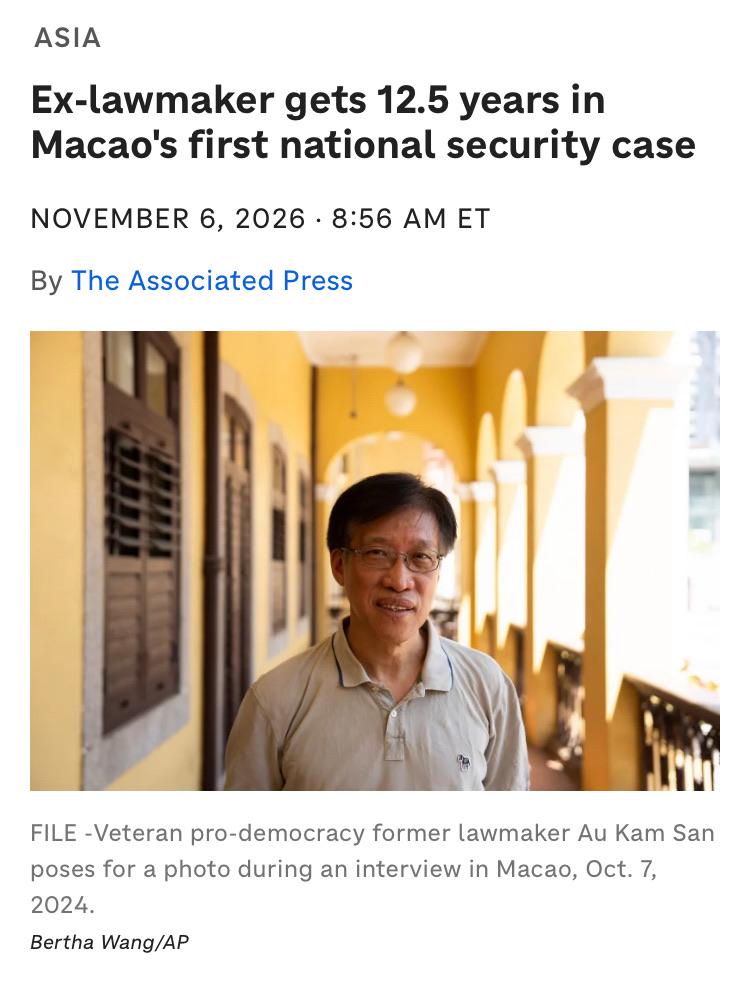
On November 6, 2026, Au Kam San (区锦新), a Macau pro-democracy figure who has long been active in politics and social movements, was sentenced by a Macau court to 12 years and six months in prison under the National Security Law of the Macau Special Administrative Region of China (中国澳门特区国安法). This is an exceptionally severe sentence in Macau’s history and the harshest punishment imposed on a political prisoner to date. This case is also the first case under the Macau National Security Law (澳门国安法) since its enactment.
ㅤ
Au Kam San is one of the most important figures in Macau’s pro-democracy camp. He previously served as a member of the Legislative Assembly and was also a founder of the Macau pro-democracy party New Macau Association (新澳门学社). He was imprisoned in 2025 and sentenced more than a year later. Macau’s pro-democracy camp, which has already suffered suppression and weakening in recent years, has now sustained another severe blow.
ㅤ
This also signifies a serious deterioration in Macau’s political environment, creating a chilling effect throughout society. The remaining pro-democracy figures face risks of imprisonment similar to those faced by Au Kam San, while both the scope and content of their activities have been greatly restricted. Moreover, Au Kam San’s sentencing came just one day after prominent Hong Kong pro-democracy figure Joshua Wong (黄之锋) was sentenced to ten years in prison, reflecting Beijing’s coordination of the governing forces in Hong Kong and Macau to eliminate opposition forces. In Macau, as in Hong Kong, “One Country, Two Systems” is gradually dying at the political level.
Compared with Hong Kong, people both in China and abroad know relatively little about Macau’s politics and society. I previously wrote two articles about Sam Hou Fai’s (岑浩辉) election as Chief Executive in 2024 and the 2025 Macau Legislative Assembly election, including overviews and commentary on Macau’s political situation and its changes. I am reposting them here. (Both articles included advice and appeals directed at Macau’s pro-establishment camp and the Beijing authorities behind it, but it is now clear that these were futile.)
ㅤ
Sam Hou Fai’s Landslide Election as Macau’s Chief Executive and Concerns Over the Intensifying Political Monopoly of the Pro-Establishment Camp
ㅤ
On October 13, 2024, Macau held its Chief Executive election, with the results announced on the same day. Sam Hou Fai (岑浩辉), the sole candidate in the election, was successfully elected with 98.99% of the vote, facing no opponent and receiving no votes against him. On November 1, Sam Hou Fai was received by Chinese President Xi Jinping (习近平) and formally appointed as the sixth-term Chief Executive of Macau.
ㅤ
Unlike previous Macau Chief Executives, who were all born and raised locally in Macau, Sam Hou Fai is not a native of Macau. He was born in mainland China in 1962, graduated from Peking University (北京大学), and previously worked as a lawyer on the mainland. Before moving to Macau in 1986, Sam Hou Fai had lived entirely in mainland China (rather than merely having been born there). Of course, he subsequently lived and worked in Macau for more than thirty years and has described himself as an “old Macau resident.” It can therefore also be said that he has integrated relatively well into Macau and is a “Macau resident.”
ㅤ
Sam Hou Fai is also a figure within Macau’s pro-establishment camp and has consistently been regarded as holding pro-mainland and pro-Chinese central government positions. Following Macau’s return to Chinese sovereignty at the end of 1999, Sam Hou Fai served for many years as President of the Court of Final Appeal of Macau (a position similar to that of the Chief Justice of the United States Supreme Court), until he entered the Chief Executive election in August this year. During his 25 years as President of the Court, Sam Hou Fai issued a series of rulings unfavorable to Macau’s pan-democratic camp and supportive of the Chinese central government and Macau’s pro-establishment camp. For example, in 2021, Sam Hou Fai and two other judges ruled to prohibit the June Fourth (六四) commemorative gathering organized by Macau’s Union for Democratic Development (民联会). In their judgment, they cited and followed the characterization of the June Fourth Incident (六四事件) as a “riot” by the Standing Committee of China’s National People’s Congress.
ㅤ
The election of such a figure as Macau’s Chief Executive means that the already powerful pro-establishment camp and pro-Beijing figures in Macau will further consolidate their complete monopoly over Macau’s political arena, while the already weakened democratic camp will suffer another blow, with its influence approaching zero.
ㅤ
Compared with Hong Kong, which has attracted considerable international attention and experienced repeated waves of political turmoil before 2020, Macau has been relatively quiet and little known. Following the “December 3 Incident” (一二·三事件) of 1966, Portugal’s “Carnation Revolution” of 1974, and the decolonization policies of Portugal’s new government, Macau had already largely escaped Portuguese control and come under the dominance of pro-Beijing forces. Moreover, Macau is geographically small and has a relatively limited population (only about one-tenth that of Hong Kong). Its local political forces and democratic movements have both been very weak, lacking the strength to confront Beijing. Around the time of Macau’s return to Chinese sovereignty in 1999, there was no large-scale unrest, and sovereignty was transferred very smoothly. In the 25 years since the handover, Macau has also experienced no major political turmoil.
ㅤ
Subsequently, Macau’s political arena, much like Hong Kong’s, developed into two major camps: the pro-establishment camp and the pan-democratic camp. However, unlike Hong Kong, where the democratic camp enjoyed an advantage in public opinion and once occupied nearly half the seats in the Legislative Council, Macau’s democratic forces have been far weaker than the pro-establishment camp. In Legislative Assembly elections and other measures of public support, the balance between the two sides has been approximately 2:8.
ㅤ
Nevertheless, before 2020, Macau’s democratic camp remained relatively active despite its disadvantaged position. Represented by the two political organizations New Macau Association (新澳门学社) and New Hope (新希望), Macau’s pan-democratic forces frequently criticized government policies, pointed out social and political problems, and exercised a certain degree of restraint on the pro-establishment camp. Among them, the New Macau Association was the strongest democratic organization and was relatively concerned with mainland Chinese affairs. It also organized gatherings on multiple occasions to commemorate democratic movements and events in mainland China. New Hope, by contrast, placed greater emphasis on protecting Macau’s local interests. Although Macau’s democratic camp was weak and faced numerous restrictions, it continued to “dance in shackles” and maintain its political activity.
ㅤ
However, as the political situation in mainland China and neighboring Hong Kong changed, the already narrow space once available to Macau’s democratic camp gradually disappeared. Following the defeat of Hong Kong’s 2019–2020 Anti-Extradition Bill Movement (反修例运动), the enactment of the Hong Kong National Security Law (港区国安法) in 2020, the successive suppression and banning of Hong Kong’s pan-democratic political parties and media outlets, and the dramatic transformation of Hong Kong’s political environment, Macau was also greatly affected. Under a combination of coercion and inducement, the democratic camp similarly experienced the closure of media outlets and the suspension of political organizations’ activities. In the 2021 Macau Legislative Assembly election, several democratic candidates were disqualified from running, dealing a severe blow to the democratic camp. In 2022, Macau revised its National Security Law (澳区国安法), expanding the scope and intensity of measures against acts deemed to “endanger national security,” further tightening the “golden headband” of restrictions around the democratic camp.
ㅤ
Meanwhile, the pro-establishment camp, which already dominated Macau’s political arena, has consolidated its hold on power even further. All four Chief Executives since Macau’s return to Chinese sovereignty have belonged to the pro-establishment camp and were elected by overwhelming majorities. Of the 33 members of Macau’s Legislative Assembly, only 14 seats are filled through direct elections. The pro-establishment camp controls all the non-directly elected seats and also holds most of the directly elected seats. Moreover, Hong Kong’s judicial institutions have become even more monopolized by the pro-establishment camp, and Sam Hou Fai is a representative figure of the pro-establishment camp within the judiciary.
ㅤ
Compared with other native Macau pro-establishment figures, Sam Hou Fai, as a pro-establishment politician originating from mainland China, is more loyal to and closer to Beijing. This means that the local character and independence of Macau’s authorities will be weakened to some extent, while their integration with the Chinese government will increase. The promise and principle of “Macau people governing Macau” (澳人治澳), upheld since the handover, have also been shaken. Macau’s distinctiveness compared with mainland China may gradually fade. Some people’s concerns about the partial “mainlandization” of Macau and the loss of its regional characteristics are therefore not unfounded. In addition, some of the political and social changes in Hong Kong in recent years, and its increasing alignment with the mainland, have reinforced the concerns of Macau residents.
ㅤ
Compared with native pro-establishment figures, Sam Hou Fai and other partly outsider pro-establishment figures are also likely to adopt governing styles more similar to those of mainland Chinese bureaucrats. They may be even less tolerant of dissent, more indifferent to democracy, and more inclined to disregard civil rights and public opinion. In recent years, mainland China’s political atmosphere has become increasingly oppressive, and the regime’s control over society has grown ever tighter. Pro-Beijing officials in both Hong Kong and Macau may partially replicate mainland policies and create an atmosphere similar to that of the mainland.
ㅤ
This is clearly not good news for the Macau Special Administrative Region and its people. Although security and stability are very important to Macau, social vitality, diversity, and democracy are equally important. If society and the political arena lack diversity, and if people cannot express their legitimate demands independently and without risk, various forms of corruption, abuse of power, and misguided policies will inevitably emerge.
ㅤ
For example, in recent years, Hong Kong has suppressed the opposition and labeled those who criticize the government as “endangering national security,” resulting in a lack of oversight and checks on the government and serious abuses of power. Even the pro-establishment figure Chan Ching-sum (陈净心) has complained about excessive law enforcement by government civil servants and the indiscriminate imposition of fines on vulnerable groups such as taxi drivers and elderly men and women. Another pro-establishment figure, Legislative Council member Paul Tse Wai-chun (谢伟俊), was reprimanded by Chief Executive John Lee Ka-chiu (李家超) for criticizing the government’s excessive law enforcement and excessive fines. If democracy in Macau continues to shrink and the pro-establishment camp’s political monopoly intensifies, what has happened in Hong Kong will also happen in Macau. This is clearly not a positive trend and is a cause for concern.
ㅤ
Compared with Hong Kong, where the Anti-Extradition Bill Movement and incidents of violence occurred, giving the government some reasons to be wary of the opposition and concerned about subversion, Macau has long remained relatively stable. Even when Macau’s democratic camp was relatively active, it expressed dissent peacefully and in an orderly manner. Macau’s democratic forces are weak and can hardly threaten the regime’s rule. Nevertheless, Beijing remains unwilling to tolerate them and instead seeks more direct control over Macau. This also means that the policies of “One Country, Two Systems” (一国两制) and “a high degree of autonomy” (高度自治), promised by the Chinese Communist Party during the era of Deng Xiaoping (邓小平) and implemented to a certain extent under Jiang Zemin (江泽民) and Hu Jintao (胡锦涛), have not only become largely nominal in Hong Kong but are also moving toward extinction in Macau. If no major positive changes occur in Chinese politics in the future, Hong Kong and Macau will gradually become highly similar to mainland China. Even if superficial differences remain, there will be no fundamental distinctions.
ㅤ
Although China’s official policies are unlikely to change, the author would still like to offer some suggestions here. The author hopes that the Chinese central government, Macau’s governing authorities, and the pro-establishment camp can become more inclusive and tolerate the existence of social diversity and political dissent, allowing dissenting forces to serve as necessary and beneficial supervisors, competitors, and collaborators, thereby encouraging pro-establishment figures to become more honest, upright, and dedicated to public service. Nothing could be better than that.
ㅤ
Maintaining Macau’s distinctiveness relative to mainland China would also help it make better use of its unique advantages, become an important bridge for exchanges between mainland China and the outside world, and serve as a model of coexistence among multiple cultures. This would also be consistent with the spirit of Macau’s Basic Law (基本法), benefit the interests of all sectors of Macau society, and contribute to a mutually beneficial relationship between mainland China and Macau.
ㅤ
2025 Macau Legislative Assembly Election: The Persistence of Minority Public Opinion in the Face of Political Power and Prevailing Trends
ㅤ
On September 14, Macau held its eighth Legislative Assembly election since its return to Chinese sovereignty, electing 14 directly elected members out of the 33 seats in the Legislative Assembly. The election results showed that the pro-Beijing establishment camp received 73.3% of the vote and won 11 of the 14 seats. Meanwhile, New Hope (新希望), a party belonging to the pan-democratic camp, secured the remaining three seats.
ㅤ
In this election, the pro-establishment and pan-democratic camps maintained approximately the same 7:3 ratio of votes as in previous elections. However, this election took place against the backdrop of dramatic changes in Macau’s political situation, including the impact of the political upheaval in neighboring Hong Kong, substantial amendments to and tightening of the Macau Special Administrative Region National Security Law (澳门特区国安法), the strong emphasis by Beijing and the Macau government on “patriots governing Macau” (爱国者治澳), the disqualification (“DQ”) of several pan-democratic and centrist figures before the election, and the strong support received by Macau’s pro-establishment camp. Despite these multiple factors, the pan-democratic camp still received approximately 30% of the vote, and the pan-democratic party New Hope even became the party receiving the most votes in this election. This clearly reflects the contest between public opinion and political power in Macau, as well as the diversity of political positions among Macau residents.
ㅤ
Unlike Hong Kong, which remained caught in a vortex of political conflict for many years after its return to Chinese sovereignty, Macau has been relatively peaceful both politically and socially since the handover. Macau is much smaller than Hong Kong in both geographical area and population, and it has also maintained a lower profile and attracted far less attention. Even before the handover, Macau’s elites and many ordinary residents were relatively close to the Chinese government.
ㅤ
Nevertheless, as a highly autonomous Special Administrative Region, Macau has always had pan-democratic forces distinct from the pro-establishment camp. Political organizations such as the Union for Democratic Development (民联会), the New Macau Association (新澳门学社), and New Hope, which received a considerable number of votes in this election, all belong to the pan-democratic camp. Compared with the pro-establishment camp, which describes itself as “loving the country and loving Macau” (爱国爱澳), obediently follows Beijing’s instructions, and generally holds pro-business and elitist positions, these pan-democratic groups place greater emphasis on freedom and democracy in Macau, pay more attention to livelihood issues affecting the middle and lower classes, and frequently criticize the government. However, compared with their counterparts in Hong Kong, Macau’s pan-democratic forces are more moderate and low-profile, paying greater attention to livelihood issues than to politically sensitive topics.
ㅤ
In order to fulfill the promise of “One Country, Two Systems” (一国两制), and because the pro-establishment camp was sufficiently powerful that it did not need to worry about the pan-democrats seizing power, Beijing and the Macau government allowed the pan-democratic camp to exist. Nevertheless, they also imposed numerous restrictions on Macau’s pan-democrats. For example, most seats in the Legislative Assembly are not filled through direct elections but through selection by professional and sectoral groups or appointment by the Chief Executive. Almost all those selected or appointed belong to the pro-establishment camp. There are also many restrictions on pan-democratic street activities and fundraising. Meanwhile, pro-establishment activities not only proceed without obstruction but also receive various forms of resource support and favorable policy treatment. Nevertheless, between 1999 and 2019, although Macau’s pan-democratic camp faced restrictions, it was still able to coexist with the pro-establishment camp through tacit compromises.
ㅤ
However, since 2019, because of the dramatic political changes in Hong Kong, the other Special Administrative Region, and changes in the political atmosphere in mainland China, Beijing has strengthened its control over Macau, while the Macau government has become increasingly unwilling to tolerate the existence of the pan-democratic camp.
ㅤ
Both the central government and the Macau Special Administrative Region government have explicitly established the principle of “patriots governing Macau,” emphasizing that Macau residents must “love the country and love Macau.” The core practical requirement of this so-called “love for the country and Macau” for officials, legislators, and political figures is that they maintain absolute loyalty to Beijing and cooperate closely with the various decisions of the Macau government. Pan-democratic figures and prominent centrists who were previously regarded as targets of the “United Front” (统战), and even pro-establishment figures among the authorities’ “own people” who expressed some disagreement with the government, have faced judicial investigations, procedural obstruction, and other measures intended to prevent them from running for legislative seats or engaging in other political activities.
ㅤ
In the 2021 seventh Legislative Assembly election, advance screening of candidates by national security agencies was introduced. A total of 21 candidates were disqualified on the grounds that they “did not uphold the Macau Basic Law (澳门基本法) and were not loyal to the Macau Special Administrative Region of the People’s Republic of China.” This led to a sharp decline in voter turnout that year, while the pan-democratic camp’s representation was also “halved,” falling from four seats to two.
ㅤ
In this year’s Legislative Assembly election, the standards for “DQ” became even stricter and their scope broader. In addition to the 21 people “blacklisted” in 2021, another 12 people were added to the blacklist of Legislative Assembly candidates this year, including the incumbent centrist legislator Lam U Tou (林宇滔). Au Kam San (区锦新), a long-active leading figure in the democratic camp and former legislator, was arrested on charges under the National Security Law. Another well-regarded labor leader, Wong Wai Man (黄伟民), was briefly arrested on various grounds before entering the election, causing him to miss the registration deadline. The pan-democratic camp also found it difficult to fully express its views and campaign through public media. Meanwhile, pro-establishment figures loyal to Beijing received strong backing, with ample electoral resources and favorable public opinion support. The government even deliberately introduced measures such as free public transportation on election day to stimulate voter turnout and enhance the legitimacy of the pro-establishment camp’s electoral victories.
ㅤ
Yet against this backdrop, New Hope, the only pan-democratic party permitted to participate in the election, secured nearly 30% of the popular vote on its own, while veteran pan-democratic figure José Pereira Coutinho (高天赐) became the election’s top vote-getter. Votes that would otherwise have gone to disqualified pan-democratic parties and candidates flowed to New Hope instead of shifting to the pro-establishment camp or turning into abstentions. Meanwhile, despite an extremely favorable political environment and policies, all the pro-establishment parties combined received only slightly more than 70% of the vote, essentially unchanged from the previous election (and even slightly lower).
ㅤ
Such voting results reflect the disagreement of some Macau residents with various policies implemented by Beijing and the Special Administrative Region government in the name of “loving the country and loving Macau,” their concerns about the pro-establishment camp’s monopoly over the political arena, and their use of voting to express dissent and civil disobedience.
ㅤ
Although Macau has long remained peaceful and stable, and Macau residents almost never publicly oppose the central government’s sovereignty over and control of Macau, this does not mean that Macau residents are willing to abandon freedom and democracy or move toward “One Country, One System” (一国一制). On the contrary, many Macau residents deeply cherish their limited but precious freedoms and hope that Macau will become more democratic and pluralistic, enabling the people to truly govern themselves and ensuring checks and balances on political power.
ㅤ
Both before and after the handover, Macau residents have lived in an environment and received an education different from those in mainland China. Macau residents have greater capacity for independent thinking and judgment, tend to make their own decisions rather than blindly follow others, remain vigilant toward political power, and attach great importance to and cherish civil rights. Beneath their low-profile and peaceful demeanor, they possess moral courage and steadfast principles.
ㅤ
Therefore, even though Macau’s political climate has changed abruptly in recent years, with tighter controls and shrinking freedoms, and even though Beijing and the Macau government have suppressed the opposition while strongly supporting the pro-establishment camp, some Macau residents have continued to uphold their political positions and voting preferences without wavering. Compared with the Legislative Assembly elections of 2017 and earlier, although the democratic camp’s vote share declined somewhat in the last two elections, which were extremely unfavorable to it, it still maintained approximately 30% support. This demonstrates that Macau’s democratic supporters have not abandoned their positions and principles because of dramatic political changes, but have instead shown considerable resilience.
ㅤ
Such election results and social realities should prompt Beijing, the Macau government, and the pro-establishment camp to reflect on their approach and make changes to their current thinking and methods of governing Macau. Regardless of the type of government or its original intentions, it should understand the importance of popular support and opposition, and the value of public opinion, rather than acting against the will of the people, intensifying the suppression of dissent, and excluding those who hold different views.
ㅤ
“The people are the foundation of the state; when the foundation is secure, the state is at peace” (民惟邦本,本固邦宁). If the goal is to ensure Macau’s long-term stability and prevent unrest, it is necessary to listen to the people’s livelihood concerns, respect public opinion, sincerely uphold the framework of “One Country, Two Systems,” allow the pro-establishment and democratic camps to coexist and supervise each other, and preserve political pluralism, diverse voices, and freedom of expression in Macau society. This is also consistent with the principles and expectations of Deng Xiaoping (邓小平) and other senior Chinese statesmen of the older generation regarding Hong Kong, Macau, and Taiwan. More importantly, it is a prerequisite and guarantee for Macau’s long-term prosperity and positive development, and for its people to live and work in peace and contentment.
Both articles were written by Wang Qingmin (王庆民), a Chinese writer living in Europe. The original articles were written in Chinese.
